Category Archives: Animated

Never let me down: Midwinter cinema therapy

By Dennis Hartley

It seems like a good time to re-post this one. Ocean waves, Bob. -D.H.

(Originally posted on Digby’s Hullabaloo on February 4, 2023)

https://i0.wp.com/localist-images.azureedge.net/photos/779142/original/fdd26e107abf4ea7626e5fb98b61b17c14ebb00f.png?resize=615%2C410&quality=80&ssl=1

Dee: Jane, do you ever feel like you are just this far from being completely hysterical twenty-four hours a day?

Jane:  Half the people I know feel that way. The lucky ones feel that way. The rest of the people ARE hysterical twenty-four hours a day.

— from Grand Canyon, screenplay by Lawrence and Meg Kasdan

HAL 9000: Look Dave, I can see you’re really upset about this. I honestly think you ought to sit down calmly, take a stress pill, and think things over.

— from 2001: A Space Odyssey, screenplay by Stanley Kubrick and Arthur C. Clarke

George Fields: [to Dorothy/Michael] I BEGGED you to get therapy!

— from Tootsie, screenplay by Murray Schisgal

As if the mid-winter blues weren’t enough, there’s been an odd confluence of celestial events recently – a close encounter with a hurtling asteroid, an eerie green comet lighting up the night skies, and the mysterious appearance of a high altitude “spy balloon” the size of three metro buses that has the conspiracy nuts twisting themselves into pretzels. Not that I believe in heavenly portents, but I am feeling the need for some “cinema therapy” right about now.

With that in mind, here are 12 films I’ve watched an unhealthy number of times; the ones I’m most likely to reach for when I’m depressed, anxious, uncertain about the future…or all the above. These films, like my oldest and dearest friends, have never, ever let me down. Take one or two before bedtime; cocktail optional.

https://i0.wp.com/blog.laemmle.com/wp-content/uploads/2019/02/ac-black-orpheus-b-e1549559052137.jpg?quality=89&ssl=1

Black Orpheus – Marcel Camus directed this mesmerizing 1959 film, a modern spin on a classic Greek myth. Fueled by the pulsing rhythms of Rio’s Carnaval and tempered by the gentle sway of Luiz Bonfa and Antonio Carlos Jobim’s samba soundtrack, Black Orpheus fully engages the senses. Camus and Jacques Viot adapted the screenplay from the play by Vinicius de Moraes.

Handsome tram operator Orfeo (Breno Mello) is engaged to vivacious Mira (Lourdes de Olivera) but gets hit by the thunderbolt when he meets sweet, innocent Eurydice (Marpessa Dawn). As in most romantic triangles, things get complicated, especially when Mr. Death (Ademar da Silva) starts lurking about the place.

You may be scratching your head as to why I’m “comforted” by a story based on a Greek tragedy; but Black Orpheus is graced by one of the most beautiful, life-affirming denouements in cinema; which always assures me that everything is going to be alright.

https://i0.wp.com/compote.slate.com/images/d6f03cb6-8f97-4d63-9472-4409c8b8cc48.jpeg?ssl=1

The Dish  – This 2000 Australian sleeper dramatizes the story behind the live televised images of Neil Armstrong setting foot on the moon in 1969. The worldwide broadcast was facilitated by a tracking station located on a sheep farm in New South Wales.

Quirky characters abound in Rob Sitch’s culture-clash comedy (reminiscent of Bill Forsyth’s Local Hero). It’s not all played for yucks; the re-enactment of the telecast is genuinely stirring. Sam Neill heads a fine cast. Director Sitch and co-writers Santo Cilauro, Tom Gleisner, and Jane Kennedy also collaborated on the charming 1997 dramedy The Castle (recommended!).

https://m.media-amazon.com/images/M/MV5BMjExMzQxNDEwNF5BMl5BanBnXkFtZTgwMzY4MTg3NTE@._V1_.jpg

Diva – Jean-Jacques Beineix’s 1981 cult fave kicked off a sub-genre labelled Cinéma du look (e.g. Beineix’s Betty Blue, and Luc Besson’s Subway, La Femme Nikita, and Leon the Professional).

Our unlikely antihero is mild-mannered postman Jules (Frédéric Andréi), a 20-something opera fan obsessed with a Garbo-like diva (American soprano Wilhelmenia Wiggins Fernandez). She has never recorded a studio album and stipulates that her live performances are never to be taped and/or reproduced in any medium.

An enraptured Jules attends one of her concerts and makes a high-quality recording, for his own edification. By pure chance, a pair of nefarious underworld characters witness Jules bootlegging the concert, sparking a chain of events that turns his life upside down.

Diva is an entertaining pop-art mélange of neo-noir, action-thriller, and comic-book fantasy. Chockablock with quirky characters, from a pair of hipster hit men (Gérard Darmon and Dominique Pinon) to a Zen-like international man of mystery named Gorodish (Richard Bohringer) who is currently “going through his cool period” as his girlfriend (Thuy Ann Luu) confides to Jules. Slick, stylish and thoroughly engaging.

https://i0.wp.com/cdn.britannica.com/50/23150-050-A823EED9/The-Beatles-A-Hard-Days-Night.jpg?resize=615%2C477&quality=89&ssl=1

A Hard Day’s Night – This 1964 masterpiece has been often copied, but never equaled. Shot in a semi-documentary style, the film follows a “day in the life” of John, Paul, George and Ringo at the height of their youthful exuberance and charismatic powers. Thanks to the wonderfully inventive direction of Richard Lester and Alun Owen’s clever script, the essence of what made the Beatles “the Beatles” has been captured for posterity.

Although it’s meticulously constructed, Lester’s film has an improvisational feel; and feels as fresh and innovative as when it first hit theaters all those years ago. I still catch subtle gags that surprise me (like John snorting the Coke bottle). Music highlights: “I Should Have Known Better”, “All My Loving”, “Don’t Bother Me”, “Can’t Buy Me Love”, and the fab title song.

https://i0.wp.com/theartsdesk.com/sites/default/files/styles/mast_image_landscape/public/mastimages/harold%20and%20maude_header.jpg?ssl=1

Harold and Maude – Harold loves Maude. And Maude loves Harold. It’s a match made in heaven-if only society would agree. Because Harold (Bud Cort) is a teenager, and Maude (Ruth Gordon) is just shy of 80. Falling in love with a woman old enough to be his great-grandmother is the least of Harold’s quirks. He’s a chronically depressed trustafarian who amuses himself by staging fake suicides to freak out his patrician mother (wonderfully droll Vivian Pickles). He also “enjoys” funerals-which is where Harold and Maude Meet Cute.

The effervescent Maude is Harold’s polar opposite; while he wallows in morbid speculation how any day could be your last, she seizes each day as if it actually were. Obviously, she has something to teach him. Despite dark undertones, this is one “midnight movie” that manages to be life-affirming. Hal Ashby directed, and Colin Higgins (who would later write and direct Foul Play and 9 to 5) wrote the screenplay. Outstanding soundtrack by Cat Stevens.
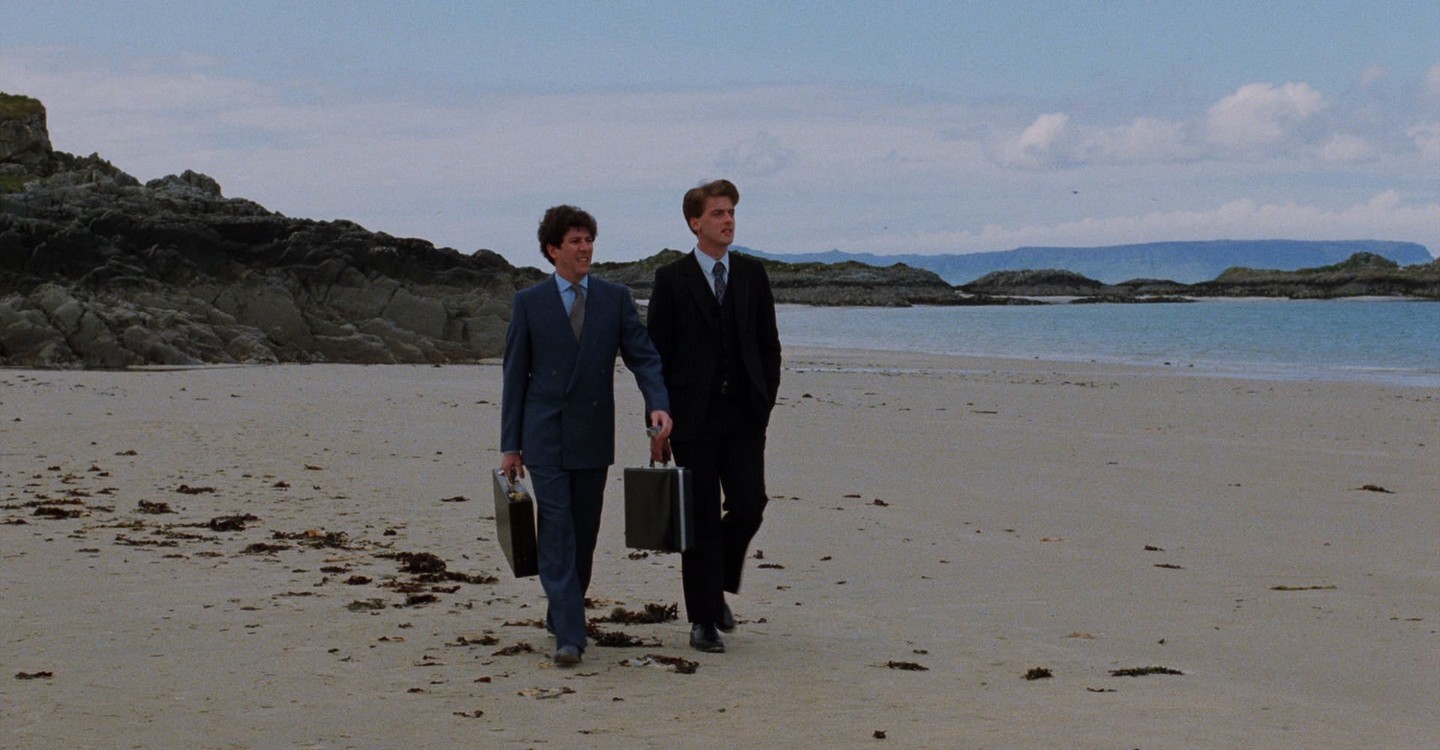
https://images.justwatch.com/backdrop/133833962/s1440/local-hero

Local Hero – This low-key, observant 1983 social satire from Scottish writer-director Bill Forsyth stars Peter Reigert as Macintyre, a Texas-based executive who is assigned by the head of “Knox Oil & Gas” (Burt Lancaster) to scope out a sleepy Scottish hamlet that sits on an oil-rich bay. He is to negotiate with local property owners and essentially buy out the town so that the company can build a huge refinery.

While he considers himself “more of a Telex man”, who would prefer to knock out such an assignment “in an afternoon”, Mac sees the overseas trip as a possible fast track for a promotion within the corporation. As this quintessential 80s Yuppie works to ingratiate himself with the unhurried locals, a “fish out of water” transformation ensues. It’s the kindest and gentlest Ugly American tale you’ll ever see.

https://pics.filmaffinity.com/Man_on_the_Train-495405654-large.jpg

Man on the Train – There are a only a handful of films I have become  emotionally attached to, usually for reasons I can’t completely fathom. This 2002 drama is one of them. Best described as an “existential noir”, Patrice LeConte’s relatively simple tale of two men in their twilight years with disparate life paths (a retired poetry teacher and a career felon) forming an unexpected deep bond turns into a transcendent film experience. French pop star Johnny Hallyday and screen veteran Jean Rochefort deliver mesmerizing performances. I feel an urge to watch it right now.

https://i0.wp.com/cdna.artstation.com/p/assets/images/images/024/683/844/4k/alice-marshall-my-neighbor-totoro2.jpg?ssl=1

My Neighbor Totoro  – While this 1988 film was anime master’s Hayao Miyazaki’s fourth feature, it was one of his (and Studio Ghibli’s) first international hits.

It’s a lovely tale about a young professor and his two daughters settling into their new country house while Mom convalesces at a nearby hospital. The rambunctious 4 year-old goes exploring and stumbles into the verdant court of a “king” nestled within the roots of a gargantuan camphor tree. This king rules with a gentle hand; a benign forest spirit named Totoro (an amalgam of every plush toy you ever cuddled with as a child).

Granted, it’s Miyazaki’s most simplistic and kid-friendly tale…but that’s not a put down. Miyazaki’s usual themes remain intact; the animation is breathtaking, the fantasy elements magical, yet the human characters are down-to-earth and universally relatable. A charmer.

https://i0.wp.com/denofcinema.com/wp-content/uploads/2022/01/shermans-march-1024x576.jpg?resize=1024%2C576&quality=89&ssl=1

Sherman’s March – Filmmaker Ross McElwee is one of America’s hidden treasures. McElwee, a genteel Southern neurotic (Woody Allen meets Tennessee Williams) has been compulsively documenting his personal life since the mid 70’s and managed to turn the footage into some of the most hilarious, moving and thought-provoking films most people have never seen.

Audiences weaned on “reality TV” may wonder “what’s the big deal about one more schmuck making glorified home movies?” but they would be missing an enriching glimpse into the human condition. Sherman’s March began as a project to retrace the Union general’s path of destruction through the South, but ended up as rumination on the eternal human quest for love and acceptance, filtered through McElwee’s search for the perfect mate.

Despite its 3 hour length, I’ve found myself returning to this film for repeat viewings, and enjoying it just as much as the first time. The unofficial “sequel”, Time Indefinite, is also worth a peek.

https://i0.wp.com/digbysblog.net/wp-content/uploads/2023/02/image-123.png?resize=1024%2C576&quality=80&ssl=1

The Thin Man – W.S. Van Dyke’s delightful mix of screwball comedy and murder mystery (adapted from Dashiell Hammett’s novel by Albert Hackett and Frances Goodrich) never gets old for me. Story takes a backseat to the repartee between private investigator (and perpetually tipsy socialite) Nick Charles (William Powell) and his wisecracking wife Nora (sexy Myrna Loy). Top it off with a scene-stealing wire fox terrier (Asta!) and you’ve got a winning formula that has spawned countless imitations; particularly a bevy of sleuthing TV couples (Hart to Hart, McMillan and Wife, Moonlighting, Remington Steele, et.al.).

https://i.ytimg.com/vi/AuUgRaBc4og/maxresdefault.jpg

True Stories – Musician/raconteur David Byrne enters the Lone Star state of mind with his subtly satirical Texas travelogue from 1986. Not easy to pigeonhole; part social satire, long-form music video, and mockumentary. The vignettes about the quirky but generally likable inhabitants of sleepy Virgil, Texas should hold your fascination once you buy into “tour-guide” Byrne’s bemused anthropological detachment. Among the town’s residents: John Goodman, “Pops” Staples, Swoosie Kurtz and the late Spalding Gray. The outstanding cinematography is by Edward Lachman. Byrne’s fellow Heads have cameos performing “Wild Wild Life”.

https://cinemaaxis.com/wp-content/uploads/2013/12/wings-of-desire-2.jpg?w=770

Wings of Desire – I’ve never attempted to compile a Top 10 list of my all-time favorite films (I’ve just seen too many damn movies…I’d be staring at an empty page for weeks, if my head didn’t explode first) but I’m certain Wim Wenders’ 1987 stunner would be a shoo-in. Now, attempting to describe this film is something else altogether.

If I told you it’s about an angel (Bruno Ganz) who hovers over Berlin in a trench coat, monitoring people’s thoughts and taking notes, who spots a beautiful trapeze artist (Solveig Dommartin) and follows her home, wallows in her deepest longings, watches her undress, then falls in love and decides to chuck the mantle of immortality and become human…you’d probably say “That sounds like a story about a creepy stalker.” And if I told you it features Peter Falk, playing himself, you’d laugh nervously and say, “Oh, look at the time.” Of course, there is more to it-about life, the universe, and everything.

BONUS!

If you really want to go all out for movie night (which is pretty much every night for me), you have to watch a cartoon before the movie, right? Here’s my 2011 review of a Blu-ray box set always guaranteed to lift your spirits. Keep it handy, right next to the first aid kit.

https://i0.wp.com/digbysblog.net/wp-content/uploads/2023/02/image-122.png?w=945&quality=80&ssl=1

The Looney Tunes Platinum Collection, Vol. 1  – During those long, dark nights of my soul, when all seems hopeless and futile, there’s one thought that never fails to bring me back to the light. It’s that feeling that somewhere, out there in the ether, there’s a frog, with a top hat and a cane, waiting for his chance to pop out of a box and sing:

Hello my baby, hello my honey, hello my ragtime gal

Send me a kiss by wire, baby my heart’s on fire…

If you don’t know what I’m talking about, just go ahead and skip to the next review now.

The rest of you might want to check out this fabulous 3-disc collection, which features 50 classic animated shorts (and 18 rarities) from the Warner Brothers vaults. Deep catalog Looney Tunes geeks may quibble until the cows come home about what’s not here (Warner has previously released six similar DVD collections in standard definition), but for the casual fans (like yours truly) there is plenty to please. I’m just happy to have “One Froggy Evening”, “I Love to Singa”, “Rabbit of Seville”, “Duck Amuck”, “Leghorn Lovelorn”, “Three Little Bops” and “What’s Opera Doc?” in one place. The selections cover all eras, from the 1940s onward.

One thing that does become clear, as you watch these restored gems in gorgeous hi-def (especially those from the pre-TV era) is that these are not “cartoons”, they are 7 ½ minute films, every bit as artful as anything else cinema has to offer. Extras include a trio of excellent documentaries about the studio’s star director, the legendary Chuck Jones. The real diamond among the rarities is The Dot and the Line: A Romance in Lower Mathematics (directed by Jones for MGM), which won the 1965 Oscar for Best Animated Short Film.

More medicine:

Book of Saturday

Book of Saturday II

Book of Saturday III

Book of Saturday IV

Lazy, hazy, crazy: Top 10 Summer Idyll Films

By Dennis Hartley

(Originally posted on Digby’s Hullabaloo on July 12, 2025)

https://buffaloakg.org/sites/default/files/styles/fixed_height_medium/public/artwork/1948_007_o2.jpg?itok=PiWS8qe7

Since it’s now officially summer, I thought it would be a good excuse to cull a list of my 10 seasonal favorites for your consideration. These would be films that I feel capture the essence of these “lazy, hazy, crazy” days; stories infused with the sights, the sounds, the smells, of summer. So, here you go…as per usual, in alphabetical order:

https://i0.wp.com/digbysblog.net/wp-content/uploads/2023/06/image-130.png?resize=1024%2C576&ssl=1

Jazz on a Summer’s Day– Bert Stern’s groundbreaking documentary about the 1958 Newport Jazz Festival is not so much a “concert film” as it is a fascinating and colorful time capsule of late 50s American life. Don’t get me wrong, there are plenty of gorgeously filmed numbers spotlighting the artistry of Thelonius Monk, Anita O’Day, Dinah Washington, Louis Armstrong, etc. and the performances are outstanding.

The effect is like “being there” in 1958 Newport on a languid summer’s day. If you’ve ever attended an outdoor music festival, you know half the fun is people-watching, and Stern obliges. Stern breaks with film making conventions of the era; this is the genesis of the cinema verite music documentary, which wouldn’t come to full flower until a decade later with films like Don’t Look Back, Monterey Pop, Woodstock and Gimme Shelter.

https://i0.wp.com/digbysblog.net/wp-content/uploads/2023/06/image-131.png?w=600&ssl=1

Last Summer– This underrated 1969 gem is from the husband-and-wife film making team of director Frank Perry and writer Eleanor Perry (who adapted from Evan Hunter’s novel).

On the surface, it’s a character study about three friends on the cusp of adulthood (Bruce Davison, Barbara Hershey and Richard Thomas) who develop a Jules and Jim-style relationship during an idyllic summer vacation on Fire Island. When a socially awkward stranger (Catherine Burns) bumbles into this simmering cauldron of raging hormones and burgeoning sexuality, it blows the lid off the pressure cooker, leading to unexpected twists. Think Summer of ’42 meets Lord of the Flies; I’ll leave it there.

Beautifully acted and directed. In 2022, Davison and Thomas appeared in Season 4 of the Netflix series Ozark (although they didn’t share any scenes).

https://i0.wp.com/digbysblog.net/wp-content/uploads/2023/06/image-132.png?w=750&ssl=1

Mid-August Lunch– This slice-of-life charmer from Italy, set during the mid-August Italian public holiday known as Ferragosto, was written and directed by Gianni Di Gregorio (who also co-scripted the 2009 gangster drama Gomorra).

Di Gregorio casts himself as Giovanni, an easy-going middle-aged bachelor living in Rome with his elderly mother. He doesn’t work, because as he tells a friend, taking care of mama is his “job”.

One day, his landlord drops in. He wants to take a weekend excursion with his mistress and asks for a “small” favor. In exchange for forgiveness on back rent, he requests Giovanni take a house guest for the weekend-his elderly mother. Giovanni agrees, but is chagrined when the landlord turns up with two little old ladies (he hadn’t mentioned his aunt). Soon after, Giovanni’s doctor makes a house call; in lieu of a service charge he asks Giovanni if he doesn’t mind taking on his dear old mama as well (Ferragosto is a popular “getaway” holiday in Italy).

It’s the small moments that make this film such a delight. Giovanni reading Dumas aloud to his mother, until she quietly nods off in her chair. Two friends, sitting in the midday sun, enjoying white wine and watching the world go by. In a scene that reminded me of a classic sequence in Fellini’s Roma, Giovanni and his pal glide us through the streets of Rome on a sunny motorcycle ride. This mid-August lunch might offer you a limited menu, but you’ll find every morsel worth savoring.

https://i0.wp.com/digbysblog.net/wp-content/uploads/2023/06/image-133.png?w=1000&ssl=1

Mommy is at the Hairdresser’s- Set at the beginning of an idyllic Quebec summer, circa 1966, Lea Pool’s beautifully photographed drama centers around the suburban Gauvin family. A teenager (Marianne Fortier) and her little brothers are thrilled that school’s out for summer. Their loving parents appear to be the ideal couple; Mom (Celine Bonnier) is a TV journalist and Dad (Laurent Lucas) is a medical microbiologist. A marital infidelity precipitates a separation, leaving the kids in the care of their well-meaning but now titular father, and young Elise finds herself the de facto head of the family. This is a perfect film about an imperfect family; a bittersweet paean to the endless summers of childhood lost.

https://i0.wp.com/digbysblog.net/wp-content/uploads/2023/06/image-134.png?resize=1024%2C576&ssl=1

Smiles of a Summer Night– “Lighthearted romp” and “Ingmar Bergman” are not normally synonymous, but it applies to this wise, drolly amusing morality tale from the director whose name is synonymous with somber dramas. Bergman regular Gunnar Bjornstrand heads a fine ensemble, as an amorous middle-aged attorney with a young wife (whose “virtue” remains intact) and a free-spirited mistress, who juggles a few lovers herself. As you may guess, this leads to amusing complications.

Love in all its guises is represented by a bevy of richly drawn characters, who converge in a third act set on a sultry summer’s eve at a country estate (the inspiration for Woody Allen’s A Midsummer Night’s Sex Comedy). Fast-paced, literate, and sensuous, it has a muted cry here and a whisper there of that patented Bergman “darkness”, but compared to most of his oeuvre, this one is a veritable screwball comedy.

https://i0.wp.com/digbysblog.net/wp-content/uploads/2023/06/image-135.png?w=828&ssl=1

Stand By Me– Director Rob Reiner was on a roll in the mid-to late 80s, delivering five exceptional films, book-ended by This is Spinal Tap in 1984 and When Harry Met Sally in 1989. This 1986 dramedy was in the middle of the cycle. Based on a Stephen King novella (adapted by Raynold Gideon and Bruce A. Evans) it’s a bittersweet “end of summer” tale about four pals (Wil Wheaton, River Phoenix, Corey Feldman and Jerry O’Connell) who embark on a search for the body of a missing teenager, during the course of which they learn hard life lessons. Reiner coaxes extraordinary performances from the young leads, and Richard Dreyfus provides the narration.

https://i0.wp.com/digbysblog.net/wp-content/uploads/2023/06/image-136.png?resize=1024%2C563&ssl=1

Summer Wars– Don’t be misled by the cartoon title of Mamoru Hosoda’s eye-popping movie-this could be the Gone with the Wind of Japanese anime. OK…that’s a tad hyperbolic. But it does have drama, romance, comedy, and war-centering around a summer gathering at a bucolic family estate. Tokyo Story meets War Games? At any rate, it’s one of the finer animes of recent years. While some narrative devices in Satoko Ohuder’s screenplay will feel familiar to anime fans (particularly the “cyber-punk” elements), it’s the humanist touches and subtle social observations (reminiscent of Yasujiro Ozu’s films) that makes it unique and worthwhile.

https://i0.wp.com/digbysblog.net/wp-content/uploads/2023/06/image-137.png?resize=1024%2C576&ssl=1

A Summer’s Tale– It’s nearly 8 minutes into Eric Rohmer’s romantic comedy before anyone utters a word; and it’s a man calling a waitress over to order a chocolate crepe. But not to worry, because things are about to get much more interesting.

In fact, our young man, an introverted maths grad named Gaspar (Melvil Poupaud), who is killing time in sunny Dinard until his “sort of” girlfriend arrives to join him on summer holiday, will soon find himself in a dizzying girl whirl. It begins when he meets bubbly and outgoing Margo (Amanda Langlet) an ethnologist major who is spending her summer break waitressing at her aunt’s seaside creperie. Margo is also (sort of) spoken for, with a boyfriend (currently overseas). A friendship blooms. But will they stay “just friends”?

Originally released in France in 1996, this film (which didn’t make its official U.S. debut until 2014) rates among the late director’s best work (strongly recalling Pauline at the Beach, which starred a then teenage Langlet, who is wonderful here as the charming Margo).

In a way, this is a textbook “Rohmer film”, which I define as “a movie where the characters spend more screen time dissecting the complexities of male-female relationships than actually experiencing them”. Don’t despair; it won’t (as Gene Hackman’s character in Night Moves states regarding a Rohmer film) be akin to “watching paint dry”. Even a neophyte will glean the director’s ongoing influence (particularly if you’ve seen Once, When Harry Met Sally, or Richard Linklater’s “Before” trilogy).

https://i0.wp.com/digbysblog.net/wp-content/uploads/2023/06/image-138.png?w=700&ssl=1

Tempest– “Show me the magic.” Nothing says “idyllic” like a Mediterranean getaway, which provides the backdrop for Paul Mazursky’s seriocomic 1982 update of Shakespeare’s classic play.

His Prospero is a harried Manhattan architect (John Cassavetes) who spontaneously quits his firm, abandons his wife (Gena Rowlands), packs up his teen daughter (Molly Ringwald) and retreats to a Greek island for an open-ended sabbatical. He soon adds a young lover (Susan Sarandon) and a Man Friday (Raul Julia) to his entourage. But will this idyll inevitably be steamrolled by the adage: “Wherever you go…there you are”?

The pacing lags a little bit on occasion, but superb performances, gorgeous scenery and bits of inspired lunacy (like a choreographed number featuring Julia and his sheep dancing to “New York, New York”) make up for it.

https://i0.wp.com/digbysblog.net/wp-content/uploads/2023/06/image-139.png?resize=1024%2C704&ssl=1

3 Women– If Robert Altman’s haunting 1977 character study plays like a languid, sun-baked California fever dream…it’s because it was (the late director claimed that the story came to him in his sleep). What ended up on the screen not only represents Altman’s best, but one of the best American art films of the 1970s.

The women are Millie (Shelly Duvall), a chatty physical therapist, considered a needy bore by everyone except her childlike roommate/co-worker Pinky (Sissy Spacek), who worships the ground she walks on, and enigmatic Willie (Janice Rule), a pregnant artist who only paints anthropomorphic lizard figures (empty swimming pools as her canvas). As the three personas slowly merge (bolstered by fearless performances from the three leads), there’s little doubt that Millie, Pinky and Willie hail from the land of Wynken, Blynken and Nod.

Tribeca 2025: Dog of God (***)

By Dennis Hartley

(Originally posted on Digby’s Hullabaloo on June 7, 2025)

https://www.marchedufilm.com/wp-content/thumbnails/uploads/2024/04/fantastic7_dogofgod-1-scaled-tt-width-1200-height-630-fill-0-crop-1-bgcolor-f0f2f7.jpg

Witch hunt! Put Hammer horror, Ralph Bakshi, Peter Greenaway and Ken Russell in a blender, and out pops something that approximates co-directors Raitis and Lauris Ābele’s rotoscoped animation fantasy, set in a Livonian village in the 1600s. A comely herbalist/tavern maid (who may or may not be a witch), an impotent Duke, a malevolent Benedictine pastor and his long-suffering whipping boy, and a (sort of) werewolf all converge in this entertainingly over-the-top folk horror tale of superstition, dogma, and human frailty. Earthy, sexy, visceral, and hallucinogenic, with a dash of dark humor. Not for all tastes (or the squeamish), but adult animation fans should dig it.

SIFF 2025: Sanatorium Under the Sign of the Hourglass (***)

By Dennis Hartley

(Originally posted on Digby’s Hulllabaloo on May 17, 2025)

https://iffr.com/en/wp-content/uploads/sites/2/2024/12/e0bb99a8-e197-4fa9-9bce-0df494b82f8d.jpg?image-crop-positioner-ts=1734557642

How do I describe the weird micro-universe Stephen and Timothy Quay have created through their stop-motion/live action films? They’re pieces of dreams; a screen capture of that nanosecond of Jungian twilight between nodding off and jerking awake. Their latest film explores grief and memory through the eyes of a man who travels to a sanatorium where his father has died. Or that’s what he believes…until he arrives. The “reality” is left up to the viewer.

Blu-ray reissue: Heavy Traffic (***)

By Dennis Hartley

(Originally posted on Digby’s Hullabaloo on January 25, 2025)

https://i0.wp.com/digbysblog.net/wp-content/uploads/2025/01/MV5BNTFlZGRhMGEtMWJlZS00MDE2LTg2MDUtNTkwN2M0NjcxNDVmXkEyXkFqcGc%40._V1_.jpg?resize=1024%2C576&quality=89&ssl=1

Heavy Traffic (Sandpiper Pictures)

Within the realm of animated films, Ralph Bakshi’s name may not be as universally recognizable (or revered) as Walt Disney or Studio Ghibli, but I would consider him no less of an important figure in the history of the genre. During his heyday (1972-1983) the director pumped out 8 full-length features (including Fritz the Cat, The Lord of the Rings, Wizards and American Pop) using his signature blend of live-action, rotoscoping, and  traditional cel animation.

I view this semi-autobiographical 1973 entry (his 2nd feature) as Bakshi’s Mean Streets. A young man obsessed with drawing cartoon caricatures lives in a cramped Brownsville apartment with his constantly bickering parents (a Jewish mother and an Italian father).

Yearning to strike out on his own to sow his wild oats, he moves out and ingratiates himself with an array of dubious characters who lurk in some of NYC’s seedier neighborhoods. The ensuing eye-popping (and very adult) misadventures may (or may not) be a figment of the budding artist’s wild imagination. Surreal, outrageous, cringing, hilarious and guaranteed to contain something to offend everybody in a contemporary audience (you have been warned).

This is my first awareness of Sandpiper Pictures; the image and sound quality is decent, but the package is bare bones; no extras or commentary track. That said, I’m glad to see this belated Blu-ray release, as it officially completes my Ralph Bakshi collection!

Tribeca 2024: Boys Go To Jupiter (**1/2)

By Dennis Hartley

(Originally posted on Digby’s Hullabaloo on June 15, 2024)

https://i0.wp.com/digbysblog.net/wp-content/uploads/2024/06/large_BOYS_GO_TO_JUPITER_Clean_16x9_01.png?w=980&quality=80&ssl=1

Well, you know what they say: “Boys go to Jupiter to get more stupider, girls go to college to get more knowledge.” Truth be told, I was completely oblivious about the existence of that (alleged) children’s rhyme until I consulted Mr. Google a few moments ago (I never went to college, you see). 3-D animator Julian Glander’s musical comedy fantasy (set in Florida between Christmas and New Year’s) centers on a teenage odd-jobber named Billy 5000 (voiced by Jack Corbett) who is laser-focused on making $5,000.

His pals think he works too much; chiding him for not chilling with them at the beach. When Billy stumbles across an alien creature that resembles a purple donut, he is forced to reassess his raison d’être. Toss in a subplot about an evil orange juice company out to take over the world (or something), and there you have it. Fitfully amusing, in the vein of Clerks and Slacker (the light social satire and absurdist anarchy reminded me of The Firesign Theatre at times). I enjoyed the music soundtrack, which has a pleasant dream pop vibe. For a niche audience.

SIFF 2024: The Missing(***)

By Dennis Hartley

(Originally posted on Digby’s Hullabaloo on May 11, 2024)

https://www.siff.net/images/FESTIVAL/2024/Films/Film%20Detail%20Hero%20Sizes/Features/Missing.jpg

Writer-director Carl Joseph Papa uses a combination of rotoscoping and hand-drawn animation for this semi-autobiographical drama (the Philippines’ first animated Oscars submission for Best International Feature). A young gay animator who has been mute since childhood suffers a break from reality after discovering his uncle’s body during a wellness check. As the young man comes to grips with suppressed memories, what ensues is an honest, raw, and emotional look at the effects of childhood trauma.

Blu-ray reissue: American Pop (****)

By Dennis Hartley

(Originally posted on Digby’s Hullabaloo on February 24, 2024)

https://i0.wp.com/digbysblog.net/wp-content/uploads/2024/02/1981-movie-project-american-pop-01-470x310@2x.jpg?w=940&quality=89&ssl=1

American Pop (Columbia/Sony)

Within the realm of animated films, Ralph Bakshi’s name may not be as universally recognizable (or revered) as Walt Disney or Studio Ghibli, but I would consider him no less of an important figure in the history of the genre. During his heyday (1972-1983) the director pumped out 8 full-length feature films (Fritz the Cat, Heavy Traffic, Wizards, et. al.) using his signature blend of live-action, rotoscoping, and  traditional cel animation.

In his 1981 film American Pop, director Bakshi  and screenwriter Ronni Kern ambitiously attempt to distill the history of 20th Century American popular music (essentially from Vaudeville to Punk) in 90 minutes. The narrative is framed via the triumphs and travails of four generations of a Russian-Jewish immigrant family (all of whom are involved one way or the other in the music business). Intelligently written, beautifully animated, with an eclectic soundtrack (everything from “Swanee” to “Pretty Vacant”).

Columbia/Sony’s release is bare bones; no commentary tracks or extra features. The transfer, while a definite improvement over my 2009 Columbia DVD edition, does not appear to be a “restored” print (the “mastered in high definition” notation on the back of the keep case is a tell). The 2.0 DTS-HD MA audio track is adequately robust for this engaging musical-drama.

Child’s Guide to War: A film troika*

By Dennis Hartley

(Originally posted on Digby’s Hullabaloo on October 10, 2023)

*This is a revised version of an older post that (sadly) is relevant again.

https://i0.wp.com/digbysblog.net/wp-content/uploads/2023/10/il_fullxfull.3722572928_e661.webp?w=1024&quality=80&ssl=1

Have you heard the reasons why?
(Yeah, we’ve heard it all before)
But have you seen the nation cry?
(Yeah, we’ve seen it all before)

-From “War Weary World” by The Call

Oy. It’s been a trying couple of days…

Bertrand Russell said, “war does not determine who is right-only who is left.” That may be pithy, but he’s yet to be proven wrong.

I realize that the 24-hour news channels have little choice but to “recycle” a certain amount of horrific footage as a huge international story of this nature is developing, but I’m old enough to recall when such imagery was processed as deterrence to conflict and a call for diplomacy, rather than a base and puerile incitement for vengeance (not by those reporting the news but as some politicians and pundits have been wont to do).

What I find particularly heartbreaking is the plight of the non-combatants (on both sides) caught in the middle of the mayhem…especially the children.

But perhaps I’m just naive, what with my pacifist wishes and hippy-dippy poster dreams. It’s a complicated world, and I’m just a simple farmer. A person of the land. The common clay of the American West. You know…a moron. That’s why I’m just the movie guy around these parts.

That being said, I believe there’s something that the following movies, or more specifically their young protagonists can teach us about such matters.

And so I’m spotlighting three essential films that offer an immediate ground-level view of the effects of war, filtered through the eyes of innocents, uncluttered by any political machinations or jingoist agendas. Hey, feel free to invite your favorite war hawk over for dinner and a movie. Just make sure that they are taking notes:

Grave of the Fireflies– For years, the term ‘anime’ conjured visions of saucer-eyed cartoon characters in action-packed fantasy-adventures (generally targeting younger audiences). However, sometime around the mid-80s, the paradigm shifted when Japanese production houses like Studio Ghibli began to find international success with more eclectic, character-driven fare. One transcendent example is writer-director Isao Takahata’s 1988 drama, Grave of the Fireflies.

While it is animated, and its protagonists are children, it is not necessarily a children’s film; its unflinching approach and anti-war subtext puts it in a league with Roberto Rossellini’s Germany Year Zero and Andrei Tarkovsky’s Ivan’s Childhood.

The story (based on Akiyuki Nosaka’s novel) takes place in Kobe in 1945, and concerns the travails of a teenage boy named Seita (voiced by Tsutomo Tatsumi) and his little sister Setsuko (voiced by Ayano Shiraishi), who are orphaned when their mother perishes in an Allied firebombing raid. After brief lodgings with a less-than-hospitable aunt, the siblings have to fend for themselves. Do not expect a Hollywood ending (I wouldn’t recommend  it for children under 12).

One interesting commonality between Grave of the Fireflies and the aforementioned Rossellini film is that Japan and Germany were the aggressor nations in WW2. The pain and suffering of innocents caught in the crossfire doesn’t know from borders or ideology.

Son of Babylon– This heartbreaking Iraqi drama is set in 2003, just weeks after the fall of Saddam. It follows the arduous journey of a Kurdish boy named Ahmed (Yasser Talib) and his grandmother (Shazda Hussein) as they head for the last known location of Ahmed’s father, who disappeared during the first Gulf War.

As they traverse the bleak, post-apocalyptic landscapes of Iraq’s bomb-cratered desert, a portrait emerges of a people struggling to keep mind and soul together, and to make sense of the horror and suffering precipitated by two wars and a harsh dictatorship.

Director Mohamed Al Daradji and co-screenwriter Jennifer Norridge deliver something conspicuously absent in the Iraq War(s) movies from Western directors in recent years-an honest and humanistic evaluation of the everyday people who inevitably get caught in the middle of such armed conflicts-not just in Iraq, but in any war, anywhere.

While the film alludes to the regional and international politics involved, the narrative is constructed in such a way that at the end of day, whether Ahmed’s father was killed by American bomb sorties or Saddam gassing his own people is moot.

That message is distilled in a small, compassionate gesture and a single line of dialogue. An Arabic-speaking woman, also searching for a missing loved one at a mass grave site sets her own suffering aside to lay a comforting hand on the lamenting grandmother’s shoulder. “I’m sorry, I don’t speak Kurdish,” she says, “…but I can feel this woman’s pain and sadness.”

One thing I can say (aside that this emotionally shattering film should be required viewing for heads of state, commanders-in-chief, generals, or anyone else wielding the power to wage war)…I don’t speak Kurdish, either.

Testament- Originally an American Playhouse presentation, this film (with a screenplay adapted by John Sacred Young from a story by Carol Amen) was released to theaters and garnered a well-deserved Best Actress nomination for Jane Alexander. Director Lynne Littman takes a low key approach, but pulls no punches; I think this is what gives her film’s anti-nuke message more teeth and makes its scenario more relatable than Stanley Kramer’s similarly-framed but more sanitized and preachy 1959 drama On the Beach.

Alexander, her husband (William DeVane) and three kids live in sleepy Hamlin, California, where afternoon cartoons are interrupted by a news flash that nuclear explosions have occurred in New York. Then there is a flash of a different kind when nearby San Francisco (where DeVane has gone on a business trip) receives a direct strike.

There is no exposition on the political climate that precipitates the attacks; this is a wise decision, as it puts the focus on the humanistic message of the film. All of the post-nuke horrors ensue, but they are presented sans the melodrama that informs many entries in the genre. The fact that the nightmarish scenario unfolds so deliberately, and amidst such everyday suburban banality, is what makes it very difficult to shake off.

As the children (and adults) of Hamlin succumb to the inevitable scourge of radiation sickness and steadily “disappear”, like the children of the ‘fairy tale’ Hamlin, you are left haunted by the final line of the school production of “The Pied Piper” glimpsed earlier in the film… “Your children are not dead. They will return when the world deserves them.”

Tribeca 2022: Deep Sea (***)

By Dennis Hartley

(Originally posted on Digby’s Hullabaloo on June 17, 2023)

https://i0.wp.com/digbysblog.net/wp-content/uploads/2023/06/image-62.png?w=800&ssl=1

Xiaopeng Tian’s colorful 3-D animation fantasy follows the dreamlike journey of a melancholy little girl named Shenxiu (voiced by Wang Ting Wen) after she falls overboard during a storm while on an ocean cruise with her father, stepmother, and baby brother. Shenxiu longs to reconnect with her biological mother, who she hasn’t seen or heard from since her parents’ divorce. Akin to the little boy in Where the Wild Things Are, Shenxiu encounters strange and wondrous characters that embody her troubled emotional state; anthropomorphic creatures that also serve as avatars for the people who are closest to her. An imaginative and family-friendly adventure in the vein of Hayao Miyazaki’s Spirited Away.