(Originally posted on Digby’s Hullabaloo on January 24, 2026)
In my review of the documentary Antarctica: A Year on Ice, I wrote:
For decades now, my long-time Alaskan friends and I have speculated as to why no one has ever thought to produce a documentary about the unique, once-in-a-lifetime experience shared by the thousands of men and women who worked on the massive Trans-Alaska Pipeline construction project back in the 1970s. From 1975-1977, I worked as a laborer on the project (that’s right…Fairbanks Local #942, baby!), doing 6-to-10 week stints in far-flung locales with exotic handles like Coldfoot, Old Man, Happy Valley, and the ever-popular Pump Station #3 (now that was one cold motherfucker).
These remote work camps, frequently the only bastions of “civilization” for hundreds of square miles in all directions, developed their own unique culture…part moon base, part Dodge City. It’s a vibe that is tough to explain to anyone who wasn’t actually there. Traditionally, I usually cite the sci-fi “western” Outland as the closest approximation.
They don’t call Alaska “The Last Frontier” for nothing. Yippee ki-yay.
Yes, the subarctic can be harsh and otherworldly. Yet, there is also poetry there…as these verses from Robert Service’s “The Spell of the Yukon” attest:
I’ve stood in some mighty-mouthed hollow
That’s plumb-full of hush to the brim;
I’ve watched the big, husky sun wallow
In crimson and gold, and grow dim,
Till the moon set the pearly peaks gleaming,
And the stars tumbled out, neck and crop;
And I’ve thought that I surely was dreaming,
With the peace o’ the world piled on top.
The summer—no sweeter was ever;
The sunshiny woods all athrill;
The grayling aleap in the river,
The bighorn asleep on the hill.
The strong life that never knows harness;
The wilds where the caribou call;
The freshness, the freedom, the farness—
O God! how I’m stuck on it all.
The winter! the brightness that blinds you,
The white land locked tight as a drum,
The cold fear that follows and finds you,
The silence that bludgeons you dumb.
The snows that are older than history,
The woods where the weird shadows slant;
The stillness, the moonlight, the mystery,
I’ve bade ’em good-by—but I can’t
I second that emotion. From my review of the documentary Happy People: A Year in the Taiga:
As I was watching the film, a certain sense of familiarity began to gnaw at me. It was something about the stark wintry beauty of naturally flocked spruce forests, the crisp contrast of white birch against blue skies, and the odd moose galumphing into the frame. Or maybe it was the relentless vampirism of swarming mosquitos during the short but intense sub-arctic summer. Then it dawned on me. I had lived there! Was this a past life memory? Then I remembered that I don’t believe in that sort of thing…so I Googled a map of Siberia, which solved the mystery: the village of Bakhta lies roughly on the same longitude as Fairbanks, Alaska, where I lived for 23 years. I couldn’t see Russia from my house, but I now feel a spiritual kinship with these hardy Siberians. Okay, I’m not a survivalist (if I were to venture out on Gennady’s trap line; I’d end up like the protagonists in Kalatozov’s Letter Never Sent). But I think you catch my drift…
Winter Storm Fern could etch itself into weather history in four different ways across the South, Midwest and Northeast.Some winter storms affect only a relatively limited area. Not Winter Storm Fern.
Fern is expected to dump significant snow and/or ice over 34 states affecting over 220 million people in the U.S. That’s almost two out of every three Americans, according to population estimates.
Fern will also dump significant snow in parts of southeastern and Atlantic Canada.
This storm will lead to widespread dangerous travel for days, and “catastrophic” ice accumulations in the South could lead to widespread power outages and tree damage, according to NOAA’s Weather Prediction Center. […]
This could be the region’s most widespread, damaging ice storm in at least several years, with damage that could take days to recover from.
Weather forecasters are also warning about possible snow accumulations of 12 inches or more in some areas, as well as record cold temperatures.
I’ve bade ’em good-by—but I can’t.
I do not know how long in the snow I wrestled with grisly fear;
But the stars came out and they danced about ere again I ventured near;
I was sick with dread, but I bravely said: “I’ll just take a peep inside.
I guess he’s cooked, and it’s time I looked”; … then the door I opened wide.
And there sat Sam, looking cool and calm, in the heart of the furnace roar;
And he wore a smile you could see a mile, and he said: “Please close that door.
It’s fine in here, but I greatly fear you’ll let in the cold and storm—
Since I left Plumtree, down in Tennessee, it’s the first time I’ve been warm.”
–from “The Cremation of Sam McGee”, by Robert Service
Don’t try that at home, kids…but do what you can keep warm, and stay safe. In the meantime, grab yourself a cup of hot chocolate (those directly in path of the storm may want to add a splash of Kahlua), a good pair of noise-cancelling ‘phones, and curl up with my wintry mixtape. As usual, best enjoyed in the order presented:
“The Immigrant Song” – Led Zeppelin
“Waiting for the Winter” – The Popguns
“Hazy Shade of Winter” – The Bangles
“Baby it’s Cold Outside” – Pezband
“Snowman” – XTC
“Winter in the Country” – Cleaners from Venus
“Valley Winter Song” – Fountains of Wayne
“Life in a Northern Town” – The Dream Academy
“Skyway” – The Replacements
“Snowstorm” – Galaxie 500
“Winter Song” – The Screaming Trees
“Winter” – The Rolling Stones
“South Side of the Sky” – Yes
“Rangers at Midnight” – Crack the Sky
“The Northern Lights” – Renaissance
“Snowbound” – Genesis
“I Am a Rock” – Simon and Garfunkel
“California Dreaming” – Mamas and the Papas
“Sometimes in Winter” – Blood, Sweat, and Tears
“Wintertime Love” – The Doors
“Winter Winds” – Fotheringay
“Skating Away (On the Thin Ice of a New Day)” – Jethro Tull
(Originally posted on Digby’s Hullabaloo on January 17, 2026)
“We are now faced with the fact that tomorrow is today. We are confronted with the fierce urgency of now. In this unfolding conundrum of life and history, there “is” such a thing as being too late. This is no time for apathy or complacency. This is a time for vigorous and positive action.”
― Martin Luther King Jr.
That oft-quoted excerpt is from Dr. Martin Luther King Jr.’s “I Have a Dream” speech, which he delivered to a crowd of 250,000 civil rights workers in Washington D.C. in the summer of 1963. He may have said “we are now faced with the fact that tomorrow is today” 62 years ago, but his emphasis on the “urgency of now” rings truer than ever:
This is how far you have to scroll on the NYTimes homepage to get any coverage of what's going on day-to-day in an occupied American city where schools are closing because the government is checking the papers of all brown or Asian people then brutalizing, imprisoning or killing them.
During the 2020 protests ignited by George Floyd’s death, I wrote:
Yes, I live in a blue city chock full of Marxists and dirty Hippies. Few cities are “bluer” than Seattle. We have a weed shop on every corner. We have public statues of Jimi Hendrix and V.I. Lenin. We have a progressive, openly gay female mayor. We have a female African American police chief. We have a high-profile female city council member who is a Socialist Alternative. As Merlin once foretold-a dream for some…a nightmare for others:
Oh, dear. Let’s take a peek at the terrorist-fueled burning and pillaging that has been raging in Seattle’s Capitol Hill Autonomous Zone for the past week (sensitive viewers be warned):
The humanity. Not quite as harrowing as a Burning Man festival…but in the ballpark.
My insufferable facetiousness aside, there is in fact a “revolution” happening in Seattle right now; and on streets all over America. “Revolution” doesn’t always equate “burning and pillaging”. Granted, some of that did occur when the protests started two weeks ago.
There’s something happening here What it is ain’t exactly clear There’s a man with a gun over there Telling me I got to beware I think it’s time we stop, children, what’s that sound Everybody look what’s going down
— The Buffalo Springfield, “For What It’s Worth”
But there is something happening here; something percolating worldwide that goes deeper than that initial visceral expression of outrage over the injustice of George Floyd’s senseless death; it feels like change may be in the offing. It will still take some…nudging. And I fear some feathers may get ruffled.
It isn’t nice to block the doorway, It isn’t nice to go to jail, There are nicer ways to do it But the nice ways always fail.
— Malvina Reynolds, “It Isn’t Nice”
*sigh* I was such a silly Polyanna. Digby posted this a couple days ago:
In case you were wondering what MAGA is saying about Minnesota:
MAGA influencer Steve Bannon suggested that President Donald Trump should invoke the Insurrection Act in Minnesota because “they hate white people” in the state.
After Trump threatened to use the law to send troops to Minnesota, Bannon opened his Thursday War Room show with a full-throated endorsement of the idea.
“We demand mass deportations!” Bannon exclaimed. “Not the onesies, twosies you’re seen in Minnesota. You haven’t seen anything yet. We’re the biggest advocate of invoking the Insurrection Act and going in and cleaning out the mess.”
“And what you see in Minnesota is an act of — they hate America, they hate American citizens, dare I say they hate white people?” he continued. “We have said for a long time, this is where the rubber meets the road, this is where the fight’s going to be. Bring it.”
“And that scum in the streets, bring it. Let’s invoke the Insurrection Act and let’s do it today. Let’s get up there and clean out that mess.”
Yeah, Minnesota hates white people. Can he hear himself? Minnesota? Has he seen who is protesting there?
Minnesota has a predominantly White population around 75-78%, Black around 7%, Asian around 5%, Hispanic/Latino around 6-7%, and Two or More Races around 4-5%.
It’s so idiotic I don’t know what to say.
Bannon and his ilk are promoting a race war which is pretty much where we’ve been headed since Trump came down that escalator 10 years ago.
Plus ca change…
And now there’s this:
I took that screenshot directly from the official government National Parks website today. Do you notice anything…missing this year? Here’s another clue for you all:
National park goers will not get free admission on Martin Luther King Jr. Day – a change from years past.
When the National Park Service announced free-entrance days for 2026, both Martin Luther King Jr. Day and Juneteenth were left off the list. They were replaced by other days, including Flag Day on June 14, which is also President Trump’s birthday.
The shift to remove the days tied to Black history was condemned by Derrick Johnson, the president and CEO of NAACP.
“Removing MLK Day and Juneteenth from the national parks calendar is more than petty politics — it’s an attack on the truth of this nation’s history,” Johnson said in a statement.
The National Park Service started free entry days in 2009. The selection and number of days have varied, but Martin Luther King Jr. Day has been on the list ever since 2011.
To Omar Montgomery, the president of the NAACP Rocky Mountain state conference for Colorado, Montana and Wyoming, the day’s removal felt like an effort by the Trump Administration to undermine and erase the contributions of Black people in the United States.
“If the federal government is sending the message that the Reverend Dr. Martin Luther King Jr. is a day that we don’t have special accommodations for people to get into national parks for free,” he said, “then what you’re saying is, this day is also not important for our schools to be able to talk about the holiday.”
NAACP said the removal of free entry days followed other actions by the Trump Administration to suppress Black history. According to reporting by The Washington Post, National Park Service officials last year ordered the removal of interpretive materials related to slavery.
The National Park Service did not respond to a request for comment on this story. The changes to free entrance days coincided with other policy shifts, including special fees for international visitors.
Somebody’s white slip is showing.
The fierce urgency of now. In honor of Martin Luther King Day, I’ve combed my review archives and curated 10 films that reflect on race relations in America; some that look back at where we’ve been, some that give us a reality check on where we’re at now and maybe even one or two that offer hope for the future. We still may not have quite reached that “promised land” of colorblind equality, but each of us doing whatever we can in our own small way to help keep Dr. King’s legacy alive will surely help light the way-especially in these dark times.
BlackKkKlansman (2018)– So what do you get if you cross Cyrano de Bergerac with Blazing Saddles? You might get Spike Lee’s BlackKkKlansman. That is not to say that Lee’s film is a knee-slapping comedy; far from it. Lee takes the true story of Ron Stallworth (John David Washington), an African-American undercover cop who managed to infiltrate the KKK in Colorado in the early 70s and runs with it, in his inimitable fashion.
I think this is Lee’s most affecting and hard-hitting film since Do the Right Thing (1989). The screenplay (adapted by Charlie Wachtel, David Rabinowitz, Kevin Willmott and Lee from Stallworth’s eponymous memoir) is equal parts biopic, docudrama, police procedural and social commentary, finding a nice balance of drama, humor and suspense. (Full review)
The Black Power Mixtape (2011)–Historically, the Black Power movement of the mid-60s to mid-70s has been somewhat misrepresented, with a tendency to spotlight its more sensationalist elements. The time is ripe to re-examine the movement, which despite its flaws, represents one of the last truly progressive grass roots political awakenings we’ve had in this country (if you’re expecting bandolier-wearing, pistol-waving interviewees spouting fiery Marxist-tinged rhetoric-dispense with that hoary stereotype now).
Director Goran Olsson was given access to a trove of vintage yet pristine 16mm footage that had been tucked away for years in the basement of Swedish Television; representing a decade of candid interviews with movement leaders, as well as meticulous documentation of Black Panther Party activities. Olsson presents the clips in a historically chronological timeline, with minimal commentary. While not perfect, it is an essential document, and one of the more eye-opening films I have seen on this subject. (Full review)
The Boys of Baraka (2005) – Co-directors Heidi Ewing and Rachel Grady deliver a fresh take on a well-worn cause celebre: the sad, shameful state of America’s inner-city school system. Eschewing the usual hand-wringing about the underfunded, over-crowded, glorified daycare centers that many of these institutions have become for poor, disenfranchised urban youth, the filmmakers chose to showcase one program that strove to make a real difference.
The story follows a group of 12-year-old boys from Baltimore who attended a boarding school in Kenya, staffed by American teachers and social workers. In addition to more personalized tutoring, there was emphasis on conflict resolution through communication, tempered by a “tough love” approach. The events that unfold from this bold social experiment (filmed over a three year period) are alternately inspiring and heartbreaking. (Full review)
The Force (2017) – Peter Nicks’ documentary examines the rocky relationship between Oakland’s police department and its communities of color. The force has been under federal oversight since 2002, due to myriad misconduct cases. Nicks utilizes the same cinema verite techniques that made his film The Waiting Room so compelling. It’s like a real-life Joseph Wambaugh novel (The Choirboys comes to mind). The film offers no easy answers-but delivers an intimate, insightful glimpse at both sides. (Full review)
The Girls in the Band (2011)– Contextual to a curiously overlooked component within the annals of American jazz music, it’s tempting to extrapolate on Dr. King’s dream. Wouldn’t it be great to live in a nation where one is not only primarily judged by content of character, but can also be judged on the merits of creativity, or the pure aesthetics of artistic expression, as opposed to being judged solely by the color of one’s skin…or perhaps gender? At the end of the day, what is a “black”, or a “female” jazz musician? Why is it that a Dave Brubeck is never referred to as a “white” or “male” jazz musician?
In her film, director Judy Chaikin chronicles the largely unsung contributions that female jazz musicians (a large portion of them African-American) have made (and continue to make) to this highly influential American art form. Utilizing rare archival footage and interviews with veteran and contemporary players, Chaikin has assembled an absorbing, poignant, and celebratory piece. (Full review)
I Am Not Your Negro (2016)– The late writer and social observer James Baldwin once said that “Whatever white people do not know about Negroes reveals, precisely and inexorably, what they do not know about themselves.” Sadly, thanks to the emboldening of certain elements within American society that have been drawn from the shadows by the openly racist rhetoric that spouted from the Former Occupant of the White House, truer words have never been spoken.
Indeed, anyone who watches Raoul Peck’s documentary will recognize not only the beauty of Baldwin’s prose, but the prescience of such observations. Both are on display in Peck’s timely treatise on race relations in America, in which he mixes archival news footage, movie clips, and excerpts from Baldwin’s TV appearances with narration by an uncharacteristically subdued Samuel L. Jackson, reading excerpts from Baldwin’s unfinished book, Remember This House. An excellent and enlightening film. (Full review)
In the Heat of the Night(1967)–“They call me Mister Tibbs!” In this classic (which won 1967’s Best Picture Oscar) the late Sidney Poitier plays a cosmopolitan police detective from Philly who gets waylaid in a torpid Mississippi backwater, where he is reluctantly recruited into helping the bigoted sheriff (Rod Steiger) solve a local murder. Poitier nails his performance; you can feel Virgil Tibb’s pain as he tries to maintain his professional cool amidst a brace of surly rednecks, who throw up roadblocks at every turn.
While Steiger is outstanding as well, I find it ironic that he won “Best Actor in a leading role”, when Poitier was ostensibly the star of the film (it seems Hollywood didn’t get the film’s message). Sterling Silliphant’s brilliant screenplay (another Oscar) works as a crime thriller and a “fish out of water” story. Director Norman Jewison was nominated but didn’t score a win. Future director Hal Ashby won for Best Editing. Quincy Jones composed the soundtrack, and Ray Charles sings the sultry theme. (Full review)
The Landlord (1970)–Hal Ashby only directed a relative handful of films, but most, especially his 70’s output, were built to last (Harold and Maude, The Last Detail, Bound for Glory, Shampoo, Being There).
In The Landlord, Beau Bridges plays a trustafarian with “liberal views” that his conservative parents find troubling…especially after he buys a run-down inner-city tenement, with intentions to renovate. His subsequent involvement with the various black tenants is played sometimes for laughs, other times for intense drama, but always for real. The social satire and observations about race relations are dead-on, but never preachy or condescending.
Top-notch ensemble work, featuring a young Lou Gossett (with hair!) giving a memorable turn. The lovely Susan Anspach is hilarious as Bridge’s perpetually stoned and bemused sister. A scene featuring Pearl Bailey and Lee Grant getting drunk and bonding over a bottle of “sparkling” wine is a minor classic all on its own. Moses Gunn’s sharp screenplay was adapted from Kristin Hunter’s novel. They don’t make ‘em like this anymore-honest, bold, uncompromising, socially and politically meaningful, yet also entertaining. (Full review)
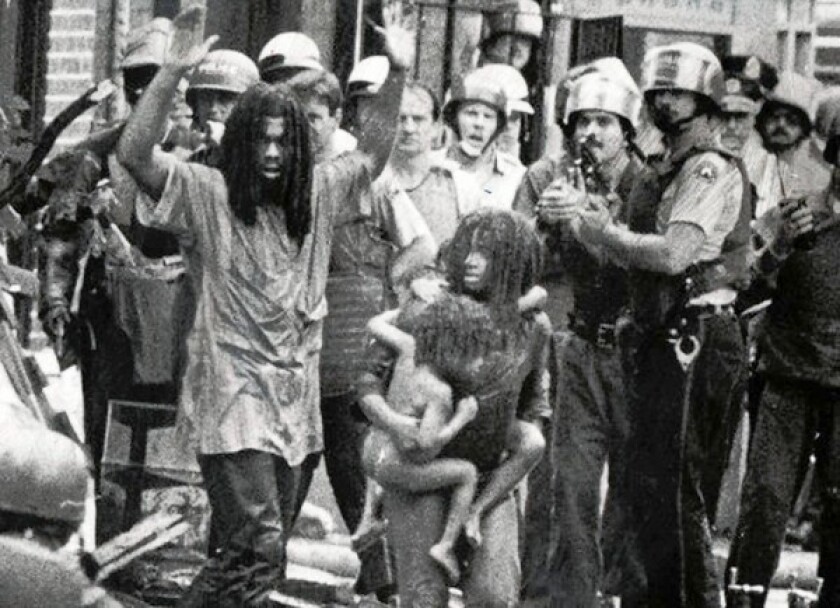
Let the Fire Burn(2013)– While obscured in public memory by the (relatively) more “recent” 1993 Branch Davidian siege in Waco, the eerily similar demise of the Philadelphia-based MOVE organization 8 years earlier was no less tragic on a human level, nor any less disconcerting in its ominous sociopolitical implications.
In this compelling documentary, director Jason Osder has parsed a trove of archival “live-at-the-scene” TV reports, deposition videos, law enforcement surveillance footage, and other sundry “found” footage (much of it previously unseen by the general public) and created a tight narrative that plays like an edge-of-your-seat political thriller.
Let the Fire Burn is not only an essential document of an American tragedy, but a cautionary tale and vital reminder of how far we have yet to go to completely purge the vestiges of institutional racism in this country. (Full review)
The Trials of Muhammad Ali (2013)– There have been a number of films documenting and dramatizing the extraordinary life of Muhammad Ali, but they all share a curious anomaly. Most have tended to gloss over Ali’s politically volatile “exile years” (1967-1970), during which the American sports icon was officially stripped of his heavyweight crown and essentially “banned” from professional boxing after his very public refusal to be inducted into the Army on the grounds of conscientious objection to the Vietnam War.
Director Bill Siegel (The Weather Underground) fills in those blanks in his documentary. As you watch the film, you begin to understand how Ali the sports icon transmogrified into an influential sociopolitical figure, even if he didn’t set out to become the latter. It was more an accident of history; Ali’s affiliation with the Nation of Islam and stance against the Vietnam War put him at the confluence of both the burgeoning Black Power and anti-war movements. How it all transpired makes an absorbing watch. (Full review)
It seems like a good time to re-post this one. Ocean waves, Bob. -D.H.
(Originally posted on Digby’s Hullabaloo on February 4, 2023)
Dee: Jane, do you ever feel like you are just this far from being completely hysterical twenty-four hours a day?
Jane: Half the people I know feel that way. The lucky ones feel that way. The rest of the people ARE hysterical twenty-four hours a day.
— from Grand Canyon, screenplay by Lawrence and Meg Kasdan
HAL 9000: Look Dave, I can see you’re really upset about this. I honestly think you ought to sit down calmly, take a stress pill, and think things over.
— from 2001: A Space Odyssey, screenplay by Stanley Kubrick and Arthur C. Clarke
George Fields: [to Dorothy/Michael] I BEGGED you to get therapy!
— from Tootsie, screenplay by Murray Schisgal
As if the mid-winter blues weren’t enough, there’s been an odd confluence of celestial events recently – a close encounter with a hurtling asteroid, an eerie green comet lighting up the night skies, and the mysterious appearance of a high altitude “spy balloon” the size of three metro buses that has the conspiracy nuts twisting themselves into pretzels. Not that I believe in heavenly portents, but I am feeling the need for some “cinema therapy” right about now.
With that in mind, here are 12 films I’ve watched an unhealthy number of times; the ones I’m most likely to reach for when I’m depressed, anxious, uncertain about the future…or all the above. These films, like my oldest and dearest friends, have never, ever let me down. Take one or two before bedtime; cocktail optional.
Black Orpheus – Marcel Camus directed this mesmerizing 1959 film, a modern spin on a classic Greek myth. Fueled by the pulsing rhythms of Rio’s Carnaval and tempered by the gentle sway of Luiz Bonfa and Antonio Carlos Jobim’s samba soundtrack, Black Orpheus fully engages the senses. Camus and Jacques Viot adapted the screenplay from the play by Vinicius de Moraes.
Handsome tram operator Orfeo (Breno Mello) is engaged to vivacious Mira (Lourdes de Olivera) but gets hit by the thunderbolt when he meets sweet, innocent Eurydice (Marpessa Dawn). As in most romantic triangles, things get complicated, especially when Mr. Death (Ademar da Silva) starts lurking about the place.
You may be scratching your head as to why I’m “comforted” by a story based on a Greek tragedy; but Black Orpheus is graced by one of the most beautiful, life-affirming denouements in cinema; which always assures me that everything is going to be alright.
The Dish – This 2000 Australian sleeper dramatizes the story behind the live televised images of Neil Armstrong setting foot on the moon in 1969. The worldwide broadcast was facilitated by a tracking station located on a sheep farm in New South Wales.
Quirky characters abound in Rob Sitch’s culture-clash comedy (reminiscent of Bill Forsyth’s Local Hero). It’s not all played for yucks; the re-enactment of the telecast is genuinely stirring. Sam Neill heads a fine cast. Director Sitch and co-writers Santo Cilauro, Tom Gleisner, and Jane Kennedy also collaborated on the charming 1997 dramedy The Castle (recommended!).
Diva – Jean-Jacques Beineix’s 1981 cult fave kicked off a sub-genre labelled Cinéma du look (e.g. Beineix’s Betty Blue, and Luc Besson’s Subway, La Femme Nikita, and Leon the Professional).
Our unlikely antihero is mild-mannered postman Jules (Frédéric Andréi), a 20-something opera fan obsessed with a Garbo-like diva (American soprano Wilhelmenia Wiggins Fernandez). She has never recorded a studio album and stipulates that her live performances are never to be taped and/or reproduced in any medium.
An enraptured Jules attends one of her concerts and makes a high-quality recording, for his own edification. By pure chance, a pair of nefarious underworld characters witness Jules bootlegging the concert, sparking a chain of events that turns his life upside down.
Diva is an entertaining pop-art mélange of neo-noir, action-thriller, and comic-book fantasy. Chockablock with quirky characters, from a pair of hipster hit men (Gérard Darmon and Dominique Pinon) to a Zen-like international man of mystery named Gorodish (Richard Bohringer) who is currently “going through his cool period” as his girlfriend (Thuy Ann Luu) confides to Jules. Slick, stylish and thoroughly engaging.
A Hard Day’s Night – This 1964 masterpiece has been often copied, but never equaled. Shot in a semi-documentary style, the film follows a “day in the life” of John, Paul, George and Ringo at the height of their youthful exuberance and charismatic powers. Thanks to the wonderfully inventive direction of Richard Lester and Alun Owen’s clever script, the essence of what made the Beatles “the Beatles” has been captured for posterity.
Although it’s meticulously constructed, Lester’s film has an improvisational feel; and feels as fresh and innovative as when it first hit theaters all those years ago. I still catch subtle gags that surprise me (like John snorting the Coke bottle). Music highlights: “I Should Have Known Better”, “All My Loving”, “Don’t Bother Me”, “Can’t Buy Me Love”, and the fab title song.
Harold and Maude – Harold loves Maude. And Maude loves Harold. It’s a match made in heaven-if only society would agree. Because Harold (Bud Cort) is a teenager, and Maude (Ruth Gordon) is just shy of 80. Falling in love with a woman old enough to be his great-grandmother is the least of Harold’s quirks. He’s a chronically depressed trustafarian who amuses himself by staging fake suicides to freak out his patrician mother (wonderfully droll Vivian Pickles). He also “enjoys” funerals-which is where Harold and Maude Meet Cute.
The effervescent Maude is Harold’s polar opposite; while he wallows in morbid speculation how any day could be your last, she seizes each day as if it actually were. Obviously, she has something to teach him. Despite dark undertones, this is one “midnight movie” that manages to be life-affirming. Hal Ashby directed, and Colin Higgins (who would later write and direct Foul Play and 9 to 5) wrote the screenplay. Outstanding soundtrack by Cat Stevens.
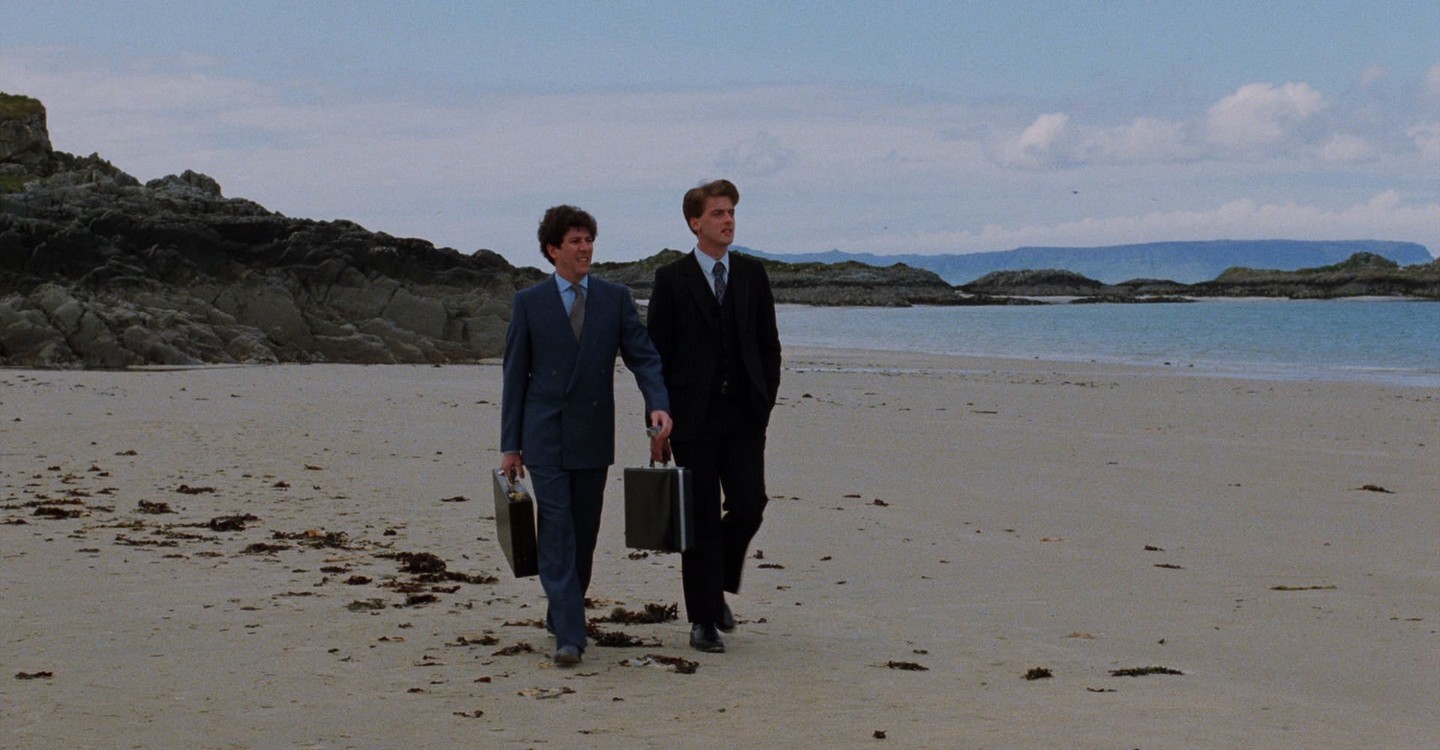
Local Hero – This low-key, observant 1983 social satire from Scottish writer-director Bill Forsyth stars Peter Reigert as Macintyre, a Texas-based executive who is assigned by the head of “Knox Oil & Gas” (Burt Lancaster) to scope out a sleepy Scottish hamlet that sits on an oil-rich bay. He is to negotiate with local property owners and essentially buy out the town so that the company can build a huge refinery.
While he considers himself “more of a Telex man”, who would prefer to knock out such an assignment “in an afternoon”, Mac sees the overseas trip as a possible fast track for a promotion within the corporation. As this quintessential 80s Yuppie works to ingratiate himself with the unhurried locals, a “fish out of water” transformation ensues. It’s the kindest and gentlest Ugly American tale you’ll ever see.
Man on the Train – There are a only a handful of films I have become emotionally attached to, usually for reasons I can’t completely fathom. This 2002 drama is one of them. Best described as an “existential noir”, Patrice LeConte’s relatively simple tale of two men in their twilight years with disparate life paths (a retired poetry teacher and a career felon) forming an unexpected deep bond turns into a transcendent film experience. French pop star Johnny Hallyday and screen veteran Jean Rochefort deliver mesmerizing performances. I feel an urge to watch it right now.
My Neighbor Totoro – While this 1988 film was anime master’s Hayao Miyazaki’s fourth feature, it was one of his (and Studio Ghibli’s) first international hits.
It’s a lovely tale about a young professor and his two daughters settling into their new country house while Mom convalesces at a nearby hospital. The rambunctious 4 year-old goes exploring and stumbles into the verdant court of a “king” nestled within the roots of a gargantuan camphor tree. This king rules with a gentle hand; a benign forest spirit named Totoro (an amalgam of every plush toy you ever cuddled with as a child).
Granted, it’s Miyazaki’s most simplistic and kid-friendly tale…but that’s not a put down. Miyazaki’s usual themes remain intact; the animation is breathtaking, the fantasy elements magical, yet the human characters are down-to-earth and universally relatable. A charmer.
Sherman’s March – Filmmaker Ross McElwee is one of America’s hidden treasures. McElwee, a genteel Southern neurotic (Woody Allen meets Tennessee Williams) has been compulsively documenting his personal life since the mid 70’s and managed to turn the footage into some of the most hilarious, moving and thought-provoking films most people have never seen.
Audiences weaned on “reality TV” may wonder “what’s the big deal about one more schmuck making glorified home movies?” but they would be missing an enriching glimpse into the human condition. Sherman’s March began as a project to retrace the Union general’s path of destruction through the South, but ended up as rumination on the eternal human quest for love and acceptance, filtered through McElwee’s search for the perfect mate.
Despite its 3 hour length, I’ve found myself returning to this film for repeat viewings, and enjoying it just as much as the first time. The unofficial “sequel”, Time Indefinite, is also worth a peek.
The Thin Man – W.S. Van Dyke’s delightful mix of screwball comedy and murder mystery (adapted from Dashiell Hammett’s novel by Albert Hackett and Frances Goodrich) never gets old for me. Story takes a backseat to the repartee between private investigator (and perpetually tipsy socialite) Nick Charles (William Powell) and his wisecracking wife Nora (sexy Myrna Loy). Top it off with a scene-stealing wire fox terrier (Asta!) and you’ve got a winning formula that has spawned countless imitations; particularly a bevy of sleuthing TV couples (Hart to Hart, McMillan and Wife, Moonlighting, Remington Steele, et.al.).
True Stories – Musician/raconteur David Byrne enters the Lone Star state of mind with his subtly satirical Texas travelogue from 1986. Not easy to pigeonhole; part social satire, long-form music video, and mockumentary. The vignettes about the quirky but generally likable inhabitants of sleepy Virgil, Texas should hold your fascination once you buy into “tour-guide” Byrne’s bemused anthropological detachment. Among the town’s residents: John Goodman, “Pops” Staples, Swoosie Kurtz and the late Spalding Gray. The outstanding cinematography is by Edward Lachman. Byrne’s fellow Heads have cameos performing “Wild Wild Life”.
Wings of Desire – I’ve never attempted to compile a Top 10 list of my all-time favorite films (I’ve just seen too many damn movies…I’d be staring at an empty page for weeks, if my head didn’t explode first) but I’m certain Wim Wenders’ 1987 stunner would be a shoo-in. Now, attempting to describe this film is something else altogether.
If I told you it’s about an angel (Bruno Ganz) who hovers over Berlin in a trench coat, monitoring people’s thoughts and taking notes, who spots a beautiful trapeze artist (Solveig Dommartin) and follows her home, wallows in her deepest longings, watches her undress, then falls in love and decides to chuck the mantle of immortality and become human…you’d probably say “That sounds like a story about a creepy stalker.” And if I told you it features Peter Falk, playing himself, you’d laugh nervously and say, “Oh, look at the time.” Of course, there is more to it-about life, the universe, and everything.
BONUS!
If you really want to go all out for movie night (which is pretty much every night for me), you have to watch a cartoon before the movie, right? Here’s my 2011 review of a Blu-ray box set always guaranteed to lift your spirits. Keep it handy, right next to the first aid kit.
The Looney Tunes Platinum Collection, Vol. 1– During those long, dark nights of my soul, when all seems hopeless and futile, there’s one thought that never fails to bring me back to the light. It’s that feeling that somewhere, out there in the ether, there’s a frog, with a top hat and a cane, waiting for his chance to pop out of a box and sing:
Hello my baby, hello my honey, hello my ragtime gal
Send me a kiss by wire, baby my heart’s on fire…
If you don’t know what I’m talking about, just go ahead and skip to the next review now.
The rest of you might want to check out this fabulous 3-disc collection, which features 50 classic animated shorts (and 18 rarities) from the Warner Brothers vaults. Deep catalog Looney Tunes geeks may quibble until the cows come home about what’s not here (Warner has previously released six similar DVD collections in standard definition), but for the casual fans (like yours truly) there is plenty to please. I’m just happy to have “One Froggy Evening”, “I Love to Singa”, “Rabbit of Seville”, “Duck Amuck”, “Leghorn Lovelorn”, “Three Little Bops” and “What’s Opera Doc?” in one place. The selections cover all eras, from the 1940s onward.
One thing that does become clear, as you watch these restored gems in gorgeous hi-def (especially those from the pre-TV era) is that these are not “cartoons”, they are 7 ½ minute films, every bit as artful as anything else cinema has to offer. Extras include a trio of excellent documentaries about the studio’s star director, the legendary Chuck Jones. The real diamond among the rarities is The Dot and the Line: A Romance in Lower Mathematics (directed by Jones for MGM), which won the 1965 Oscar for Best Animated Short Film.
For those of us of “a certain age”, that is to say, old enough to have actually witnessed the moon landing live on TV… the fact that “we” were even able to achieve this feat “by the end of the decade” (as President Kennedy projected in 1961) still feels like a pretty big deal to me.
Of course, there are still big unanswered questions out there about Life, the Universe, and Everything, but I’ll leave that to future generations. I feel that I’ve done my part…spending my formative years plunked in front of a B&W TV in my PJs eating Sugar Smacks and watching Walter Cronkite reporting live from the Cape.
Those particular memories resurfaced recently as I watched Richard Linklater’s charming 2022 animated memoir Apollo 10 1/2: A Space Age Childhood, which I stumbled across on Netflix:
Of course, 10 year-old Linklater didn’t land on the moon and return safely to the Earth just ahead of Neil Armstrong and Buzz Aldrin; that’s the fantasy part of his tale. It was the earthbound elements of his narrative that triggered an emotional sense memory of being a kid again, living in suburbia in 1969 (and watching the moon landing on a boxy black and white television set). I guess what I’m trying to say is that I was imprinted at an early age by the comforting visage of Walter Cronkite delivering the nightly news, long before I could intellectualize what “journalistic integrity” meant-or how important it was.
While Cronkite’s name is synonymous with “CBS news”, he was just part of a pantheon that includes Edward R. Murrow, Douglas Edwards, Mike Wallace, Dan Rather, Eric Sevareid, Harry Reasoner, Katie Couric, Connie Chung, Morley Safer, Marlene Sanders, et. al. For decades, CBS News was held in the highest regard; a trusted and reliable source for both straight-up reporting and hard-hitting investigative journalism.
You may have noticed by now that I am speaking in the past tense:
As part of a promotional rollout ahead of taking up the legendary CBS Evening News anchor chair, Tony Dokoupil posted a video message this week where he claimed that legacy media has ignored the views of the “average American.”
Meanwhile, CBS News’ editor-in-chief Bari Weiss is scoping out a private jet and a troop of armed guards to facilitate her participation in a multi-million dollar tour of the country.
The co-host of CBS Mornings since 2019, Dokoupil was officially named the new face of CBS Evening News last month, replacing the short-lived co-anchor team of John Dickerson and Maurice DuBois. His tenure is set to begin Monday. Dokoupil’s promotion came after Weiss failed to poach a big name from another network to headline the ratings-challenged nightly news program.
In an effort to make a splash and gain some publicity for his debut, the network is sending Dokoupil out on a 10-city “Live From America” cross-country kickoff tour during his first two weeks in the chair. Throughout his swing through the nation, CBS Evening News will broadcast from cities such as Miami, Dallas, Detroit, Cincinnati before wrapping things up in Pittsburgh.
According to three sources with knowledge of the matter, Weiss is planning on chartering a private plane to fly to each location for the “Live From America” tour this month. Besides taking Dokoupil and CBS Evening News executive producer Kim Harvey on the flights, Weiss’ personal security detail of five armed bodyguards will also be on board.
The increased involvement from Weiss on the CBS Evening News reboot in recent days has raised eyebrows over her desire to be on location for each telecast.
That potential additional expense comes after the news network laid off roughly 100 employees and is preparing for more crippling cost cuts from owner David Ellison and Paramount. It also seems to fly in the face of Dokoupil’s anti-elite mission statement for the show, according to sources who spoke to The Independent.
“Nothing says ‘meeting Americans where they are’ by flying around the country on a private jet costing millions of dollars,” one network staffer said. […]
This latest flareup within CBS News comes less than two weeks after Weiss came under fire for the 11th-hour spike of a 60 Minutes story that was critical of President Donald Trump’s administration, sparking a possible “revolt” among the show’s staff.
Since her arrival at the network three months ago, the self-described “radical centrist” – with minimal broadcast news experience – Weiss has drawn criticism from staff and media observers alike over many of her editorial decisions, which many have claimed is part of the new corporate ownership’s efforts to push CBS News in a “MAGA-friendly” direction.
Uncle Walter is spinning. Frankly, I’m glad he’s not here to see social media posts like this:
Or this…
Weasel words? I guess they’ll get back to us on that. There’s more:
…and finally [cue the fife and drum corps]…
Oh, I think I know where we are going here.
And that’s the way it is. All that in mind, I thought I would re-post this piece. Courage.
Breaking News: 10 Docs for World Press Freedom Day
(Originally posted on Digby’s Hullabaloo on May 3, 2025)
This just in: Today is World Press Freedom Day. Say what? (via the United Nations website)
World Press Freedom Day was proclaimed by the UN General Assembly in December 1993, following the recommendation of UNESCO’s General Conference. Since then, 3 May, the anniversary of the Declaration of Windhoek is celebrated worldwide as World Press Freedom Day.
After 30 years, the historic connection made between the freedom to seek, impart and receive information and the public good remains as relevant as it was at the time of its signing. Special commemorations of the 30th anniversary are planned to take place during World Press Freedom Day International Conference.
May 3 acts as a reminder to governments of the need to respect their commitment to press freedom. It is also a day of reflection among media professionals about issues of press freedom and professional ethics. It is an opportunity to:
celebrate the fundamental principles of press freedom;
assess the state of press freedom throughout the world;
defend the media from attacks on their independence;
and pay tribute to journalists who have lost their lives in the line of duty.
If you’re a regular reader around these parts, I’m sure you’d concur that it couldn’t come a day too soon. Via Amnesty International:
Around the world, journalists are being silenced, jailed, and disappeared—simply for doing their jobs. From Guatemala to Hong Kong, Russia to Tunisia, governments are increasingly weaponizing vague laws, judicial systems, and the use of force to suppress the truth.
These attacks on the press are not isolated incidents; they are deliberate strategies to dismantle the very foundations of human rights. The erosion of press freedom is a warning sign—one that signals a broader slide toward authoritarian practices, including in the United States, where attacks against the media grow more hostile by the day. […]
President Trump is attacking the freedom of the press, including hand-picking which outlets can cover the White House and demonizing reporters. Before becoming president, he sued media outlets CBS News and the Des Moines Register for publishing something he didn’t agree with. He’s barred the AP from covering events at the White House because he disagreed with an editorial decision to use “Gulf of Mexico” instead of “Gulf of America.” He’s called on outlets to fire specific reporters for coverage that doesn’t paint him in the light he wants and has quipped that he’d jail reporters opens in a new tab as retribution for unfavorable coverage. In addition to dismantling Voice of America, he’s supported slashing funding for outlets like NPR and PBS.
What’s more, while President Trump is attacking freedom of the press and journalistic integrity, social media companies, including Meta and Elon Musk’s X, have been granted unprecedented access to the White House, have dismantled fact-checking programs on their platforms, contributing to the spread of disinformation, especially with such a high percentage of Americans getting their news from social media platforms.
To scrutinize and ultimately hold political leaders accountable, the press must have the freedom to report independent news without being blocked from access, punished, or intimidated. The government must respect and protect free and independent media and maximize transparency and access to information.
We are only 100 days into the new administration…so please join me in raising a glass to intrepid journalists everywhere who continue to speak truth to power, and do what you can to support their work. And for your perusal, I’ve combed my review archives and selected 10 documentaries that embody the spirit of World Press Freedom Day:
#Chicago Girl: The Social Network Takes on a Dictator – Not long ago, the MSM relegated social media to kickers about flash mobs, or grandpa’s first tweet. Then, the Arab Spring happened, precipitating the rise of the citizen journalist. Case in point: 19 year-old Ala’a Basatneh, subject of Joe Piscatella’s doc. The Damascus-born Chicagoan is a key player in the Syrian revolution, as in “key stroke”. It’s not just about Ala’a, but her compatriots in Syria, some who’ve made the ultimate sacrifice. Timely and moving. (Available on Google Play)
Cartoonists: Foot Soldiers of Democracy? – French filmmaker Stephanie Valloatto’s globetrotting documentary profiles a dozen men and women who make their living drawing funny pictures about current events. I know what you’re thinking…beats digging ditches, right? Well, that depends. Some of these political cartoonists ply their trade under regimes that could be digging a “special” ditch, reserved just for them (if you know what I’m saying).
The film can be confusing; in her attempt to give all 12 subjects equal face time, Valloatto’s frequent cross-cutting can make you lose track of which country you’re in (it’s mostly interior shots). That aside, she gets to the heart of what democracy is all about: speaking truth to power. It’s also timely; in one scene, an interviewee says, “Like a schoolchild, I told myself: I shouldn’t draw Muhammad.” Then, holding up a sketch of you-know-who, he concludes: “Drawing is the correct answer to the forbidden.”
Forbidden Voices – Swiss director Barbara Miller’s excellent doc profiles three influential “cyber-feminists” who bravely soldier on in the blogosphere whilst running a daily gauntlet of intimidation from their respective governments, including (but not limited to) overt surveillance, petty legal harassment and even physical beatings. Despite the odds, Yoani Sanchez (Cuba), Farnez Seifi (Iran, currently exiled in Germany) and Zeng Jinyan (China) are affecting change (if only baby steps). (Available on kanopy)
Gonzo: The Life and Work of Hunter S. Thompson – Director Alex Gibney takes an approach as scattershot and unpredictable as his subject; using a frenetic pastiche of talking heads, vintage home movies, film clips, animation, audio tapes and snippets of prose (voiced by Johnny Depp, who has become to Thompson what Hal Holbrook is to Mark Twain). This is not a hagiography; several ex-wives and associates make no bones about reminding us that the man could be a real asshole. On the other hand, examples of his genuine humanity and idealism are brought to the fore as well, making for an insightful and fairly balanced overview of this “Dr. Gonzo and Mr. Thompson” dichotomy. What the director does not forget is that, at the end of the day, HST was the most unique American political commentator/ social observer who ever sat down to peck at a bullet-riddled typewriter. (Full review) (Available on various streaming platforms)
Hacking Hate – Move over, Lisbeth Salandar…there’s a new hacker in town, and she’s stirring up a hornet’s nest of wingnuts. Simon Klose’s timely documentary follows award-winning Swedish journalist My Vingren as she meticulously constructs a fake online profile, posing as a male white supremacist. Her goal is to smoke out a possible key influencer and glean how he and others fit into right-wing extremist recruiting.
Vingren is like a one-woman Interpol; her investigation soon points her to U.S.-based extremist networks as well, leading her to consult with whistle-blower Anika Collier Navaroli (the former Twitter employee who was instrumental in getting Trump booted off the platform) and Imrab Ahmed (another one of Elon Musk’s least-favorite people, he was sued by the X CEO for exposing the rampant hate speech on the platform).
This isn’t a video game; considering the inherently belligerent nature of the extremist culture she is exposing, Vingren is taking considerable personal risk in this type of investigative journalism (she’s much braver than I am). Especially chilling is the shadowy figure at the center of her investigation, who is like a character taken straight out of a Frederick Forsyth novel.
Hugh Hefner: Playboy, Activist, and Rebel – Did you know Ray Bradbury was only paid $400 for the original serialized version of Fahrenheit 451 published in Playboy in 1954? That’s one of the interesting tidbits I picked up from this lengthy yet absorbing documentary about the iconoclastic founder and publisher of the magazine that I, personally, have always read strictly for the articles (of clothing that were conspicuously absent-no, I’m kidding). Seriously-there’s little of prurient interest here. In a manner of speaking, it’s mostly about “the articles”.
Brigitte Berman (director of the excellent 1985 documentary Artie Shaw: Time is All You’ve Got) interweaves well-selected archival footage and present day interviews with Hefner and friends (as well as some of his detractors) to paint a fascinating portrait. Whether you admire him or revile him, as you watch the film you come to realize that there is probably no other public figure of the past 50 years who has so cannily tapped in to or (perhaps arguably) so directly influenced the sexual, social, political and pop-cultural zeitgeist of liberated free-thinkers everywhere.
I Am Not Your Negro – The late writer and social observer James Baldwin once said that “Whatever white people do not know about Negroes reveals, precisely and inexorably, what they do not know about themselves.” Sadly, thanks to the emboldening of certain elements within American society that have been drawn from the shadows by the openly racist rhetoric spouted by the Current Occupant of the White House, truer words have never been spoken.
Indeed, anyone who watches Raoul Peck’s documentary will recognize not only the beauty of Baldwin’s prose, but the prescience of such observations. Both are on display in Peck’s timely treatise on race relations in America, in which he mixes archival news footage, movie clips, and excerpts from Baldwin’s TV appearances with narration by an uncharacteristically subdued Samuel L. Jackson, reading excerpts from Baldwin’s unfinished book, Remember This House. An excellent and enlightening film. (Full review) (Available on various streaming platforms)
Like a Rolling Stone: The Life and Times of Ben Fong-Torres – Nothing against Ben Fong-Torres, but I approached this film with trepidation. “Please, god,” I thought to myself, “Don’t let ‘Fortunate Son’ be on the soundtrack.” Thankfully, there’s credence, but no Creedence in Suzanne Joe Kai’s documentary, which despite the implications of its title is not another wallow in the era when being on the cover of the Rolling Stone mattered, man.
OK, there is some of that; after all, journalist and author Ben Fong-Torres’ venerable career began when he first wrote for Rolling Stone in 1968. By the following year he was hired as the editor and wrote many of the cover stories. Fong-Torres quickly showed himself to be not only an excellent interviewer, but a gifted writer. His journalistic approach was the antithesis to the gonzo stylists like Lester Bangs and Hunter Thompson in that his pieces were never about him, yet still eminently personal and relatable.
Just like her subject, Kai’s portrait is multi-faceted, revealing aspects of Fong-Torres’ life outside of his profession I was not aware of (like his activism in the Asian-American community, and how it was borne of a heartbreaking family tragedy). (Available on Netflix and Prime Video)
Raise Hell: The Life and Times of Molly Ivins – Janice Engel profiles the late, great political columnist and liberal icon Molly Ivins, who suffered no fools gladly on either side of the aisle. Engel digs beneath Ivins’ bigger-than-life public personae, revealing an individual who grew up in red state Texas as a shy outsider.
Self-conscious about her physicality (towering over her classmates at 6 feet by age 12), she learned how to neutralize the inevitable teasing with her fierce intelligence and wit (I find interesting parallels with Janis Joplin’s formative Texas years). Her political awakening also came early (to the chagrin of her conservative oilman father).
The archival clips of Ivins imparting her incomparable wit and wisdom are gold; although I was left wishing Engel had included more (and I am dying to know what Ivins would say about you-know-who). (Available on various streaming platforms)
Rather – Few journalists have had such a long and storied career as Dan Rather; long enough for several generations to claim their own reference point. At the risk of eliciting an eye-rolling “OK Boomer” from some quarters, mine is “I think we’re dealing with a bunch of thugs here, Dan!” (others of “a certain age” will recall that as Walter Cronkite’s reaction to watching his colleague getting roughed up by security on live TV while reporting from the floor of the 1968 Democratic National Convention). For Gen Xers, he’s the inspiration for R.E.M.’s “What’s the Frequency Kenneth?”, which is what a pair of assailants repeatedly asked Rather during a 1986 attack in New York. To Millennials, he’s a wry and wise nonagenarian with over 2 million Twitter followers.
As evidenced in Frank Marshall’s documentary, the secret to Rather’s longevity may be his ability to take a punch (literally or figuratively) and get right up with integrity intact. All the career highlights are checked, from Rather’s early days as a reporter in Dallas (where he came to national prominence covering the JFK assassination) to overseas reporting for CBS from the mid-to-late 60s (most notably in Vietnam), to taking over the coveted CBS Evening News anchor chair vacated by Cronkite in 1981, and onward. An inspiring warts-and-all portrait of a dogged truth-teller who is truly a national treasure. (Available on Netflix and Prime Video)