Tag Archives: On Pop Culture

Accept the obvious: R.I.P. Dick Gregory

By Dennis Hartley

https://variety.com/wp-content/uploads/2017/08/civil-rights-activist-dick-gregory.jpg?w=1000

“The most difficult thing to get people to do is to accept the obvious.”

-Dick Gregory

Man, did Dick Gregory pick a bad weekend to go. With the passing of Jerry Lewis and eclipse mania building to a fever pitch, his death in Washington D.C. this past Saturday earned him but a few perfunctory thirty second obits on network and cable newscasts.

Truth be told, Gregory was not so much a “comedian” who went out of his way to make you laugh as he was a righteous, erudite truth teller, who also happened to be very funny.  He was a trickster of a sort;  he would lower your guard with a perfect zinger, then seconds later he would raise your consciousness with a sharp social insight.

“Last time I was down South I walked into this restaurant, and this white waitress came up to me and said, ‘We don’t serve colored people here.’  I said: ‘that’s all right, I don’t eat colored people. Bring me a whole fried chicken.’ “

-Dick Gregory

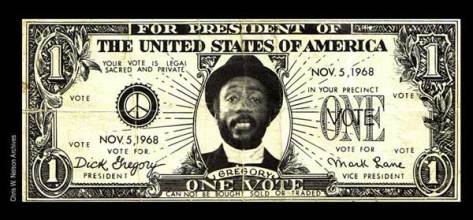
https://sundayisforlovers.files.wordpress.com/2012/04/dick-gregory-dollar-printed.jpg

When it came to his political activism, he didn’t just talk the talk:

[From The Los Angeles Times]

An invitation from civil rights leader Medgar Evers to speak at voter registration rallies in Jackson, Miss., in 1962 launched Gregory into what he called “the civil rights fight.”

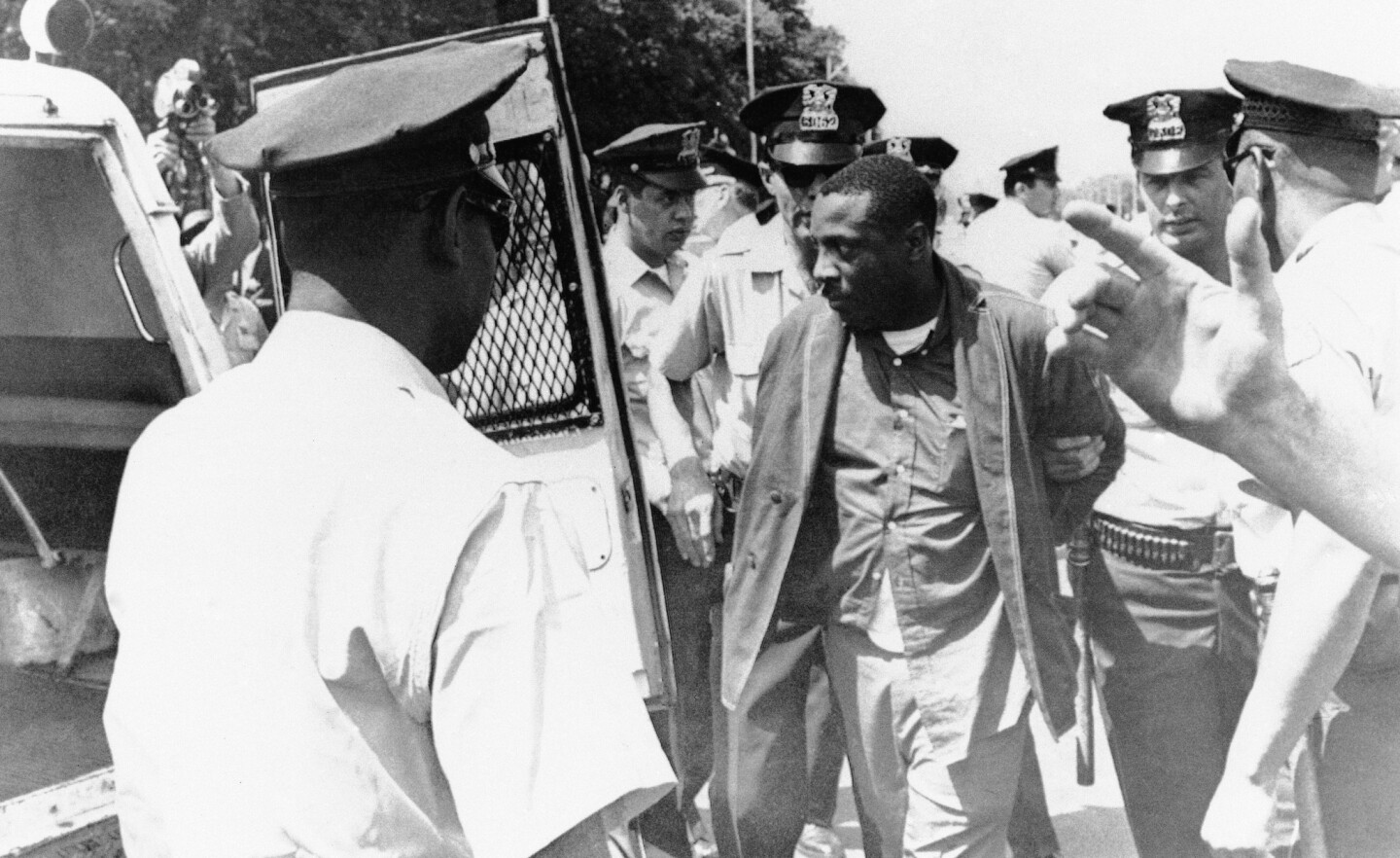
He was frequently arrested for his activities in the ’60s, and once spent five days in jail in Birmingham, Ala. after joining demonstrators in 1963 at the request of the Rev. Martin Luther King Jr.

Gregory, who was shot in the leg while trying to help defuse the Watts riots in 1965, made a failed run for mayor of Chicago as a write-in candidate in 1967. A year later, he ran for president as a write-in candidate for the Freedom and Peace Party, a splinter group of the Peace and Freedom Party. Hunter S. Thompson was one of his most vocal supporters.

In the late ’60s, he began going on 40-day fasts to protest the Vietnam War.

In 1980, impatient with President Carter’s handling of the Iranian hostage crisis, he flew to Iran and began a fast, had a “ceremonial visit” with revolutionary leader Ayatollah Ruhollah Khomeini and met with the revolutionary students inside the embassy. After four and a half months in Iran, his weight down to 106 pounds, he returned home.

Not exactly your everday “ha-ha funny” type of clown, was he?

https://ca-times.brightspotcdn.com/dims4/default/aef570f/2147483647/strip/true/crop/2048x1255+0+0/resize/1440x882!/quality/90/?url=https%3A%2F%2Fcalifornia-times-brightspot.s3.amazonaws.com%2Fec%2F9b%2Fa02ba35c9c33cb4f2c449a8110c8%2Fla-me-dick-gregory-photos-20170819-004

His activism never stopped. From today’s Democracy Now tribute (I’d recommend watching the entire tribute-its quite moving)…

Gregory became one of the most popular comedians in the country, paving the way for generations of African-American comedians. On Sunday Chris Rock wrote on Instagram, “We lost a king. They’ll never be another. Read his books. Look him up you won’t be disappointed. Unfortunately the America that produced Dick Gregory still exists.” Dick Gregory was the first African-American comedian to sit on the couch of The Tonight Show, then hosted by Jack Parr. As his popularity grew, so did his activism.

[…]

More recently, his face appeared in newspapers across the country for his community action to — approach to investigate allegations behind the CIA’s connection with drugs in the African American community. He camped out in dealer-ridden public parks and rallied community leaders to shut down head shops. He protested at CIA headquarters and was arrested. Throughout his life, Dick Gregory has been a target of FBI and police surveillance. And he was virtually banned from the entertainment arena for his political activism.

The last sentence above  explains in part (sadly) why, despite his long career, you’ll find virtually no Dick Gregory performance clips on YouTube. That’s because he has essentially been blacklisted for years; there are very few archived TV or club appearances that exist.

Here’s a little taste of his early standup days:

Here’s a rare latter-day television appearance, on Arsenio in 2014:

There’s a lot of truth-telling going on in that interview. Interesting to note that Arsenio Hall’s “revival” run (that started in 2013)  was cancelled soon after (file under “Things That Make You Go: ‘Hmm.'”)

“To me, seeing a great comedian is a bit like watching a musician or a poet.”

-Dick Gregory

Accept the obvious:  America’s conscience has lost its Poet Laureate. R.I.P.

The day the clowns cried: R.I.P. Jerry Lewis

By Dennis Hartley

http://assets.nydailynews.com/polopoly_fs/1.2679537.1466348974!/img/httpImage/image.jpg_gen/derivatives/article_750/arp2336340.jpg

“Jerry Lewis is never just OK or adequate; he’s either very funny or he’s awful.”  – Jerry Lewis, commenting on his film oeuvre.

Yes, I used “Jerry Lewis” and “oeuvre” in the same sentence. “Ouevre” is a fancy French word that means “Hey, LAAY-DEE!”

I’m kidding. Mirriam-Webster defines  it as “…a substantial body of work constituting the life work of a writer, an artist, or a composer.”

Jerry Lewis, who died this morning in Las Vegas, certainly left behind a substantial body of work.  From 1949 to 2016, he acted in over 50 films; out of those he directed 23, and wrote 20 of them. And, as Lewis himself observed, some were very funny, others not so much.

Some of Lewis’ early, funnier movies include 1952’s The Stooge, 1955’s Artists and Models, 1959’s Don’t Give Up the Ship (those three co-starring his decade-long stage and screen comedy partner Dean Martin),  The Bellboy (1960), Cinderfella (1960), The Ladies Man (1961), The Nutty Professor (1963),  and The Disorderly Orderly (1964).

Martin Scorsese gave Lewis a second wind when he offered him a juicy part in his brilliant 1982 show biz satire The King of Comedy (highly recommended). It not only introduced Lewis to a new generation of fans, but allowed him to demonstrate that he had chops as a dramatic actor (when he wasn’t pulling faces, that is). Two more post-Scorsese Lewis performances worth a rental are Emir Kusturica’s 1993 off-the-wall sleeper Arizona Dream, and Peter Chelsom’s 1995 dramedy Funny Bones.

While he had continued writing, directing and starring in films through the early 70s, Lewis floundered at the box office as his particular brand of shtick went out of vogue in Hollywood. “Hollywood” is the key word here; as everyone and their grandmother knows, it was the undying admiration by the French that ultimately kept Lewis’ rep as a film maker afloat during his wilderness years (they gave him the Legion of Honor award in 1983).

Despite all the joking and ridicule spawned by France’s love affair with Jerry Lewis, they were on to something. He was, by definition, an auteur,  having written, directed and starred in so many films. A lot of people are not aware that he was also an innovator. He essentially invented the “video tap”, a signal-splitting device that attaches to a movie camera and allows the director to share the  camera operator’s view in real time, via a separate video monitor.

I am aware that Lewis’ self-appraisal as being either “very funny or awful” as an artist could apply on occasion to his off-stage life. He didn’t always think before he spoke. That noted, stepping back to look at the big picture, this was a human being who devoted well over 70 years of his long and productive life to making people laugh.

And that’s a good thing. Going up?

Guild 45th: The last picture show

By Dennis Hartley

(Originally posted on Digby’s Hullabaloo on June 17, 2017)

http://denofcinema.com/wp-content/uploads/2017/06/GUILD-45th.jpg

6/11/17: Miyazaki sky courtesy of my chintzy Android

 This is the song at the end of the movie
When the house lights go on
The people go home
The plot’s been resolved
It’s all over

 – Joan Baez

“How tall was King Kong?” asks Eli Cross (Peter O’Toole), the larger-than-life director of the film-within-the-film in Richard Rush’s 1980 black comedy, The Stunt Man. Once you discover that King Kong was but “three foot, six inches tall”, it’s clear Cross’s query is code for a bigger question: “What is reality?” Or perhaps he’s asking “What is film?” Is film a “ribbon of dreams” as Orson Welles once said?

Those are questions to ponder as you take Rush’s wild ride through the Dream Factory. Because from the moment that its protagonist, a fugitive on the run from the cops (Steve Railsback) tumbles ass over teakettle onto Mr. Cross’s set, where he is filming an art-house World War I drama, his (and our) concept of what is real and what isn’t becomes diffuse.

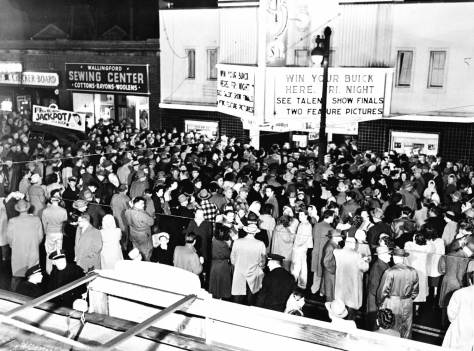
Despite lukewarm critical reception, it is now considered a classic. A 43-week run at the Guild 45th Theater in Seattle (booked by Rush himself, out of his frustration with the releasing studio’s lackluster support) is credited for building word of mouth and assuring the film’s cult status. There is symbiosis in that story (recounted in Rush’s 2000 documentary, The Sinister Saga of Making the Stunt Man); for as surely as The Stunt Man is a movie for people who love movies, the Guild is the type of “neighborhood theater” that people who love movies fall in love with.

The Guild’s buff-friendly vibe stems from the ethos established by former owner-operator Randy Finley. As Matthew Halverson writes in his 2009 Seattle Met article, “The Movie Seattle Saved”:

Randy Finley didn’t like to take chances when booking movies for the Guild 45th Theatre. He took it so seriously that during his 18 years as owner of Seattle’s Seven Gables Theatres chain, he recruited a small cadre of film-buff confidantes who would join him at screenings and then debate whether what they’d seen met Seven Gables’ standards: Could it generate compelling word of mouth? Would it get great critical support? Did they like the people behind the picture? He took a lot of pride in having run movies like “The Black Stallion” and “Harold and Maude” in his theaters when others wouldn’t. And he took even more pride in turning them into art house hits. “If you went to the Guild 45th when I was booking it,” Finley says, “you would walk out thinking you’d just seen one of the best pictures of the year—if not the best.”
https://sherrlock.files.wordpress.com/2009/03/guild-451.jpg

The Guild originally opened circa 1920; it was called The Paramount until the Seattle Theater (downtown) adapted the name in 1930. It went through several ownership changes (Finley purchased it in 1975, adding the venue to his local Seven Gables chain). In 1983, Finley added a smaller auditorium two doors down (The Guild II). In 1989, both theaters (along with the rest of the Seven Gables properties) were sold to Landmark, who have run them ever since.

That is…until this happened:

[From The Stranger Slog]

On Monday afternoon, Griffin Barchek, a rising junior at UW, headed to Wallingford to work a shift at the Guild 45th, as he had been doing roughly 30 hours a week for the past year-and-a-half. He heard the bad news before he even stepped inside. “I was the second person to get there,” Barchek said. “I was told immediately by a disgruntled co-worker outside. Then there was a sign on the counter that said ‘We’re closed for renovations.’”

Though he had no hard evidence to support the hypothesis, he believes the sign is a pipe dream. “Renovations are very unlikely,” he speculated. “It’s probably just closed for good.”

Once inside, Barchek said a representative from Landmark’s corporate office was on hand to inform him and his co-workers that both the Guild and the Seven Gables would be closed indefinitely (“for renovations”), that their services were no longer required, and that they’d all be receiving three weeks’ severance. Barchek said he earned the $15/hr minimum wage for his work as an usher, in the box office, and behind the concessions counter.

“She just kept saying ‘I’m sorry’ and kind of making a duck face,” he said of the Landmark representative. (As has been the case with all press inquiries regarding the sudden closure of these theaters, Landmark has refused to comment beyond saying they are closed for renovations.)

I was blindsided by this myself. Last Sunday, I was checking the listings, looking for something to cover for tonight’s weekly film review (preferably something/anything that didn’t involve aliens, comic book characters, or pirates), and was intrigued by Sofia Coppola’s remake of The Beguiled. Being a lazy bastard, I was happy to discover that the exclusive Seattle booking was at my neighborhood theater (the Guild 45th!), which is only a three-block walk from my apartment.

Imagine my surprise when I went to their website for show times and was greeted by this message: “The Seven Gables and Guild 45th Theaters have closed. Please stay tuned for further details on our renovation plans for each location. During the down time, we look forward to serving you at the Crest Cinema Center.” The Crest (now Landmark’s sole local venue open for business) is another great neighborhood theater, programmed with first-run films on their final stop before leaving Seattle (and at $4 for all shows, a hell of a deal). But for how long, I wonder?

It’s weird, because I drive past the Guild daily, on my way to work; and I had noticed that the marquees were blank one morning last week. I didn’t attach much significance to it at the time; while it seemed a bit odd, I just assumed that they were in the process of putting up new film titles. Also, I’ve been receiving weekly updates from the Landmark Theaters Seattle publicist for years; last week’s email indicated business as usual (advising me on upcoming bookings, available press screeners, etc.), and there was absolutely no hint that this bomb was about to drop.

Where was the “ka-boom”?! There was supposed to be an Earth-shattering “ka-boom”. Oh, well.

It would appear that the very concept of a “neighborhood theater” is quickly becoming an anachronism, and that makes me feel sad, somehow. Granted, not unlike many such “vintage” venues, the Guild had seen better days from an aesthetic viewpoint; the floors were sticky, the seats less than comfortable, and the auditorium smelled like 1953…but goddammit, it was “my” neighborhood theater, it’s ours because we found it, and now we wants it back (it’s my Precious).

My gut tells me the Guild isn’t being “renovated”, but rather headed for the fires of Mount Doom; and I suspect the culprit isn’t so much Netflix, as it is Google and Amazon. You may be shocked, shocked to learn that Seattle is experiencing a huge tech boom. Consequently, the housing market (including rentals) is tighter than I’ve ever seen it in the 25 years I’ve lived here.

The creeping signs of over-gentrification (which I first started noticing in 2015) are now reaching critical mass. Seattle’s once-distinctive neighborhoods are quickly losing their character, and mine (Wallingford) is the latest target on the urban village “up-zoning” hit list. Anti-density groups are rallying, but I see the closure of our 100 year-old theater as a harbinger of ticky-tacky big boxes.

https://s-media-cache-ak0.pinimg.com/736x/98/7b/d3/987bd3113761646ab683139acc44b903.jpg

Some of my fondest memories of the movie-going experience involve neighborhood theaters; particularly during a 3-year period of my life (1979-1982) when I was living in San Francisco. But I need to back up for a moment. I had moved to the Bay Area from Fairbanks, Alaska, which was not the ideal environment for a movie buff. At the time I moved from Fairbanks, there were only two single-screen movie theaters in town. To add insult to injury, we were usually several months behind the Lower 48 on first-run features (it took us nearly a year to even get Star Wars).

Keep in mind, there was no cable service in the market, and VCRs were a still a few years down the road. There were occasional midnight movie screenings at the University of Alaska, and the odd B-movie gem on late night TV (which we had to watch in real time, with 500 commercials to suffer through)…but that was it. Sometimes, I’d gather up a coterie of my culture vulture pals for the 260-mile drive to Anchorage, where there were more theaters for us to dip our beaks into.

Consequently, due to the lack of venues, I was reading more about movies, than watching them. I remember poring over back issues of The New Yorker at the public library, soaking up Penelope Gilliat and Pauline Kael; but it seemed requisite to  live in NYC (or L.A.) to catch all these cool art-house and foreign movies they were raving about  (most of those films just didn’t make it out up to the frozen tundra). And so it was that I “missed” a lot of 60s and 70s cinema.

Needless to say, when I moved to San Francisco, which had a plethora of fabulous neighborhood theaters in 1979, I quickly set about making up the deficit. While I had a lot of favorite haunts (The Surf, The Balboa, The Castro, and the Red Victorian loom large in my memory), there were two venerable (if a tad dodgy) downtown venues in particular where I spent an unhealthy amount of time in the dank and the dark with snoring bums who used the auditoriums as a $2 flop: The Roxie and The Strand.

That’s because they were “repertory” houses; meaning they played older films (frequently double and triple bills, usually curated by some kind of theme). That 3 years I spent in the dark was my film school; that’s how I got caught up with Francis Ford Coppola, Stanley Kubrick, Martin Scorsese, Robert Altman, Hal Ashby, Terrence Malick, Woody Allen, Sidney Lumet, Peter Bogdanovich, Werner Herzog, Ken Russell, Lindsay Anderson, Wim Wenders, Michael Ritchie, Brian De Palma, etc.

Of course, in 2017 any dweeb with an internet connection can catch up on the history of world cinema without leaving the house…which explains (in part) why these smaller movie houses are dying. But they will never know the sights, the sounds (the smells) of a cozy neighborhood dream palace; nor, for that matter, will they ever experience the awesomeness of seeing the classic films as they were originally intended to be seen-on the big screen.  Everybody should experience the magic at least once. C’mon-I’ll save you the aisle seat.

http://3.bp.blogspot.com/-MssEMGTBA_U/UJg-u30VYWI/AAAAAAAAGpQ/CGvULUWh6-I/s1600/Bogdanovich+Last+Picture+Show.JPG

She had spunk

By Dennis Hartley

http://hookedonhouses.net/wp-content/uploads/2009/06/mary-tyler-moore-opening-credits.jpg

1936-2017

Well, we almost made it all the way through the first month of 2017…but alas, another pop icon of my youth is gone. I was too young to fall in love with Mary Tyler Moore as Laura Petrie on the innovative Dick Van Dyke Show in the early 60s, but her endearing characterization of the warm, smart, and fiercely independent Mary Richards on the equally groundbreaking sitcom, The Mary Tyler Moore Show, completely captured my heart and made me a lifetime fan.

She was an admirable person off the set as well, with her dedication  to animal rights activism and as a spokesperson for juvenile diabetes.

She was a gifted comedic actor, but had more range than many people seemed willing to give her credit for. Consider this subtly played scene of underlying tension from Robert Redford’s Ordinary People:

Moore received an Oscar nom for Best Actress in 1980 for her work in that film; if you’ve never seen it I highly recommend it. That said, I’ll always be most grateful for all the laughs over the years;  her comedy chops are on full display in this classic Mary Tyler Moore Show bit:

It’s OK to laugh. Mary would consider it an insult if you didn’t. R.I.P.


The act of empathy

By Dennis Hartley

As if I didn’t already have enough reasons to admire Meryl Streep:

Wow. Truth to power, baby. In case you missed the gist:

“Thank you, Hollywood foreign press. Just to pick up on what Hugh Laurie said. You and all of us in this room, really, belong to the most vilified segments in American society right now. Think about it. Hollywood, foreigners, and the press. But who are we? And, you know, what is Hollywood anyway? It’s just a bunch of people from other places. […]

Hollywood is crawling with outsiders and foreigners. If you kick ’em all out, you’ll have nothing to watch but football and mixed martial arts, which are not the arts. They gave me three seconds to say this. An actor’s only job is to enter the lives of people who are different from us and let you feel what that feels like. And there were many, many, many powerful performances this year that did exactly that, breathtaking, passionate work.

There was one performance this year that stunned me. It sank its hooks in my heart. Not because it was good. There was nothing good about it. But it was effective and it did its job. It made its intended audience laugh and show their teeth. It was that moment when the person asking to sit in the most respected seat in our country imitated a disabled reporter, someone he outranked in privilege, power, and the capacity to fight back. It kind of broke my heart when I saw it. I still can’t get it out of my head because it wasn’t in a movie. It was real life.

And this instinct to humiliate, when it’s modeled by someone in the public platform, by someone powerful, it filters down into everybody’s life, because it kind of gives permission for other people to do the same thing. Disrespect invites disrespect. Violence incites violence. When the powerful use their position to bully others, we all lose. […]

This brings me to the press. We need the principled press to hold power to account, to call them on the carpet for every outrage.That’s why our founders enshrined the press and its freedoms in our constitution. So I only ask the famously well-heeled Hollywood Foreign Press and all of us in our community to join me in supporting the committee to protect journalists. Because we’re going to need them going forward. And they’ll need us to safeguard the truth.

[…] And we have to remind each other of the privilege and the responsibility of the act of empathy. We should all be very proud of the work Hollywood honors here tonight.

As my friend, the dear departed Princess Leia, said to me once, take your broken heart, make it into art. Thank you.”

Stay tuned for Orange Julius Caesar’s 3am Tweet storm…

*    *   *   UPDATE 1/9/17   *   *   *

Right on cue:

Your new POTUS in just 11 days, America! Sad!

Godspeed, Princess

By Dennis Hartley

http://img.cinemablend.com/cb/5/d/e/a/4/9/5dea49e85d1672067a19ae1306b8ba353e1eac91be17d09a3ee9a50c3fa7db8d.jpg

1956-2016

Can we just say that 2017 officially begins today?  Seriously, I’ve had it with you, 2016. You have more than worn out your welcome. Over.

I’ve  always felt Carrie Fisher missed her calling. Of course, she  will be forever cemented in our collective unconscious as Princess Leia; the smart, fearless, beautiful, and wisecracking heroine of the original Star Wars saga. But Carrie Fisher herself happened to be smart, fearless, beautiful, wisecracking ; a gifted comedic writer and raconteur. As we say in the business of show: she had “funny bones”.

Even if Star Wars had never been part of the equation, she would have taken her place alongside Fran Lebowitz  or Spalding Gray. If you’ve seen her autobiographical one-woman show, Wishful Drinking, you know what I’m talking about.  If not, when you’re done with your Star Wars marathon, do yourself a favor and catch it (I believe it’s still available  in HBO’s On Demand). You’ll see a Carrie Fisher who is brutally honest, self-effacing…and an absolute riot.

I bet she already has Ziggy Stardust and John Glenn in stitches. R.I.P.

Surely, he’s joking: R.I.P. Gene Wilder

By Dennis Hartley

(Originally posted on Digby’s Hullabaloo on August 29, 2016)

http://66.media.tumblr.com/bcc619518372f6c50bdc190763df05cc/tumblr_mszjorY2xo1rgetbio1_1280.jpg

I guess I must have been in shock.

When I received a text from Digby asking if I’d heard about Gene Wilder, I steeled myself and immediately queried Mr. Google. There it was. But I refused to believe it. This just couldn’t be. That’s when I began a one-sided argument with my, erm…laptop:

“Wait a minute. Gene Wilder is no longer with us? Are you saying, he is no longer with us? Is that what you’re telling me, that Gene Wilder…is no longer here? No longer here. He was here, but now, he is not? IS THAT WHAT YOU’RE TRYING TO TELL ME?!”

Goddammit.

Sorry, but people that talented, that funny, are simply not allowed to just up and leave us.

Here are several reasons why, right off the top of my head:

Rest in peace, you bloody little genius.

# # #

UPDATE:

From his family’s official statement:

The decision to wait until this time to disclose his condition wasn’t vanity, but more so that the countless young children that would smile or call out to him “there’s Willy Wonka,” would not have to be then exposed to an adult referencing illness or trouble and causing delight to travel to worry, disappointment or confusion. He simply couldn’t bear the idea of one less smile in the world.

Wow. And then there’s this, from one comedy legend to another…

50 years gone: Lenny Bruce is not afraid

By Dennis Hartley

http://cbldf.org/wp-content/uploads/2013/01/bruce3.jpg

Today is the 50th anniversary of comedian Lenny Bruce’s death.

On August 3, 1966, he was found dead in his Hollywood Hills home, from (what was ruled as) an accidental overdose of morphine.

For years following his passing, he was arguably more famous for the suffering he endured for his art, rather than the visionary nature of it.

In fact, it wasn’t until 2003, after years of lobbying  by members of the entertainment industry and free speech advocates, that New York governor George Pataki issued Bruce an official posthumous pardon for his 1964 obscenity conviction. It is worth noting that no comedians have  been jailed in America for telling jokes to roomfuls of drunks  since Bruce died (yet…I’m currently working on a review for a sobering new documentary called Can We Take a Joke? It’s an eye-opener).

Of course by now everybody has jumped on the bandwagon and acknowledges the man’s genius and the groundbreaking nature of his material. But I can’t help but wonder how Lenny would have fared in the age of social media, or in front of a modern college audience (oy).

Would today’s audiences grasp the subtlety of this bit, for example? Or would Lenny suffer a virtual lynching by an outraged Twitter mob before he could reach the end, when its true message becomes clear?

“Lenny Bruce”,  by Bob Dylan  

Lenny Bruce is dead but his ghost lived on and on
Never did get any Golden Globe award, never made it to Synanon
He was an outlaw, that’s for sure
More of an outlaw than you ever were
Lenny Bruce is gone but his spirit’s living on and on.

Maybe he had some problems, maybe some things that he couldn’t work out
But he sure was funny and he sure told the truth and he knew what he was talking about
Never robbed any churches, nor cut off any babies heads
He just took the folks in high places and he shined a light in their beds
He’s on some other shore, he didn’t want to live anymore.

Lenny Bruce is dead but he didn’t commit any crime
He just had the insight to rip off the lid before its time
I rode with him in a taxi once, only for a mile and a half
Seemed like it took a couple of months
Lenny Bruce moved on and like the ones that killed him, gone.

They say he was sick ’cause he didn’t play by the rules
He just showed the wise men of his day to be nothing more than fools
They stamped him and they labeled him like they do with pants and shirts
He fought a war on a battlefield where every victory hurts
Lenny Bruce was bad, he was the brother that you never had.

    
Related posts:
Drunk Stoned Brilliant Dead: The Story of the National Lampoon
Joan Rivers: A Piece of Work
When Comedy Went to School & a Top 5 list
Funny People
Hotel Lux
Winnebago Man