Tag Archives: 2024 Reviews

It is happening again

By Dennis Hartley

(Originally posted on Digby’s Hullabaloo on June 14, 2025)

https://i0.wp.com/digbysblog.net/wp-content/uploads/2025/06/F2TjzTtXUAA6a6s.jpg?w=720&quality=89&ssl=1

[ * sigh * ] In the wake of the 2011 assassination attempt on Congresswoman Gabby Giffords, I wrote:

Although the senseless massacre in Tucson last Saturday that snuffed out six lives and left a congresswoman gravely wounded is still too recent to fully process, I think that it is safe to say that a Pandora’s Box full of peculiarly “American” issues have tumbled out in its wake: the politics of hate, the worship of guns, and the susceptibility of mentally unstable and/or socially isolated individuals to become even more so as the culture steers more toward being “plugged-in”, rather than cultivating meaningful, face-to-face human contact. […]

This prompts a question-what is it, exactly that possesses a person to commit such an act-specifically upon a politician or similarly high-profile public figure? Political extremism? Narcissism? Insanity? One from column “a” and one from column “b”? […]

I will level with you that it’s been difficult for me to take my “job” as the resident movie critic very seriously since last weekend. I have found this event to be profoundly disturbing, and it gives me a very bad feeling about where this country is headed.

Is this the beginning of the end of the American political system as we know it, or, or we are smart enough to use this as a teachable moment, a catalyst for a new age of enlightenment? It’s up to us. And if that particular concern trumps me pretending to care about how faithful the new Green Hornet film is to the ethos of the old TV show, so be it.

I’m still waiting patiently for that “new age of enlightenment”. And once again, a shocking act of political violence has prompted me to interrupt our regularly scheduled program to bring you the following rerun.

(The following was originally posted on Hullabaloo on July 15, 2024)

Andmoreagain: The American Assassin on Film (redux)

By Dennis Hartley

(Originally posted on Digby’s Hullabaloo on July 14, 2024)

https://i0.wp.com/digbysblog.net/wp-content/uploads/2024/07/1101660812_400.webp?w=400&quality=80&ssl=1

The streets are lined with camera crews
Everywhere he goes is news
Today is different
Today is not the same
Today, I’ll make the action
Take snapshot into the light
Snapshot into the light
I’m shooting into the light

– from “Family Snapshot”, by Peter Gabriel

In the wake of the horrific 2016 Orlando nightclub massacre, I wrote:

“Now is not the time to talk about [insert gun-violence related meme here] .” We’ve heard that before; predictably, we’re hearing it again.

But there is something about this mass shooting that screams “Last call for sane discourse and positive action!” on multiple fronts. This incident is akin to a perfect Hollywood pitch, writ large by fate and circumstance; incorporating nearly every sociopolitical causality that has been quantified and/or debated over by criminologists, psychologists, legal analysts, legislators, anti-gun activists, pro-gun activists, left-wingers, right-wingers, centrists, clerics, journalists and pundits in the wake of every such incident since Charles Whitman  perched atop the clock tower at the University of Texas and picked off nearly 50 victims  (14 dead and 32 wounded) over a 90-minute period. That incident occurred in 1966; 50 years ago this August. Not an auspicious golden anniversary for our country. 50 years of this madness.  And it’s still not the appropriate time to discuss? What…too soon? […]

The [shooter’s] motivation: too early to say definitively, but history points to  a likelihood of either personal, political, ideological, or perhaps ‘all of the above’.

*sigh* As of this writing, it’s too early to know what the motives were behind yesterday’s assassination attempt that left former President Trump slightly wounded, the shooter and one rally attendee dead and two other rally attendees critically injured. But one element of the event felt uncomfortably familiar to me:

(I’ve since deleted my ‘X’ account, but my original Tweet read: “Weirdly, I just re-watched Peter Bogdanovich’s (sadly) prescient drama TARGETS the other day. When I saw the chilling photo of the Pennsylvania shooter taking aim on the roof, it was eerily evocative of the freeway massacre scene in TARGETS. I wrote this capsule review in 2022:” )

Life imitating art imitating life.

It was also uncomfortably familiar to someone else-for very personal reasons:

Back in January of 2011, in my armchair psychologist’s attempt to answer “Why?” regarding yet another mass shooting, I explored the pathology of the perversely “All-American” phenomenon known as the “lone gunman” via what morphed into a rather comprehensive (wordy?) genre study I dubbed “The American Assassin on Film”.

In the piece, I posed some questions. What is the motivation? Madness? Political beef? A cry for attention? What (beside the perp) is to blame? Systemic racism? Society? Demagoguery? Legislative torpor? The internet? At any rate, in the wake of the latest in this never-ending series of horrific incidents, I feel compelled (sfx *world-weary sigh*) to republish that essay (with a few revisions and additions), just for the sake of my own sanity…and possibly yours.

(The original version of the following essay was posted on Digby’s Hullabaloo January 15, 2011, in reaction to the attempted assassination of Congresswoman Gabby Giffords on January 8, 2011)

https://i0.wp.com/digbysblog.net/wp-content/uploads/2024/07/c0c8b1d48149687b70248be7ee877748.jpg?w=500&quality=89&ssl=1

Although the senseless massacre in Tucson last Saturday that snuffed out six lives and left a congresswoman gravely wounded is still too recent to fully process, I think that it is safe to say that a Pandora’s Box full of peculiarly “American” issues have tumbled out in its wake: the politics of hate, the worship of guns, and the susceptibility of mentally unstable and/or socially isolated individuals to become even more so as the culture steers more toward being “plugged-in”, rather than cultivating meaningful, face-to-face human contact.

The irony of this situation, of course, is that by all accounts, Representative Giffords is a dedicated public servant who thrives on cultivating meaningful, face-to-face human contact with constituents; her would-be assassin, on the other hand, is a person who had become withdrawn from friends and family, living in an increasingly myopic universe of odd obsessions and posting incoherent ramblings on his personal web pages.

While many of us in the blogosphere (including this writer) admittedly could easily be accused of living in a myopic universe of odd obsessions and authoring incoherent posts-I think there is an infinitesimally microscopic possibility that I would ever go on a shooting rampage (I don’t own any weapons, nor have I ever felt the urge to pick one up).

This prompts a question-what is it, exactly that possesses a person to commit such an act-specifically upon a politician or similarly high-profile public figure? Political extremism? Narcissism? Insanity? One from column “a” and one from column “b”?

And even more specifically, why have a disproportionate number of these acts over the last 150 years or so appear to have taken place right here in the good old United States of America, home of the free, land of the brave? Digby blogged earlier this week about Anderson Cooper’s interview with Bill Maher on his AC360 news magazine. Maher made this observation:

“This is the only country in the world that shoots its leaders at the rate that we do. The last time I think a leader was shot in Britain was 1812. Canada has had 15 or 16 prime ministers. How many have been shot? Zero. (America is) a very well-armed country…with a lot of nutty people. And that’s a very bad combination.”

An astute observation. But Maher’s statement can also be read as an oversimplification, which leaves a fair amount of unanswered questions hanging in the air. I don’t pretend to be an expert on such issues-that’s why I’m just the movie guy around here, and not one of the highly respected political pundits who 99.999% of the visitors to this site are here to read and engage in intelligent discourse with.

That being said, I will level with you that it’s been difficult for me to take my “job” as the resident movie critic very seriously since last weekend. I have found this event to be profoundly disturbing, and it gives me a very bad feeling about where this country is headed.

Is this the beginning of the end of the American political system as we know it, or, or we are smart enough to use this as a teachable moment, a catalyst for a new age of enlightenment? It’s up to us. And if that particular concern trumps me pretending to care about how faithful the new Green Hornet film is to the ethos of the old TV show, so be it.

There’s an old adage: “Write about what you know.” So I’ll climb off the soapbox now and go to my “safe place”, which is where I am most comfortable. Since I truly am struggling to make sense of this whole thing, or to at least come to an understanding of how “we” have reached this point, I thought I would use a touchstone I can easily relate to-movies.

That is because when you focus on films within a specific genre, released over your lifetime (in my case, fifty-odd years) hopefully you can get a picture of where we used to be, in relation to where we are now, and maybe even figure out how we got there.

With the exception of The Conspirator (my review) I can’t recall any films that offer significant character studies of the assassins responsible for the deaths of Presidents Lincoln, Garfield or McKinley.

https://i0.wp.com/digbysblog.net/wp-content/uploads/2024/07/suddenly.webp?w=474&quality=80&ssl=1

So for the purpose of this study, I will begin with a relatively obscure low-budget entry from 1954 called Suddenly. Lewis Allen’s taut 1954 hostage drama/film noir stars a surprisingly effective Frank Sinatra as John Baron, the cold-blooded leader of a three-man hit team who are hired to assassinate the (unnamed) President during a scheduled whistle-stop at a sleepy California town (interestingly, the role of John Baron was originally offered to Montgomery Clift).

The film is essentially a chamber drama; the assassins commandeer a family’s home that affords them a clear shot at their intended target. In this case, the shooter’s motives are financial, not political (“Don’t give me that politics jazz-it’s not my racket!” Sinatra snarls after he’s accused of being “an enemy agent” by one of his hostages). Richard Sale’s script also drops in a perfunctory nod or two to the then-contemporaneous McCarthy era (one hostage speculates that the hit men are “commies”).

Also in the cast: Sterling Hayden, James Gleason, Nancy Gates, Christopher Dark, and Paul Frees (Frees would later become known as “the man of a thousand voices” for his voice-over work with Disney, Jay Ward Productions, Rankin/Bass and other animation studios).

Some aspects of the film are eerily prescient of President Kennedy’s assassination 9 years later; Sinatra’s character is an ex-military sharpshooter, zeroes down on his target from a high window, and utilizes a rifle of a European make. Most significantly, there have been more than a few claims over the years in JFK conspiracy circles suggesting that Lee Harvey Oswald had watched this film with a keen interest.

There have been conflicting stories over the years whether Sinatra had Suddenly pulled from circulation following Kennedy’s death; the definitive answer may lie in remarks made by Frank Sinatra, Jr., in a commentary track he did for a 2012 Blu-ray reissue of the film:

[Approximately 2 weeks] after the assassination of President Kennedy, a minor network official at ABC television decided he was going to run Suddenly on network television. This, while the people were still grieving and numbed from the horror of the death of President Kennedy. When word of this reached Sinatra, he was absolutely incensed…one of the very few times had I ever seen him that angry. He got off a letter to the head of broadcasting at ABC, telling them that they should be jailed; it was in such bad taste to do that after the death of President Kennedy.

Sinatra, Jr. does not elaborate any further, so I interpret that to mean that Frank, Sr. fired off an angry letter, and the fact that the film remains in circulation to this day would indicate that it was never actually “pulled” (of course, you are free to concoct your own conspiracy theory).

https://i0.wp.com/digbysblog.net/wp-content/uploads/2024/07/THE-MANCHURIAN-CANDIDATE-1962.webp?resize=1024%2C577&quality=80&ssl=1

There’s certainly more than just a perfunctory nod to Red hysteria in The Manchurian Candidate, John Frankenheimer’s 1962 cold war paranoia fest, which was the last assassination thriller of note released prior to the zeitgeist-shattering horror of President Kennedy’s murder. Oddly enough, Frank Sinatra was involved in this project as well.

Sinatra plays a Korean War vet who reaches out to help a buddy he served with (Laurence Harvey). Harvey is on the verge of a meltdown, triggered by recurring war nightmares. Sinatra has been suffering the same malady (both men had been held as POWs by the North Koreans). Once it dawns on Sinatra that they both may have been brainwashed during their captivity for very sinister purposes, all hell breaks loose.

In this narrative (based on Richard Condon’s novel) the assassin is posited as an unwitting dupe of a decidedly “un-American” political ideology; a domestic terrorist programmed by his Communist puppet masters to kill on command. Some of the Cold War references have dated; others (as it turns out) are oddly timely (as I wrote about here quite recently).

https://i0.wp.com/digbysblog.net/wp-content/uploads/2024/07/post-6343-000546400-1314977078.webp?w=474&quality=80&ssl=1

After the events of November 22, 1963, Hollywood took a decade-long hiatus from the genre; it seemed nobody wanted to “go there”. But after Americans had mulled a few years in the sociopolitical turbulence of the mid-to-late 1960s (including the double whammy of losing Robert F. Kennedy and Martin Luther King to bullets in 1968), a new cycle of more cynical and byzantine conspiracy thrillers began to crop up (surely exacerbated by Watergate).

The most significant shift in the meme was to move away from the concept of the assassin as a dupe or an operative of a “foreign” (i.e., “anti-American”) ideology; some films postulated that shadowy cabals of businessmen and/or members of the government were capable of such machinations. The rise of the JFK conspiracy cult (and the cottage industry it created) was probably a factor as well.

One of the earliest examples was the 1973 film Executive Action, directed by David Miller, and starring Burt Lancaster and Robert Ryan. Dalton Trumbo (famously blacklisted back in the 50s) adapted the screenplay from a story by Donald Freed and Mark Lane.

A speculative thriller about the JFK assassination, it offers a scenario that a consortium comprised of hard right pols, powerful businessmen and disgruntled members of the clandestine community were responsible.

Frankly, the premise is more intriguing than the film (which is flat and talky), but the filmmakers deserve credit for being the first ones to “go there”. The film was a flop at the time, but has become a cult item; as such, it is more of a curio than a classic. Still, it’s worth a watch.

https://i0.wp.com/digbysblog.net/wp-content/uploads/2024/07/image-asset.webp?resize=1024%2C570&quality=80&ssl=1

1974 was the banner year, with two outstanding offerings from two significant directors-The Conversation, written and directed by Francis Ford Coppola, and The Parallax View, directed by Alan J. Pakula.

The Conversation does not involve a “political” assassination, but does share crucial themes with other films here. It was also an obvious influence on Brian De Palma’s 1981 thriller, Blow Out (see my review below).

Gene Hackman leads a fine cast as a free-lance surveillance expert who begins to obsess that a conversation he captured between a man and a woman in San Francisco’s Union Square for one of his clients is going to directly lead to the untimely deaths of his subjects.

Although the story is essentially an intimate character study, set against a backdrop of corporate intrigue, the dark atmosphere of paranoia, mistrust and betrayal that permeates the film mirrors the political climate of the era (particularly in regards to its timely proximity to the breaking of the Watergate scandal).

24 years later, Hackman played a similar character in Tony Scott’s 1998 political thriller Enemy of the State. Some have postulated “he” is the same character (you’ve gotta love the fact that there’s a conspiracy theory about a fictional character). I don’t see that myself; although there is obvious homage with a brief shot of a photograph of Hackman’s character in his younger days that is actually a production still from …The Conversation!

https://i0.wp.com/digbysblog.net/wp-content/uploads/2024/07/the-parallax-view-1024x768-1.webp?w=1024&quality=80&ssl=1

Alan J. Pakula’s 1974 thriller The Parallax View, on the other hand takes the concept of the dark corporate cabal one step further, positing political assassination as a sustainable capitalist venture…if you can perfect a discreet and reliable algorithm for screening and recruiting the right “employees”.

Warren Beatty delivers an excellent performance as a maverick print journalist investigating a suspicious string of untimely demises that befall witnesses to a U.S. senator’s assassination in a restaurant atop the Space Needle. This puts him on a trail that leads to an enigmatic agency called the Parallax Corporation.

The supporting cast includes Hume Cronyn, William Daniels and Paula Prentiss. Nice work by cinematographer Gordon Willis (aka “the prince of darkness”), who sustains the foreboding, claustrophobic mood of the piece with his masterful use of light and shadow.

The screenplay is by David Giler and Lorenzo Semple Jr. (based on the 1970 novel by Loren Singer, with a non-credited rewrite by Robert Towne). The narrative contains obvious allusions to the JFK assassination, and (in retrospect) reflects the political paranoia of the Nixon era (perhaps this was serendipity, as the full implications of the Watergate scandal were not yet in the rear view mirror while the film was in production).

https://i0.wp.com/digbysblog.net/wp-content/uploads/2024/07/blow-out-john-travolta-1981-1108x0-c-default.webp?resize=1024%2C768&quality=80&ssl=1

Brian De Palma’s 1981 thriller Blowout is one of his finest efforts. John Travolta stars as a sound man who works on schlocky horror films. While making a field recording of ambient nature sounds, he unexpectedly captures audio of a fatal car crash involving a political candidate, which may not have been an “accident”. The proof lies buried somewhere in his recording-which naturally becomes a coveted item by some dubious characters. His life begins to unravel synchronously with the secrets on his tape.

Obvious echoes of Coppola’s The Conversation aside, the director employs an arsenal of influences (from Antonioni to Hitchcock), but succeeds in making this one of his most “De Palma-esque” with some of the deftest set-pieces he’s ever done (particularly in the climax).

https://i0.wp.com/digbysblog.net/wp-content/uploads/2024/07/Du_NV6dUwAAKrdW.jpg?w=943&quality=89&ssl=1

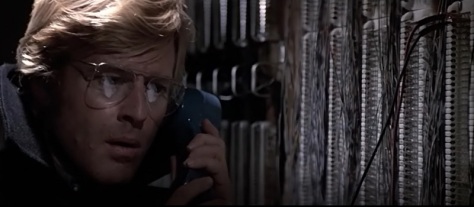
There are two more significant films in this cycle worth a mention-Sydney Pollack’s Three Days of the Condor (1975) and William Richert’s Winter Kills (1979).

Three Days of the Condor is one of seven collaborations between star Robert Redford and director Sydney Pollack, and one of the seminal “conspiracy-a-go-go” films. With a screenplay adapted by Lorenzo Semple, Jr. and David Rayfiel from James Grady’s novel “Six Days of the Condor”, this 1975 film offers a twist on the idea of a government-sanctioned assassination.

Here, you have members of the U.S. clandestine community burning up your tax dollars to scheme against other members of the U.S. clandestine community (no honor among conspirators, apparently). Also with Faye Dunaway, Cliff Robertson and Max von Sydow.

Pollack’s film conveys the same atmosphere of dread and paranoia that infuses The Conversation and The Parallax View. The final scene plays like an eerily prescient prologue for All the President’s Men, which wasn’t released until the following year. An absolutely first-rate political thriller with more twists and turns than you can shake a dossier at.

https://i0.wp.com/digbysblog.net/wp-content/uploads/2024/07/maxresdefault.jpg?w=1024&quality=89&ssl=1

Winter Kills is one of the more oddball entries in the cycle. Director William Richert adapted his screenplay from Richard Condon’s book (Condon also wrote The Manchurian Candidate, which was adapted for the screen twice).

Jeff Bridges stars as the (apolitical) half-brother of an assassinated president. After witnessing the deathbed confession of a man claiming to be a “second gunman”, he reluctantly gets drawn into a new investigation of his brother’s murder nearly 20 years after the matter was allegedly put to rest by the findings of the “Pickering Commission”.

John Huston chews the scenery as Bridges’ father (a larger-than-life character said to be loosely based on Joseph Kennedy Sr.). The cast includes Anthony Perkins, Eli Wallach, Sterling Hayden, Ralph Meeker, Toshiro Mifune, Richard Boone, and Elizabeth Taylor.

The film vacillates between byzantine conspiracy thriller and a broad satire of other byzantine conspiracy thrillersbut is eminently watchable, thanks to an interesting cast and a screenplay that, despite ominous undercurrents, delivers a great deal of dark comedy.

https://i0.wp.com/digbysblog.net/wp-content/uploads/2024/07/jfk_-_h_-_2016-928x523-1.webp?w=928&quality=80&ssl=1

The obvious bookend to this cycle is Oliver Stone’s controversial 1991 film JFK, in which Gary Oldman gives a suitably twitchy performance as Lee Harvey Oswald. However, within the context of Stone’s film, to say that we have a definitive portrait of JFK’s assassin (or “assassins”, plural) is difficult, because, not unlike Agatha Christie’s fictional detective Hercule Poirot, Stone suspects no one…and everyone.

The most misunderstood aspect of the film, I think, is that Stone is not favoring any prevalent narrative; and that it is by the director’s definition a “speculative” political thriller. Those who have criticized the approach seem to have missed that Stone himself has stated from the get-go that his goal was to provide a “counter myth” to the “official” conclusion of the Warren Commission (usually referred to as the “lone gunman theory”).

Stone’s narrative is so seamless and dynamic, many viewers didn’t get that he was mashing up at least a dozen *possible* scenarios. The message is right there in the script, when “Mr. X” (Donald Sutherland) advises New Orleans D.A. Jim Garrison (Kevin Costner), “Don’t believe me. Do your own work…your own thinking.”

https://i0.wp.com/digbysblog.net/wp-content/uploads/2024/07/3d7c34d9bb111ee0987fac72599303b2.jpg?w=600&quality=89&ssl=1

There was a mini-“revival” of the cycle during the 2000s, in the form of Niels Mueller’s 2004 true crime drama, The Assassination of Richard Nixon, and Gabriel Range’s 2006 “speculative thriller”, Death of a President (my review).

The Assassination of Richard Nixon, based on thwarted assassin Samuel Byck’s bizarre scheme to kill President Nixon in 1974, is the superior of the two films; but their respective “lone gunmen” share a similar pathology. Nixon’s would-be assassin Byck (Sean Penn) is the classic “angry white male” …a loser in marriage and career who cracks up and holds the President responsible for his own failures.

https://i0.wp.com/digbysblog.net/wp-content/uploads/2024/07/27deat.600.webp?w=600&quality=80&ssl=1

*SPOILER AHEAD* In Death of a President, the (fictional) assassin of President George W. Bush (a troubled 1991 Gulf War vet who lost his son in the second Iraq war) also holds the POTUS responsible for his personal problems (interestingly, this character is African-American; an anomaly within the typical American political assassin profile).

https://i0.wp.com/digbysblog.net/wp-content/uploads/2024/07/travis-reflection-talking-1450x800-c.jpg?resize=1024%2C565&quality=89&ssl=1

Even though it doesn’t fit quite so neatly into the “political assassination” category, no examination of the genre would be complete without a mention of Martin Scorsese’s Taxi Driver (1976). In my review of the 2008 film, The Killing of John Lennon, I wrote:

There is a particularly creepy and chilling moment of “art-imitating-life-imitating-art-imitating life” in writer-director Andrew Piddington’s film, The Killing of John Lennon, where the actor portraying the ex-Beatles’ stalker-murderer deadpans in the voice over:

“I don’t believe that one should devote his life to morbid self-attention, I believe that one should become a person like other people.”

Anyone who has seen Scorsese and Shrader’s Taxi Driver will instantly attribute that line to the fictional Travis Bickle, an alienated, psychotic loner and would be assassin who stalks a political candidate around New York City. Bickle’s ramblings in that film were based on the diary of Arthur Bremer, the real-life nutball who grievously wounded presidential candidate George Wallace in a 1972 assassination attempt.

Although Mark David Chapman’s fellow loon-in-arms John Hinckley would extrapolate even further on the Taxi Driver obsession in his attempt on President Reagan’s life in 1981, it’s still an unnerving epiphany in Piddington’s film, an eerie and compelling portrait of Chapman’s descent into alienation, madness and the inexplicable murder of a beloved music icon.

So what is it that (the fictional) Travis Bickle, and real-life stalkers Arthur Bremer, Mark David Chapman, John Hinckley (and possibly, the Tucson shooter) all have in common?

They represent a “new” breed of American assassin. They aren’t rogue members of the government’s clandestine community, “patsies” for some deeper conspiracy, or operatives acting at the behest of dark corporate cabals. And although their targets are in most cases political figures, their motives don’t necessarily appear to be 100% political in nature.

More often than not, they are disenfranchised “loners”, either by choice or precipitated by some kind of mental disturbance. Many of them fit the quintessential “angry white male” profile; impotent with rage at some perceived persecution (or betrayal) by specific people, ethnic groups, or society in general.

One thing we do know for sure, and the one thing they all share as U.S. citizens, is that they had no problem getting their hands on a firearm. I know-“Guns don’t kill people. People do.”  But still.

So what about that other issue that has come up-the possibility that inflammatory vitriol from high-profile demagogues can trigger homicidal rage from someone who is already starting to crack?

There are at least two films that have breached this scenario, if perhaps only tangentially-Sidney Lumet’s Network (1976) and Oliver Stone’s Talk Radio (1988).

https://i0.wp.com/digbysblog.net/wp-content/uploads/2024/07/3A481F49-47AA-4340-BFAC-FAC5F2F96E61-1024x575-1.jpeg?w=1024&quality=89&ssl=1

SPOILERS AHEAD*   In Network, written by the late great Paddy Chayefsky, respected news anchor Howard Beale has a mental meltdown on air, announcing his plan to commit public suicide, on camera, in an upcoming newscast.

When the following evening’s newscast attracts an unprecedented number of viewers, some of the more unscrupulous programmers and marketers at the network smell a potential cash cow, and decide to let Beale rant away in front of the cameras to his heart’s content, reinventing him as a “mad prophet of the airwaves” and giving him a nightly prime time slot.

Eventually, some of the truthiness in his nightly “news sermons” hits a little too close to home regarding some secret business dealings that the network has with some Arab investors, and it is decided that his program needs to be cancelled (with extreme prejudice). And besides, his ratings are slipping, anyway. So the network hires a team of hit men to assassinate him on air.

Obviously, this film is satirical in nature, through and through, but the idea of a media demagogue precipitating his own demise by hammering away with inflammatory on-air rants night after night is, in a fashion, oddly prescient of our current political climate.

https://i0.wp.com/digbysblog.net/wp-content/uploads/2024/07/Talk-Radio_02.png?w=768&quality=80&ssl=1

Talk Radio, on the other hand, does have some grounding in reality, because its screenplay (by Stone and Eric Bogosian) is based on a play (co-written by Bogosian and Tad Savinar), which itself was based on a non-fiction book (by Stephan Singular) about Denver talk show host Alan Berg, who was ambushed and shot to death in his driveway by members of a white nationalist fringe group in 1984. Berg was an outspoken liberal, who frequently targeted neo-Nazis and white supremacists in his on-air rants. Bogosian reprises his stage role as “shock jock” Barry Champlain, who meets with the same fate.

https://i0.wp.com/digbysblog.net/wp-content/uploads/2024/07/THE-FISHER-KING-photo-s933.jpg.webp?w=800&quality=80&ssl=1

Finally, there is one more film that  squeaks into this category-Terry Gilliam’s The Fisher King (1991). Jeff Bridges plays a successful late night radio talk show host whose career literally crashes overnight after a disturbed fan goes on a murderous shooting spree at an upscale restaurant after he hears the DJ exclaim, “They must be stopped before it’s too late…it’s us or them!” as part of a (tongue-in-cheek) anti-yuppie diatribe on his show.

One can’t help but be reminded of the Rush Limbaugh apologists who always attempt to douse any criticism of his vile hate rhetoric with the tired old “He’s just an entertainer!” meme.

So what can we learn about last Saturday’s shooting by analyzing these particular films, if anything? Frankly, I don’t feel any more enlightened about the “whys” behind this senseless violence than I did when I started this exercise.

Perhaps Bill Maher was not “oversimplifying”, after all, as I postulated earlier. Maybe the equation really is as simple as “A well armed country + A lot of nutty people = A bad combination”.

Is change even possible? Maybe we’re already on the right path by continuing to engage in the dialogue we’re engaged in and asking the questions we’re asking. Then again…like the man said: “Don’t take my word for it. Don’t believe me. Do your own work…your own thinking.”

UPDATE 6/15/25 : Plus ça change, plus c’est la même chose

Minnesota Rep. Melissa Hortman was a friend who worked with Gabby to stop gun violence. We’re thinking of her children, who've now lost both their parents, and we’re praying for Sen. Hoffman and his wife, who are still fighting for their lives. Stay strong.

Captain Mark Kelly (@captmarkkelly.bsky.social) 2025-06-15T01:00:18.274Z

Previous posts with related themes:

Suburban Fury

Aum: The Cult at the End of the World

Conspiracy a go-go (Slight Return)

The Death Hour: How Hollywood Tried to Warn Us

Getting better all the time (can’t get no worse): A New Year’s Eve mix tape

By Dennis Hartley

(Originally posted on Digby’s Hullabaloo on December 28,2024)

https://1.bp.blogspot.com/-IEctQefUYiw/Tn6Wh08xo4I/AAAAAAAAAZE/7WZ5J2OFC4Q/s800/The-Apartment-27.png

All is quiet, on New Year’s Day. Except for this mixtape (you may adjust your volume per hangover conditions New Year’s morning). Cheers!

“This Will Be Our Year” – The Zombies – Starting on a positive note. Lovely Beatle-esque number from the Odyssey and Oracle album.

You don’t have to worry
All your worried days are gone
This will be our year
Took a long time to come

At least…we can always hope, right?

“Time”David Bowie – A song as timeless as Bowie himself. Time, he’s waiting in the wings/He speaks of senseless things

1999″ – Prince – Sadly, it’s a perennial question: “Mommy…why does everybody have a bomb?”

“1921” – The WhoGot a feeling ’21 is gonna be a good year. OK, back to the drawing board …let’s make ’25 a better one.

“Time” – Oscar Brown, Jr. – A wise and soulful gem…tick, tock.

“New Year’s Day” – U2 – I know… “Edgy pick, Captain Obvious!” But it’s still a great song.

 “Year of the Cat” – Al StewartOld Grey Whistle Test clip. Strolling through the crowd like Peter Lorre, contemplating a crime

“Reeling in the Years” – Steely Dan – A pop-rock classic with a killer solo by Elliot Randall.

Encore! Fantastic live version from 2002. Randall and the backup band are on fire.

“New Year’s Resolution” – Otis Redding & Carla Thomas – Ace Stax B-side from 1968, with that unmistakable “Memphis sound”. Speaking of which… check out my review of the Stax music doc, Take Me to the River.

Same Old Lang Syne” – Dan Fogelberg – OK, a nod to those who insist on waxing sentimental. A beautiful tune from the late singer-songwriter.

Bonus track!

Not a “New Year’s song” per se, but an evergreen new year’s wish.

Skating away: A Solstice Mixtape

By Dennis Hartley

(Originally posted on Digby’s Hullabaloo on December 21, 2024)

https://i0.wp.com/digbysblog.net/wp-content/uploads/2024/12/Northern-Lights-in-Alaska-Bob-Wick-for-BLM-via-Flickr.jpg?resize=1024%2C682&quality=89&ssl=1

Happy Solstice! I thought I’d whip up a wintry mix of (literally) cool tunes to celebrate the shortest day of the year (buck up, little camper…we’ll start gaining daylight tomorrow). So for a much-needed mental health break…turn off the news, fix yourself a nice cup of hot chocolate (or kick it up a notch), dim all the lights, cozy up in front of the fireplace (real or virtual), don your favorite noise-cancelling headphones and (if I may quote from a Styx song) let the melody just drift your cares away.

California Dreamin’ – The Mamas & the Papas

A Hazy Shade of Winter– Simon & Garfunkel

Waiting for the Winter – Popguns

Theme from “Due South” – Jay Semko

Rangers at Midnight – Crack the Sky

A Winter’s Tale – Jade Warrior

Wintertime Love – The Doors

Sometimes in Winter – Blood, Sweat, & Tears

Song of the Evergreens – Chicago

Superwoman – Stevie Wonder

Snowflake – Kate Bush

Winter Wine – Caravan

Northern Lights – Renaissance

Winter in the Country – Cleaners From Venus

Ring Out, Solstice Bells – Jethro Tull

The Obligatory Year-End List

By Dennis Hartley

(Originally posted on Digby’s Hullabaloo on December 7, 2024)

https://i0.wp.com/digbysblog.net/wp-content/uploads/2024/12/CIAPELgIOgUxLjEuMg.jpg?resize=1024%2C576&quality=89&ssl=1

Yes, I know. That’s an oddly generic (some might even say silly) title for a post by someone who has been scribbling about film here for 18 years. Obviously, I love movies. That said, I am about to make a shameful confession (and please withhold your angry cards and letters until you’ve heard me out). Are you sitting down? Here goes:

I haven’t stepped foot in a movie theater since January of 2020.

There. I’ve said it, in front of God and all 7 of my regular readers.

*sigh* I can still remember it, as if it were yesterday:

It turns out that it is not just my imagination (running away with me). A quick Google search of “Seattle rain records” yields such cheery results as a January 29th CNN headline IT’S SUNLESS IN SEATTLE AS CITY WEATHERS ONE OF THE GLOOMIEST STRETCHES IN RECENT HISTORY and a Feb 1st Seattle P-I story slugged with SEATTLE BREAKS RECORD WITH RAIN ON 30 DAYS IN A MONTH. Good times!

February was a bit better: 15 rainy days with 4.1 hours a day of average sunshine. But hey-I didn’t move to the Emerald City to be “happy”. No, I moved to a city that averages 300 cloudy days a year in order to justify my predilection for a sedentary indoor lifestyle.

In fact it was a marvelously gloomy, stormy Sunday afternoon in late January when I ventured out to see Japanese anime master Makato Shinkai’s newest film Weathering with You (yes, this is a tardy review gentle reader…but what do you expect at these prices?). Gregory’s Girl meets The Lathe of Heaven in Shinkai’s romantic fantasy-drama.

That excerpt is from my review of Weathering With You, published February 9, 2020. If I had only known of the more insidious tempest about to make landfall, I would have savored that “…marvelously gloomy, stormy Sunday afternoon in late January” (and every kernel of my ridiculously overpriced popcorn) even more.

Of course, I’m referring to the COVID pandemic, which would soon put the kibosh on venturing to movie theaters (much less any public brick-and-mortar space in general) for quite a spell. Keep in mind, I live in Seattle, which is where the first reported outbreak of note in the continental U.S. occurred; I think it’s fair to say that the fear and paranoia became ingrained here much earlier on than in other parts of the country (and justifiably so).

Well, that’s all fine and dandy (you’re thinking)…but hasn’t the fear and paranoia abated since everything “opened up” again in (2022? 2021? I’ve lost track of the time-space continuum)? Here’s the thing-even before the pandemic, I had been going to theaters less and less frequently due to physical issues. I won’t bore you with details, suffice it to say I had both knees replaced (the first in 2014, the second in 2016)…but it didn’t quite “take”. And admittedly, I still mask up whenever I go to any public venue (including the grocery store). Perhaps that all adds up to “functional agoraphobia” (maybe one of you psych majors can help me out here?).

And you know what? I’m also tired of dealing with traffic, parking hassles, fellow theater patrons who are oblivious to people with disabilities, and astronomical ticket prices (add the $7 box of Junior Mints, and it’s cheaper to wait several months and just buy the Blu-ray).

And get off my lawn, goddammit.

Anyhoo, I haven’t been dashing out on opening weekend to see many first-run films in recent years; at least not the major studio releases that are playing on a bazillion screens. But thanks to “virtual” film festival accreditation, I am still able to screen and review a number of “new” movies (albeit many that have yet to find wider distribution).

So that is my long-winded way of explaining why I have decided not to entitle this (obligatory) end-of-year roundup as “the best” 10 films of 2024. Rather, out of the new films I reviewed on Hullabaloo this year, here are the 10 standouts (sans sand worms or wicked witches). I’ve noted the titles now streaming …hopefully the rest are coming soon to a theater near you!

https://i0.wp.com/digbysblog.net/wp-content/uploads/2024/12/bonjourswitzerland_01.jpg?resize=1024%2C576&quality=89&ssl=1

Bonjour Switzerland (original title: Bon Schuur Ticino) – Bananas meets The Mouse That Roared in this refreshingly old-school political satire directed by Peter Luisi. Beat Schlatter (who co-wrote the screenplay with the director) stars as a mild-mannered German-speaking federal agent who gets tasked with overseeing implementation of a controversial new Swiss law that mandates French as the country’s official language (in true Peter Sellers fashion, Schlatter also plays the high-profile media demagogue who pushed for the law). Problems quickly pile up for the hapless agent; he can barely speak French, his dear old mom becomes radicalized, and he finds himself falling for an Italian woman who belongs to a separatist group he’s been assigned to infiltrate. OK, I’ll say it: This is a hilarious, good-natured romp.

https://i0.wp.com/digbysblog.net/wp-content/uploads/2024/12/large_DOG_S_THIEF-Clean-16x9-01.webp?w=980&quality=80&ssl=1

The Dog Thief (original title: El ladrón de perros) – The future doesn’t look so bright for orphaned, semi-literate working class teenager Martin (Franklin Aro). Cruelly ridiculed by his bourgeois schoolmates, Martin ekes out a meager living as a shoeshine boy on the streets of La Paz and is only afforded lodging by the good graces of his late mother’s friend, who works as a maid in the spacious home of an ailing widow. Martin’s most loyal shoeshine customer is well-to-do tailor Mr. Novoa (Alfredo Castro). Novoa is an empty-nester who spends his off-hours training and pampering his prized German Shepherd.

One day, Martin has a sudden brainstorm for a get-rich-quick scheme; he will kidnap Mr. Novoa’s dog and then enlist his best bud to “find” it and collect the reward. As Martin ingratiates himself into insular Mr. Novoa’s life (initially as part of the scheme), an unexpected bond develops between the two, greatly complicating Martin’s not so-masterminded caper.

Reminiscent of P. T. Anderson’s Hard Eight, writer-director Vinko Tomičić Salinas’ film makes excellent use of the La Paz locales, rendered in a decidedly neorealist style (not so surprising, given the title’s wordplay on Vittorio De Sica’s neorealist classic Bicycle Thieves). Keep an eye on this filmmaker.

https://i0.wp.com/digbysblog.net/wp-content/uploads/2024/12/large_HACKING_HATE-Clean-16x9-01.webp?w=980&quality=80&ssl=1

Hacking Hate – Move over, Lisbeth Salandar…there’s a new hacker in town, and she’s stirring up a hornet’s nest of wingnuts. Simon Klose’s timely documentary follows award-winning Swedish journalist My Vingren as she meticulously constructs a fake online profile, posing as a male white supremacist. Her goal is to smoke out a possible key influencer and glean how he and others fit into right-wing extremist recruiting.

Vingren is like a one-woman Interpol; her investigation soon points her to U.S.-based extremist networks as well, leading her to consult with whistle-blower Anika Collier Navaroli (the former Twitter employee who was instrumental in getting Trump booted off the platform) and Imrab Ahmed (another one of Elon Musk’s least-favorite people, he was sued by the X CEO for exposing the rampant hate speech on the platform).

This isn’t a video game; considering the inherently belligerent nature of the extremist culture she is exposing, Vingren is taking considerable personal risk in this type of investigative journalism (she’s much braver than I am). Especially chilling is the shadowy figure at the center of her investigation, who is like a character taken straight out of a Frederick Forsyth novel. In light of the results of our recent presidential election (and the ancillary right-wing extremist threats to our democracy), this could be the most important documentary of 2024.

https://i0.wp.com/digbysblog.net/wp-content/uploads/2024/12/In-Our-Day-1-1600x900-c-default.jpeg?resize=1024%2C576&quality=89&ssl=1

In Our Day (original title: Uriui haru) – Look in the dictionary under “quiet observation”, and you’ll find a print of auteur Hong Sang-soo’s character study of two artists (a 40-ish actress and an aging poet), each at a crossroads in their creative journey. Sang-soo’s beautifully constructed narrative chugs along at the speed of life; I understand that this may induce drowsiness with some viewers-but the devil is in the details, and those who pay close attention to them will be richly rewarded.

(Available on Google Play and Apple TV)

https://i0.wp.com/digbysblog.net/wp-content/uploads/2024/12/large_LINDA_PERRY_-_LET_IT_DIE_HERE-Clean-16x9-02.webp?w=980&quality=80&ssl=1

Linda Perry: Let it Die Here – Initially bursting onto the music scene in the early 90s by creating and belting out the most distinctive “yeah yeah yeah” hook this side of The Beatles’ “She Loves You” (“What’s Up”), Linda Perry has long since slipped the surly bonds of “4 Non-Blondes’ lead singer with the hat” to become an in-demand songwriter and producer for a number of notable artists (Adele, Christina Aguilera, Brandi Carlisle, Miley Cyrus, Celine Dion, Gwen Stefani, et.al.).

What makes this otherwise by-the-numbers music doc (directed by Don Hardy) really pop is its subject herself: charismatic, indomitable and boundlessly creative. One sequence, which observes Perry as she improvises, produces and arranges one of her own songs (essentially directing an orchestra on the fly) is one of the most riveting captures of the creative process I’ve seen on film since Godard’s Sympathy for the Devil.

https://i0.wp.com/digbysblog.net/wp-content/uploads/2024/12/OldOak_photo_1-scaled-1.webp?w=1024&quality=80&ssl=1

The Old Oak – The bookend of a triptych of working-class dramas set in Northeast England (preceded by I, Daniel Blake in 2016 and Sorry We Missed You! in 2019), The Old Oak marks 87-year-old director Ken Loach’s 28th film.

The story (scripted by Paul Laverty) is set in an economically depressed “pit town” on the Northeast coast of England in 2016 (which was 2 years into the implementation of the UK’s Syrian Vulnerable Persons Resettlement Scheme), and centers on TJ (Dave Turner), a former labor organizer barely making ends meet as owner and proprietor of “The Old Oak” pub.

One day, a busload of Syrian refugees appears and disembarks in the center of town. Unfortunately, not all the locals appear willing to roll out the welcome wagon. When xenophobic catcalling escalates into a scuffle that results in a young Syrian woman’s camera getting damaged, TJ intervenes and defuses the situation.

What ensues is rife with Loach’s trademarks; not the least of which is giving his cast plenty of room to breathe. The ensemble (which ranges from first-time film actors to veteran players) delivers uniformly naturalistic performances. Hovering somewhere between Do the Right Thing and Ikuru, The Old Oak is raw, uncompromising, and genuinely moving (rare at the multiplex nowadays), with an uplifting message of hope and reconciliation. If this is indeed its director’s swan song-what a lovely, compassionate note to go out on. (Full review)

(Available on Google Play, Amazon Prime, Fandango at Home and Apple TV)

https://digbysblog.net/wp-content/uploads/2024/12/8gbtmoxcqe7h76d1depirwj2zwrc.avif

Rainier: A Beer Odyssey“Raaay-neeEER-BEEERrrrr….” If you lived in Alaska or the Northwest in the 70s and 80s, you’ll “get” that-and likely start chuckling. That said, you don’t have to have lived in Alaska or the Northwest to get a chuckle out of Isaac Olsen’s documentary. Olsen recounts the origin of the small (and unconventional) Seattle ad agency led by madmen Terry Heckler and Gordon Bowker that dreamt up a series of now-iconic Rainier Beer TV ads. A many-tendrilled odyssey indeed, with some unexpected sidebars (like cross-pollination with the inception of the Starbucks empire, and the story behind Mickey Rooney’s involvement with the campaign). A fascinating, entertaining look at the process behind the creative side of marketing, bolstered by a generous helping of the original TV ads.

https://i0.wp.com/digbysblog.net/wp-content/uploads/2024/12/large_RESTLESS-Clean-16x9-01.webp?w=980&quality=80&ssl=1

Restless -Writer-director Jed Hart’s audacious and blackly comic debut feature is driven by a terrific performance by Lyndsey Marshal, who plays a mild-mannered elder care nurse who likes nothing better than spending her off-hours baking, listening to light classical music, and settling in with her cat for some reading and quiet time. Imagine her chagrin when it becomes abundantly clear that her new next-door neighbor likes nothing better than hosting all-night ravers…every night of the week.

Her first few polite requests (usually made around 4am) for the young man and his friends to keep it down are initially met with bemusement, but the situation takes a more sinister turn once she threatens to call the police. The woman’s steady descent into madness and desperation turns a “neighbor from hell” story into a modern Edgar Allan Poe tale. A satisfying revenge fantasy for anyone who’s “been there”, and a solid reinforcement for the old adage, “Watch out for the quiet ones.”

https://i0.wp.com/digbysblog.net/wp-content/uploads/2024/12/Main-solitude_1.365.1-scaled.webp?resize=1024%2C429&quality=80&ssl=1

Solitude (original title: Einvera) – Ah, look at all the lonely people. Ninna Pálmadóttir’s quiet drama concerns an unassuming farmer named Gunnar (Thröstur Leó Gunnarsson) who reluctantly sells his beloved horses and relocates to Reykjavik after getting pushed off his land by a hydroelectric project. He has received a generous settlement, which enables him to offer cash for a condo.

For Gunnar, moving to the city is tantamount to getting drop-kicked into the 21st Century; he is overwhelmed by the stimuli. He strikes up a sweet friendship with a bubbly 10-year-old paperboy named Ari. The boy’s parents are separated. While they try to share equal time with their son, squabbles arise over scheduling conflicts, frequently leaving Ari in the lurch. As a result, Gunnar becomes his de facto babysitter. Gunnar’s naivety eventually leads to a misunderstanding that could have serious consequences for him. A beautifully acted treatise on the singularly destructive power of “assumption”.

https://i0.wp.com/digbysblog.net/wp-content/uploads/2024/12/large_UNDER_THE_GREY_SKY-Clean-16x9-01.webp?w=980&quality=80&ssl=1

Under The Grey Sky (original title: Pod szarym niebem) – This “ripped from the headlines” political drama is set during the 2020 Belarusian election. In a genuinely tense and unnerving opening scene, a journalist (Aliaksandra Vaitsekhovich) opposed to the current regime is in a friend’s apartment, live streaming an aggressive police action against demonstrators on the streets below.

Soon after an ominous pass of a police camera drone, the authorities burst in and arrest her. As her Kafkaesque nightmare ensues in the oppressive government’s court system, her husband (also a journalist) suffers his own travails as he is harassed by the police and eventually arrested on trumped-up charges. Based on a true story, writer-director Mara Tamkovich’s film is a sobering reminder that Orwellian totalitarianism is not dead…hell, it’s never even been resting. And yes…it could happen here.

…and just for giggles

Holy Krampus…have I really been writing reviews here for 18 years?! I was but a child of 50 when I began in November of 2006 (I was much older then, but I’m younger than that now). Here are my “top 10” picks for each year since I began writing for Hullabaloo.

(You may want to bookmark this post as a  handy reference for movie night).

[Click on title for full review]

2007

Eastern Promises, The Hoax, In the Shadow of the Moon, Kurt Cobain: About a Son, Michael Clayton, My Best Friend, No Country for Old Men, Pan’s Labyrinth, PaprikaZodiac

2008

Burn After Reading, The Dark Knight, The Gits, Happy Go Lucky, Honeydripper, Man on Wire, Milk, Slumdog Millionaire, Vicky Cristina Barcelona, The Visitor

2009

The Baader Meinhof Complex, Inglourious Basterds, In the Loop, The Limits of Control, The Messenger, A Serious Man, Sin Nombre, Star Trek, Where the Wild Things Are, The Yes Men Fix the World

2010

Creation, Inside Job, Joan Rivers: A Piece of Work, Little Big Soldier, A Matter of Size, My Dog Tulip, Nowhere Boy, Oceans, The Runaways, Son of Babylon

2011

Another Earth, Certified Copy, The Descendants, Drei, Drive, The First Grader, Midnight in Paris, Summer Wars, Tinker/Tailor/Soldier/Spy, The Trip

2012

Applause, Dark Horse, Killer Joe, The Master, Paul Williams: Still Alive, Rampart, Samsara, Skyfall, The Story of Film: an Odyssey, Your Sister’s Sister

2013

The Act of Killing, Big Star: Nothing Can Hurt Me, Computer Chess, 56 Up, The Hunt, Mud, The Rocket, The Silence, The Sweeney, Upstream Color

2014

Birdman, Child’s Pose, A Coffee in Berlin, The Grand Budapest Hotel, Kill the Messenger, The Last Days of Vietnam, Life Itself, A Summer’s Tale, The Wind Rises, The Theory of Everything

2015

Chappie, Fassbinder: Love Without Demands, An Italian Name, Liza the Fox Fairy, Love and Mercy, A Pigeon Sat on a Branch Reflecting on Existence, Song of the Sea, Tangerines, Trumbo, When Marnie Was There

2016

The Curve, Eat That Question, Hail, Caesar!, Home Care, Jackie, Mekko, Older Than Ireland, Snowden, The Tunnel, Weiner

2017

After the Storm, Bad Black, Becoming Who I Was, Blade Runner 2049, A Date for Mad Mary, Endless Poetry, I Am Not Your Negro, Loving Vincent, The Women’s Balcony, Your Name

2018

Big Sonia, BlacKkKlansman, Fahrenheit 11/9, The Guilty, Let the Sunshine In, Little Tito and the Aliens, Outside In, Ryuichi Sakamoto: Coda, Wild Wild Country, Won’t You Be My Neighbor?

2019

David Crosby: Remember My Name, Dolemite is My Name, Driveways, The Edge of Democracy, The Irishman, Monos, Once Upon a Time in Hollywood, Putin’s Witnesses, This is Not Berlin, Wild Rose

2020

Bloody Nose, Empty Pockets, Capital in the Twenty-First Century, Desert One, Love Spreads, Never, Rarely, Sometimes, Always, Pacified, 76 Days, Tommaso, The Trial of the Chicago 7, Weathering With You

2021

Brian Wilson: Long Promised Road, Fire Music, Heist of the Century, Kurt Vonnegut: Unstuck in Time, The Last Film Show, The Paper Tigers, The Pebble and the Boy, Surge, Waikiki, Whelm

2022

Day by Day, Drunken Birds, Hallelujah: Leonard Cohen, A Journey, A Song, The Integrity of Joseph Chambers, The Man in the Basement, Moonage Daydream, My Love Affair With Marriage, Nude Tuesday, Sweetheart Deal, Polystyrene: I Am a Cliche

2023

Adolfo, Downtown Owl, Hey, Viktor!, I Like Movies, L’immensità, The Mojo Manifesto, Next Sohee, Once Within a Time, One Night With Adela, Ride On

Conspiracy a go-go (slight return)

By Dennis Hartley

(Originally posted on Digby’s Hullabaloo on November 23, 2024)

https://denofcinema.com/wp-content/uploads/2024/11/131030-jfk-jackie-dallas-1963-03.jpg

“Strength takes many forms, and the most obvious forms are not always the most significant. The men who create power make an indispensable contribution to the Nation’s greatness, but the men who question power make a contribution just as indispensable, especially when that questioning is disinterested, for they determine whether we use power or power uses us. […] 

If sometimes our great artists have been the most critical of our society, it is because their sensitivity and their concern for justice, which must motivate any true artist, makes him aware that our Nation falls short of its highest potential. […]

We must never forget that art is not a form of propaganda; it is a form of truth […] But democratic society — in it, the highest duty of the writer, the composer, the artist is to remain true to himself and to let the chips fall where they may. In serving his vision of the truth, the artist best serves his nation.” President John F. Kennedy, from his Robert Frost tribute address (October 23, 1963)

61 years ago this past Friday, President John F. Kennedy and First Lady Jacqueline Kennedy landed in Dallas, Texas at 11:38am. They were accompanied by Texas Governor John Connally and his wife. The two couples were greeted by Vice-President Lyndon B. Johnson and Lady Bird Johnson. After about 15 minutes of schmoozing with the friendly crowd of admirers gathered on the tarmac, the Kennedys, Johnsons, and Connallys were whisked to their waiting motorcade, which would take them through downtown Dallas. Thousands of locals already lined the route, eager for a glimpse of the charismatic President and First Lady.

As we are all now painfully aware, President Kennedy had only 35 minutes left to live.

“Where were you when Kennedy got shot?” has been a meme for anyone old enough to remember what happened that day in Dallas on November 22, 1963.

I was but a wee military brat, attending my second-grade class at a public school in Columbus, Ohio (my dad was stationed at nearby Fort Hayes). Our class was herded into the gym for an all-school assembly. Someone (probably the principal) gave a brief address. It gets fuzzy from there; we either sang “My Country ‘Tis of Thee” or recited the Pledge of Allegiance (or we possibly did both), and were sent home early.

My 7-year-old mind could not grasp the profound sociopolitical impact of this tragedy; naturally I have come to understand it in the fullness of time. From my 2016 review of Jackie

Understandably, the question of “why now?” could arise, to which I would reply (paraphrasing JFK) …why not? To be sure, Jacqueline Kennedy’s story has been well-covered in a myriad of documentaries and feature films; like The Beatles, there are very few (if any) mysteries about her life and legacy to uncover at this point. And not to mention that horrible, horrible day in Dallas…do we really need to pay $15 just to see the nightmare reenacted for the umpteenth time? (Spoiler alert: the President dies at the end). 

I think that “we” do need to see this film, even if we know going in that there was no “happy ever-aftering” in this Camelot. It reminds us of a “brief, shining moment” when all seemed possible, opportunities were limitless, and everything was going to be all right, because Jack was our king and Jackie was our queen. So what if it was all kabuki, as the film implies; merely a dream, invented by “a great, tragic actress” to unite us in our sadness. Then it was a good dream, and I think we’ll find our Camelot again…someday.

If we can just get through these next four years, maybe then (I can dream, can’t I?).

https://i.ytimg.com/vi/s-cb5iDPjlw/maxresdefault.jpg

They will run you dizzy. They will pile falsehood on top of falsehood, until you can’t tell a lie from the truth – and you won’t even want to. That’s how the powerful keep their power. Don’t you read the papers? From Winter Kills (screenplay by William Richert)

The Kennedy assassination precipitated a cottage industry of independent investigations, papers, articles, non-fiction books, novels, documentaries and feature films that riff on myriad conspiracy theories.

Then of course there was that Warren Commission report released in 1964; an 888-page summation concluding JFK’s alleged murderer Lee Harvey Oswald acted alone. This “conclusive” statement, of course only fueled more speculation that our government was not being completely …forthcoming.

2024 marks the 45th anniversary of one of the more oddball conspiracy thrillers based on the JFK assassination…Winter Kills. Director William Richert adapted his screenplay from Richard Condon’s book (Condon also wrote The Manchurian Candidate, which was adapted for the screen twice).

Jeff Bridges stars as the (apolitical) half-brother of an assassinated president. After witnessing the deathbed confession of a man claiming to be a “second gunman”, he reluctantly gets drawn into a new investigation of his brother’s murder nearly 20 years after the matter was allegedly put to rest by the findings of the “Pickering Commission”.

John Huston chews the scenery as Bridges’ father (a larger-than-life character said to be loosely based on Joseph Kennedy Sr.). The cast includes Anthony Perkins, Eli Wallach, Sterling Hayden, Ralph Meeker, Toshiro Mifune, Richard Boone, and Elizabeth Taylor.

The film vacillates between byzantine conspiracy thriller and a broad satire of other byzantine conspiracy thrillersbut is eminently watchable, thanks to an interesting cast and a screenplay that, despite ominous undercurrents, delivers a great deal of dark comedy.

Is Winter Kills essential viewing? It depends. If you like quirky 60s and 70s cinema, it’s one of the last hurrahs in a film cycle of arch, lightly political and broadly satirical all-star psychedelic train wrecks like The Loved One, The President’s Analyst, Skidoo, Candy and The Magic Christian. For “conspiracy-a-go-go” completists, it is a must-see.

Here are 9 more films that either deal directly with or have a notable link with the JFK conspiracy cult. And while you’re watching, keep President Kennedy’s observation in the back of your mind: “In serving his vision of the truth, the artist best serves his nation.” https://i.pinimg.com/originals/c0/c8/b1/c0c8b1d48149687b70248be7ee877748.jpg

Suddenly – Lewis Allen’s taut 1954 hostage drama/film noir stars a surprisingly effective Frank Sinatra as John Baron, the cold-blooded leader of a three-man hit team who are hired to assassinate the (unnamed) President during a scheduled whistle-stop at a sleepy California town (interestingly, the role of John Baron was originally offered to Montgomery Clift).

The film is essentially a chamber piece; the assassins commandeer a family’s home that affords them a clear shot at their intended target. In this case, the shooter’s motives are financial, not political (“Don’t give me that politics jazz-it’s not my racket!” Sinatra snarls after he’s accused of being “an enemy agent” by one of his hostages). Richard Sale’s script also drops in a perfunctory nod or two to the then-contemporaneous McCarthy era (one hostage speculates that the hit men are “commies”).

Also in the cast: Sterling Hayden, James Gleason, Nancy Gates, Christopher Dark, and Paul Frees (Frees would later become known as “the man of a thousand voices” for his voice-over work with Disney, Jay Ward Productions, Rankin/Bass and other animation studios).

Some aspects of the film are eerily prescient of President Kennedy’s assassination 9 years later; Sinatra’s character is an ex-military sharpshooter, zeroes down on his target from a high window, and utilizes a rifle of a European make. Most significantly, there have been more than a few claims over the years in JFK conspiracy circles suggesting that Lee Harvey Oswald had watched this film with a keen interest.

There have been conflicting stories over the years whether Sinatra had Suddenly pulled from circulation following Kennedy’s death; the definitive answer may lie in remarks made by Frank Sinatra, Jr., in a commentary track he did for a 2012 Blu-ray reissue of the film:

[Approximately 2 weeks] after the assassination of President Kennedy, a minor network official at ABC television decided he was going to run “Suddenly” on network television. This, while the people were still grieving and numbed from the horror of the death of President Kennedy. When word of this reached Sinatra, he was absolutely incensed…one of the very few times had I ever seen him that angry. He got off a letter to the head of broadcasting at ABC, telling them that they should be jailed; it was in such bad taste to do that after the death of President Kennedy.

Sinatra, Jr. does not elaborate any further, so I interpret that to mean that Frank, Sr. fired off an angry letter, and the fact that the film remains in circulation to this day would indicate that it was never actually “pulled” (of course, you are free to concoct your own conspiracy theory).

https://i0.wp.com/unaffiliatedcritic.com/wp-content/uploads/2018/07/THE-MANCHURIAN-CANDIDATE-1962.png?ssl=1

The Manchurian Candidate – There’s certainly more than just a perfunctory nod to Red hysteria in John Frankenheimer’s 1962 cold war paranoia fest, which was the last assassination thriller of note released prior to the zeitgeist-shattering horror of President Kennedy’s murder. Oddly enough, Frank Sinatra was involved in this project as well. Sinatra plays a Korean War vet who reaches out to help a buddy he served with (Laurence Harvey). Harvey is on the verge of a meltdown, triggered by recurring war nightmares.

Sinatra has been suffering the same malady (both men had been held as POWs by the North Koreans). Once it dawns on Sinatra that they both may have been brainwashed during their captivity for very sinister purposes, all hell breaks loose.

In this narrative (based on Richard Condon’s novel) the assassin is posited as an unwitting dupe of a decidedly “un-American” political ideology; a domestic terrorist programmed by his Communist puppet masters to kill on command. Some of the Cold War references have dated; others (as it turns out) are evergreen.

https://i2.wp.com/denofcinema.com/wp-content/uploads/2021/11/image-w1280-1024x576.webp?resize=1024%2C576&ssl=1

Seven Days in May – This 1964 “conspiracy a-go go” thriller was director John Frankenheimer’s follow-up to The Manchurian Candidate. Picture if you will: a screenplay by Rod Serling, adapted from a novel by Fletcher Knebel and Charles W. Bailey II.

Kirk Douglas plays a Marine colonel who is the adjutant to a hawkish, hard right-leaning general (Burt Lancaster) who heads the Joint Chiefs of Staff.  The general is at loggerheads with the dovish President (Fredric March), who is perceived by the general and some of the other joint chiefs as a “weak sister” for his strident support of nuclear disarmament.

When Douglas begins to suspect that an imminent, unusually secretive military “exercise” may in fact portend more sinister intentions, he is torn between his loyalty to the general and his loyalty to the country as to whether he should raise the alarm. Or is he just being paranoid?

An intelligently scripted and well-acted nail-biter, right to the end. Also with Ava Gardner, Edmund O’Brien, and Martin Balsam.

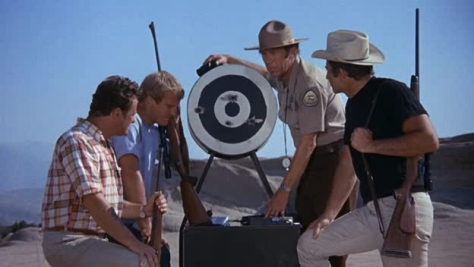
https://wolfmanscultfilmclub.files.wordpress.com/2017/01/executive-action-1973-target-pactice.jpg

Executive Action – After the events of November 22, 1963, Hollywood took a decade-long hiatus from the genre; it seemed nobody wanted to “go there”. But after Americans had mulled a few years in the sociopolitical turbulence of the mid-to-late 1960s (including the double whammy of losing Robert F. Kennedy and Martin Luther King to bullets in 1968), a new cycle of more cynical and byzantine conspiracy thrillers began to crop up (surely exacerbated by Watergate).

The most significant shift in the meme was to move away from the concept of the assassin as a dupe or an operative of a “foreign” (i.e., “anti-American”) ideology; some films postulated that shadowy cabals of businessmen and/or members of the government were capable of such machinations. The rise of the JFK conspiracy cult (and the cottage industry it created) was probably a factor as well.

One of the earliest examples was this 1973 film, directed by David Miller, and starring Burt Lancaster and Robert Ryan. Dalton Trumbo (famously blacklisted back in the 50s) adapted the screenplay from a story by Donald Freed and Mark Lane.

A speculative thriller about the JFK assassination, it offers a scenario that a consortium comprised of hard right pols, powerful businessmen and disgruntled members of the clandestine community were responsible.

Frankly, the premise is more intriguing than the film (which is flat and talky), but the filmmakers deserve credit for being the first ones to “go there”. The film was a flop at the time, but has become a cult item; as such, it is more of a curio than a classic. Still, it’s worth a watch.

https://i1.wp.com/denofcinema.com/wp-content/uploads/2021/11/the-parallax-view-1024x768.jpg?resize=1024%2C768&ssl=1

The Parallax View – Alan J. Pakula’s 1974 thriller takes the concept of the dark corporate cabal one step further, positing political assassination as a sustainable capitalist venture, if you can perfect a discreet and reliable algorithm for screening and recruiting the right “employees”.

Warren Beatty delivers an excellent performance as a maverick print journalist investigating a suspicious string of untimely demises that befall witnesses to a U.S. senator’s assassination in a restaurant atop the Space Needle. This puts him on a trail that leads to an enigmatic agency called the Parallax Corporation. irror while the film was in production).

The supporting cast includes Hume Cronyn, William Daniels and Paula Prentiss. Nice work by cinematographer Gordon Willis (aka “the prince of darkness”), who sustains the foreboding, claustrophobic mood of the piece with his masterful use of light and shadow.

The screenplay is by David Giler and Lorenzo Semple Jr. (based on the 1970 novel by Loren Singer, with a non-credited rewrite by Robert Towne). The narrative contains obvious allusions to the JFK assassination, and (in retrospect) reflects the political paranoia of the Nixon era (perhaps this was serendipity, as the full implications of the Watergate scandal were not yet in the rear view mirror while the film was in production).

https://i1.wp.com/images.squarespace-cdn.com/content/v1/50a8e2dde4b089e056eebec7/1476084542625-M2X1HGW6NXBO58IRD182/ke17ZwdGBToddI8pDm48kO3agmuenxEiKUqx4vWgN1B7gQa3H78H3Y0txjaiv_0fDoOvxcdMmMKkDsyUqMSsMWxHk725yiiHCCLfrh8O1z4YTzHvnKhyp6Da-NYroOW3ZGjoBKy3azqku80C789l0sofvP-RiTb638-KOMjny0vZqo_CDvLrpom-mRi8pK5ovAmGk7wYwPyNIiMMUIKApg/image-asset.jpeg?ssl=1

The Conversation – Written and directed by Francis Ford Coppola, this 1974 thriller does not involve a “political” assassination, but does share crucial themes with other films here. It was also an obvious influence on Brian De Palma’s 1981 thriller, Blow Out (see my review below).

Gene Hackman leads a fine cast as a free-lance surveillance expert who begins to obsess that a conversation he captured between a man and a woman in San Francisco’s Union Square for one of his clients is going to directly lead to the untimely deaths of his subjects.

Although the story is essentially an intimate character study, set against a backdrop of corporate intrigue, the dark atmosphere of paranoia, mistrust and betrayal that permeates the film mirrors the political climate of the era (particularly in regards to its timely proximity to the breaking of the Watergate scandal).

24 years later Hackman played a similar character in Tony Scott’s 1998 political thriller Enemy of the State. Some have postulated “he” is the same character (you’ve gotta love the fact that there’s a conspiracy theory about a fictional character). I don’t see that myself; although there is obvious homage with a brief shot of a photograph of Hackman’s character in his younger days that is actually a production still from …The Conversation!

https://i1.wp.com/lwlies.com/wp-content/uploads/2016/07/blow-out-john-travolta-1981-1108x0-c-default.jpg?ssl=1

Blowout -This 1981 thriller is one of Brian De Palma’s finest efforts. John Travolta stars as a sound man who works on schlocky horror films. While making a field recording of ambient nature sounds, he unexpectedly captures audio of a fatal car crash involving a political candidate, which may not have been an “accident”. The proof lies buried somewhere in his recording-which naturally becomes a coveted item by some dubious characters. His life begins to unravel synchronously with the secrets on his tape.

The director employs an arsenal of influences (from Antonioni to Hitchcock), but succeeds in making this one of his most “De Palma-esque” with some of the deftest set-pieces he’s ever done (particularly in the climax).

https://stanleyrogouski.files.wordpress.com/2020/01/condor.jpg

Three Days of the Condor – One of seven collaborations between star Robert Redford and director Sydney Pollack, and one of the seminal “conspiracy-a-go-go” films. With a screenplay adapted by Lorenzo Semple, Jr. and David Rayfiel from James Grady’s novel “Six Days of the Condor”, this 1975 film offers a twist on the idea of a government-sanctioned assassination.

Here, you have members of the U.S. clandestine community burning up your tax dollars to scheme against other members of the U.S. clandestine community (no honor among conspirators, apparently). Also with Faye Dunaway, Cliff Robertson and Max von Sydow.

Pollack’s film conveys the same atmosphere of dread and paranoia that infuses The Conversation and The Parallax View. The final scene plays like an eerily prescient prologue for All the President’s Men, which wasn’t released until the following year. An absolutely first-rate political thriller with more twists and turns than you can shake a dossier at.

https://assets.mubicdn.net/images/artworks/656502/images-original.png?1703395334

JFK – The obvious bookend to this cycle is Oliver Stone’s controversial 1991 film, in which Gary Oldman gives a suitably twitchy performance as Lee Harvey Oswald. However, within the context of Stone’s film, to say that we have a definitive portrait of JFK’s assassin (or “assassins”, plural) is difficult, because, not unlike Agatha Christie’s fictional detective Hercule Poirot, Stone suspects no one…and everyone.

The most misunderstood aspect of the film, I think, is that Stone is not favoring any prevalent narrative; and that it is by the director’s definition a “speculative” political thriller. Those who have criticized the approach seem to have missed that Stone himself has stated from the get-go that his goal was to provide a “counter myth” to the “official” conclusion of the Warren Commission (usually referred to as the “lone gunman theory”). 

Stone’s narrative is so seamless and dynamic, many viewers didn’t get that he was mashing up at least a dozen *possible* scenarios. The message is right there in the script, when “Mr. X” (Donald Sutherland) advises New Orleans D.A. Jim Garrison (Kevin Costner), “Don’t believe me. Do your own work…your own thinking.”

JICYMI- This 2023 episode of “The Commonwealth Club” features Mark Shaw, best-selling author of 6 books related to the Kennedy assassination, reflecting on the 60th anniversary of the tragedy:

Related posts:

The Irishman

On mad kings, Mueller’s report and Altman’s Secret Honor

State of Play

Wormwood

Kleptocracy Now: A Top 1% List (redux)

By Dennis Hartley

(Originally posted on Digby’s Hullabaloo on November 16, 2024)

History never repeats (I tell myself before I go to sleep)

– Split Enz

These past 10 days have felt…like a bad dream:

But alas, as Mia Farrow famously exclaimed in Rosemary’s Baby:

Speaking of bad dreams…in an excellent piece published this week entitled “Alexander Hamilton’s Nightmare Realized: How the Billionaires Hijacked America”, Thom Hartmann writes:

Alexander Hamilton thought he (and the others who wrote the Constitution) had it all figured out.

He and his colleagues never imagined that a group of billionaires would spend 43 years and billions of dollars to seize the US Supreme Court, which would then legalize political bribery.

They never conceived of a foreign billionaire family coming to American and building a nationwide media ecosystem that was capable of convincing Americans that up was down, wrong was right, and a convicted fraudster and rapist would be a noble president.

They would’ve laughed at you if you told them that the richest man in the world would come from apartheid South Africa to hook up with a grifter billionaire to become co-president.

In Federalist 68, Hamilton wrote:

“The process of election affords a moral certainty, that the office of President will never fall to the lot of any man who is not in an eminent degree endowed with the requisite qualifications.”

Indeed, while a knave or rogue or traitor may fool enough people to even ascend to the office of mayor of a major city or governor of a state, Hamilton told us, the people would ferret out such a con man or traitor and Congress and the Supreme Court would put a brake on such a man even if he were to slip past the voters and the Electoral College:

“Talents for low intrigue, and the little arts of popularity, may alone suffice to elevate a man to the first honors in a single State; but it will require other talents, and a different kind of merit, to establish him in the esteem and confidence of the whole Union, or of so considerable a portion of it as would be necessary to make him a successful candidate for the distinguished office of President of the United States.”

Hamilton’s pride in the system that he himself had helped create was hard for him to suppress.

He wrote, “It will not be too strong to say, that there will be a constant probability of seeing the station filled by characters preeminent for ability and virtue.”

He even bragged in Federalist 71 that presidents would be of such high character that they could easily avoid being seduced “by the wiles of parasites and sycophants, by the snares of the ambitious, the avaricious, the desperate, by the artifices of men who possess their confidence more than they deserve it, and of those who seek to possess rather than to deserve it.”

He also believed that good elected officials in Congress, dependent on the voters for their own political futures, would serve as a check against a corrupt president bent on exploiting his position for his own enrichment, the demands of special interest groups (like billionaires), or the interests of a hostile foreign government:

“But however inclined we might be to insist upon an unbounded complaisance in the Executive [President] to the inclinations of the people, we can with no propriety contend for a like complaisance to the humors of the legislature.”

Turns out, Hamilton was wrong. His nightmare scenario tracks back to five corrupt Republicans on the Supreme Court, starting with Lewis Powell authoring the 1978 Bellotti decision that says money is “free speech” and corporations are “persons.” It reached its fetid bottom with John Roberts’ and Clarence Thomas’ Citizens United blowing up almost all campaign contribution limits.

Without billionaire-controlled media (including billionaire-owned social media) and billions spent to carpet-bomb America with extraordinarily deceptive advertising, Donald Trump would never have had a chance. […]

This is America becoming a Mafia State; with Trump and the corrupt toadies he’s inserting into our government, we’re all now stuck living in Alexander Hamilton’s nightmare.

With that happy thought in mind (pleasant dreams!), I thought I’d revisit a “top 10 list” I originally posted on the eve of Inauguration Day 2017, which contains bellwethers that may need to be heeded once again (perhaps more now than the first time around). With my childlike grasp of investment strategies, the best tip I can give is: go long on Hope.

(The following was originally published on Hullabaloo on January 14, 2017)

https://i0.wp.com/digbysblog.net/wp-content/uploads/2024/01/drumpf-christmas.webp?resize=1024%2C691&quality=80&ssl=1

“To assess the ‘personality’ of the corporate ‘person’ a checklist is employed, using diagnostic criteria of the World Health Organization and the standard diagnostic tool of psychiatrists and psychologists. The operational principles of the corporation give it a highly anti-social ‘personality’: it is self-interested, inherently amoral, callous and deceitful; it breaches social and legal standards to get its way; it does not suffer from guilt, yet it can mimic the human qualities of empathy, caring and altruism.”

– from the official website for the film, The Corporation

I don’t know about you, but my jaw is getting pretty sore from repeatedly dropping to the floor with each successive cabinet nomination by our incoming CEO-in-chief of the United States of Blind Trust. It seems that candidate Trump, who ran on an oft-bleated promise to “drain the swamp” in Washington D.C. bears little resemblance to President-elect Trump, who is currently hell-bent on loading the place up with even more alligators.

When I heard the name “Rex Tillerson” bandied about as Trump’s pick for Secretary of State, it rang a bell. I knew he was the former head of Exxon, so it wasn’t that. Then I remembered. Mr. Tillerson was one of the “stars” of a documentary I reviewed several years back, called Greedy Lying Bastards (conversely, if I hear the words “greedy lying bastards,” bandied about, “Trump’s cabinet picks” is the first phrase that comes to mind).

So with that in mind, and in keeping with my occasional unifying theme, “Hollywood saw this coming”, I was inspired to comb my review archives of the last 10 years to see if any bellwethers were emerging that may have been dropping hints that the planets were aligning in such a manner as to set up a path to the White House for an orange TV clown (the “self-interested, inherently amoral, callous and deceitful” kind of orange TV clown).

All 10 of these films were released within the last 10 years. I’ll let you be the judge:

https://i0.wp.com/digbysblog.net/wp-content/uploads/2024/01/AR-AL617_FILM_G_P_20151210130412.jpg?w=749&quality=89&ssl=1

The Big Short Want the good news first? Writer-director Adam McKay and co-scripter Charles Randolph’s adaptation of Michael Lewis’ eponymous 2010 non-fiction book is an outstanding comedy-drama; an incisive parsing of what led to the crash of the global financial system in 2008. The bad news is…it made me pissed off about it all over again.

Yes, it’s a bitter pill to swallow, this ever-maddening tale of how we stood by, blissfully unaware, as unchecked colonies of greedy, lying Wall Street investment bankers were eventually able to morph into the parasitic gestalt monster journalist Matt Taibbi famously compared to a “…great vampire squid wrapped around the face of humanity, relentlessly jamming its blood funnel into anything that smells like money.” Good times!  (Full review)

https://i0.wp.com/digbysblog.net/wp-content/uploads/2024/01/mmoore-96f53b67912ec50544bd93c386db5ac336922db8-s1100-c50.gif?resize=1000%2C750&ssl=1

Capitalism: A Love Story – Back in 2009, Digby and I did a double post on this film, which was Michael Moore’s reaction to the 2008 crash. Here’s how I viewed his intent:

So how did we arrive to this sorry state of our Union, where the number of banks being robbed by desperate people is running neck and neck with the number of desperate banks ostensibly robbing We The People? What paved the way for the near-total collapse of our financial system and its subsequent government bailout, which Moore provocatively refers to as nothing less than a “financial coup d’etat”? The enabler, Moore suggests, may very well be our sacred capitalist system itself-and proceeds to build a case (in his inimitable fashion) that results in his most engaging and thought-provoking film since Roger and Me […] at the end of the day I didn’t really find his message to be so much “down with capitalism” as it is “up with people”.

Digby gleaned something else from the film that did a flyover on me at the time:

But this movie, as Dennis notes, isn’t really about saviors or criminals, although it features some of both. It’s a call for citizens to focus their minds on what’s actually gone wrong and take to the streets or man the barricades or do whatever defines political engagement in this day and age and demand that the people who brought us to this place are identified and that the system is reformed. Indeed, I would guess that if it didn’t feature the stuff about capitalism being evil he could have shown this to audiences of all political stripes and most of the latent teabaggers would have given him a standing ovation.

If the film manages to focus the citizenry on the most important story of our time then it will be tremendously important. If it gets lost in a cacophony of commie bashing and primitive tribalism then it will probably not be recognized for what it is until sometime later. As with all of his films, he’s ahead of the zeitgeist, so I am hopeful that this epic call to leftwing populist engagement is at the very least a hopeful sign of things to come.

She called it. “Someone” did tap into that populist sentiment; but sadly, it wasn’t the Left. (Full review)

https://i0.wp.com/digbysblog.net/wp-content/uploads/2024/01/image-w1280.webp?w=800&quality=80&ssl=1

The Corporation – While it’s not news to any thinking person that corporate greed and manipulation affects everyone’s life on this planet, co-directors Mark Achbar and Jennifer Abbott deliver the message in a unique and engrossing fashion. By applying a psychological profile to the rudiments of corporate think, Achbar and Abbott build a solid case; proving that if the “corporation” were corporeal, then “he” would be Norman Bates.

Mixing archival footage with observations from some of the expected talking heads (Michael Moore, Noam Chomsky, etc.) the unexpected (CEOs actually sympathetic with the filmmakers’ point of view) along with the colorful (like a “corporate spy”), the film offers perspective not only from the watchdogs, but from the belly of the beast itself. Be warned: there are enough exposes trotted out here to keep conspiracy theorists, environmentalists and human rights activists tossing and turning in bed for nights on end.

https://i0.wp.com/digbysblog.net/wp-content/uploads/2024/01/the_forecaster_still-1.webp?resize=1024%2C577&quality=80&ssl=1

The Forecaster – There’s a conspiracy nut axiom that “everything is rigged”. Turns out it’s not just paranoia…it’s a fact. At least that’s according to this absorbing documentary from German filmmaker Marcus Vetter, profiling economic “forecaster” Martin Armstrong. In the late 70s, Armstrong formulated a predictive algorithm (“The Economic Confidence Model”) that proved so accurate at prophesying global financial crashes and armed conflicts, that a shadowy cabal of everyone from his Wall Street competitors to the CIA made Wile E. Coyote-worthy attempts for years to get their hands on that formula.

And once Armstrong told the CIA to “fuck off”, he put himself on a path that culminated in serving a 12-year prison sentence for what the FBI called a “3 billion dollar Ponzi scheme”. Funny thing, no evidence was ever produced, nor was any judgement passed (most of the time he served was for “civil contempt”…for not giving up that coveted formula, which the FBI eventually snagged when they seized his assets). Another funny thing…Armstrong’s formula solidly backs up his contention that it’s the world’s governments running the biggest Ponzi schemes…again and again, all throughout history.

And something tells me that we ain’t seen nuthin’ yet…

https://i0.wp.com/digbysblog.net/wp-content/uploads/2024/01/greedylyingbastards.webp?resize=1024%2C511&quality=80&ssl=1

Greedy Lying Bastards – I know it’s cliché to quote Joseph Goebbels, but: “If you repeat a lie often enough, it becomes the truth.” That’s the theme of Craig Rosebraugh’s 2013 documentary. As one interviewee offers: “On one side you have all the facts. On the other side, you have none. But the folks without the facts are far more effective at convincing the public that this is not a problem, than scientists are about convincing them that we need to do something about this.” What is the debate in question here? Global warming.

Using simple but damning flow charts, Rosebraugh follows the money and connects dots between high-profile deniers (“career skeptics…in the business of selling doubt”) and their special interest sugar daddies. Shills range from media pundits (with no background in hard science) to members of Congress, presidential candidates and Supreme Court justices. Think tanks and other organizations are exposed as mouthpieces for Big Money.

Sadly, the villains outnumber the heroes-which is not reassuring. What does reassure are suggested action steps in the film’s coda…which might come in handy after January 20th. (Full review)

https://i0.wp.com/digbysblog.net/wp-content/uploads/2024/01/v2-5iemn-bi77s.jpg?resize=1024%2C585&quality=89&ssl=1

Inside Job I have good news and bad news about documentary filmmaker Charles Ferguson’s incisive parsing of what led to the crash of the global financial system in 2008. The good news is that I believe I finally grok what “derivatives” and “toxic loans” are. The bad news is…that doesn’t make me feel any better about how fucked we are.

Ferguson starts where the seeds were sown-rampant financial deregulation during the Reagan administration (“morning in America”-remember?). The film illustrates, point by point, how every subsequent administration, Democratic and Republican alike, did their “part” to enable the 2008 crisis- through political cronyism and legislative manipulation. The result of this decades long circle jerk involving Wall Street, the mortgage industry, Congress, the White House and lobbyists (with Ivy League professors as pivot men) is what we are still living with today…and I suspect it is about to get unimaginably worse.  (Full review)

https://i0.wp.com/digbysblog.net/wp-content/uploads/2024/01/13international_600.jpg?w=600&quality=89&ssl=1

The International Get this. In the Bizarro World of Tom Tykwer’s conspiracy thriller, people don’t rob banks…. banks rob people. That’s crazy! And if you think that’s weird, check this out: at one point in the film, one of the characters puts forth the proposition that true power belongs to he who controls the debt. Are you swallowing this malarkey? The filmmakers even go so far as to suggest that some Third World military coups are seeded by powerful financial groups and directed from shadowy corporate boardrooms…

What a fantasy! (Not.)

The international bank in question is under investigation by an Interpol agent (Clive Owen), who is following a trail of shady arms deals all over Europe and the Near East that appear to be linked to the organization. Whenever anyone gets close to exposing the truth about the bank’s Machiavellian schemes, they die under mysterious circumstances. Once the agent teams up with an American D.A. (Naomi Watts), much more complexity ensues, with tastefully-attired assassins lurking behind every silver-tongued bank exec.

The timing of the film’s release (in 2010) was interesting, in light of the then-current banking crisis and plethora of financial scandals. Screenwriter Eric Singer (no relation to the KISS drummer) based certain elements of the story on the real-life B.C.C.I. scandal.   (Full review)

https://i0.wp.com/digbysblog.net/wp-content/uploads/2024/01/20120624-VERSAILLES-slide-QOP6-superJumbo.jpg?resize=1024%2C683&quality=89&ssl=1

The Queen of Versailles In Lauren Greenfield’s 2012 doc, billionaire David Siegel shares an anecdote about his 52-story luxury timeshare complex in Vegas. In 2010, Donald Trump called him and said, “Congratulations on your new tower! I’ve got one problem with it. When I stay in my penthouse suite, I look out the window and all I see is ‘WESTGATE’. Could you turn your sign down a little bit?” (how he must have suffered).

While Greenfield’s portrait of Siegal, his wife Jackie, their eight kids, nanny, cook, maids, chauffeur and (unknown) quantity of yippy, prolifically turd-laying teacup dogs is chock full of wacky “you couldn’t make this shit up” reality TV moments, there is an elephant in the room…the family’s unfinished Orlando, Florida mansion, the infamous “largest home in America”, a 90,000 square foot behemoth inspired by the palace at Versailles. Drama arises when the bank threatens to foreclose on it, along with the PH Towers Westgate. So does the family end up living in cardboard boxes? I’m not telling.

However, there is a more chilling message, buried near the end of the film. When Siegel boasts he was “personally responsible” for the election of George W. Bush in 2000, the director asks him to elaborate. “I’d rather not say,” he replies, “…because it may not necessarily have been legal.” Any further thoughts? “Had I not stuck my big nose into it, there probably would not have been an Iraqi War, and maybe we would have been better off…I don’t know.” Gosh, imagine a billionaire having the power to “buy” the POTUS of their choice. Worse yet, imagine a similarly odious billionaire becoming the POTUS. Oh.   (Full review)

https://i0.wp.com/digbysblog.net/wp-content/uploads/2024/01/welcome-to-new-york-2435339.webp?w=680&quality=80&ssl=1

Welcome to New York While it is not a “action thriller” per se, Abel Ferrara’s film is likewise “ripped from the headlines”, involves an evil banker, and agog with backroom deals and secret handshakes. More specifically, the film is based on the Dominique Strauss-Kahn scandal. In case you need a refresher, he was the fine fellow who was accused and indicted for an alleged sexual assault and attempted rape of a maid employed by the ritzy NYC hotel he was staying at during a 2011 business trip. The case was dismissed after the maid’s credibility was brought into question (Strauss-Kahn later admitted in a TV interview that a liaison did occur, but denied any criminal wrongdoing).

I’m sure that the fact that Strauss-Kahn was head of the International Monetary Fund at the time (and a front-runner in France’s 2012 presidential race) had absolutely nothing to do with him traipsing out from the sordid affair smelling like a rose (2024 sidebar: Umm…)

It is interesting watching the hulking Gerard Depardieu wrestle with the motivations (and what passes as the “conscience”) of his Dostoevskian character. It doesn’t make this creep any more sympathetic, but it is a fearless late-career performance, as naked (literally and emotionally) as Marlon Brando was playing a similarly loathsome study in Last Tango in Paris. Jacqueline Bisset gives a good supporting turn as the long-suffering wife.   (Full review)

https://i0.wp.com/digbysblog.net/wp-content/uploads/2024/01/ems.jpg?w=652&quality=89&ssl=1

The Yes Men Fix the World – Anti-corporate activist/pranksters Andy Bichlbaum and Mike Bonanno (aka “The Yes Men”) and co-director Kurt Engfehr come out swinging, vowing to do a take-down of a powerful nemesis…an Idea. If money makes the world go ‘round, then this particular Idea is the one that oils the crank on the money-go-round, regardless of the human cost. It is the free market cosmology of economist Milton Friedman, which the Yes Men posit as the root of much evil in the world.

Once this springboard is established, the fun begins. Perhaps “fun” isn’t the right term, but there are hijinks afoot, and you’ll find yourself chuckling through most of the film (when you’re not crying). However, the filmmakers have a loftier goal than mining laughs: corporate accountability; and ideally, atonement. “Corporate accountability” is an oxymoron, but one has to admire the dogged determination (and boundless creativity) of the Yes Men and their co-conspirators, despite the odds. It’s a call to activism that is as timely as ever.   (Full review)

A Happy Little Space For Election Anxiety

By Dennis Hartley

(Originally posted at Digby’s Hullabaloo on November 2, 2024)

https://i0.wp.com/digbysblog.net/wp-content/uploads/2024/07/Bob-Ross.jpg?resize=1024%2C668&quality=89&ssl=1

Is there such a thing as situational ADD? I’ve really been having a hard time focusing recently. I have writer’s block. My bedtime has been all over the map. I’ve been stress eating (I had ice cream for dinner the other night). I can’t watch an entire movie in one sitting. I don’t drink, but I’ve been toying with the idea of taking it up as a pastime.

I’ve noticed that these symptoms have become more acute the closer we get to Election Day. I suspect I am not alone in this predicament, bon ami? With that in mind, let’s take a trip back in time…back to those heady days of this past July (did I mention that my perception of the time-space continuum has also taken a hit?).

That was my long-winded way of apologizing for this re-run. So until we meet again next Saturday on the other side of whatever happens this coming Tuesday, keep your feet on the ground and keep reaching for the stars (or the Dewars). Sláinte!

(Originally posted at Digby’s Hullabaloo on July 20, 2024)

Book of Saturday, Chapter III: A Chillaxing Mixtape

https://i0.wp.com/digbysblog.net/wp-content/uploads/2024/07/marina-scaled.jpg?resize=1536%2C1152&quality=89&ssl=1

Dee: Jane, do you ever feel like you are just this far from being completely hysterical twenty-four hours a day?

Jane: Half the people I know feel that way. The lucky ones feel that way. The rest of the people ARE hysterical twenty-four hours a day.

— from Grand Canyon, screenplay by Lawrence and Meg Kasdan

HAL 9000: Look Dave, I can see you’re really upset about this. I honestly think you ought to sit down calmly, take a stress pill, and think things over.

— from 2001: A Space Odyssey, screenplay by Stanley Kubrick and Arthur C. Clarke

George Fields: [to Dorothy/Michael] I BEGGED you to get therapy!

— from Tootsie, screenplay by Murray Schisgal

I’ll be honest. This has been a particularly rough week for news junkies and/or anyone who cares about the future of our democracy. As Howard Beale once said, I don’t have to tell you things are bad. Everybody knows things are bad. Of course, we’ve “been here before”, seemingly on the brink of sociopolitical collapse (I’m old enough to remember 1968). After all, history (as one of the students in The History Boys proffers) is best defined as “…just one fuckin’ thing after another.” The future’s uncertain and the end is always near-so why worry?

That said, if there is one constant through all the years, it’s sweet, sweet music (I’ll bet you thought I was going to say “baseball”, didn’t you?). Speaking of “constants through all the years”, you’ve heard the one about cockroaches and Cher surviving the Apocalypse? You can add this item to that list: Maxell UD XL-II 90 cassettes (I used to buy ’em by the “brick”).

https://i0.wp.com/digbysblog.net/wp-content/uploads/2024/07/img_0004.webp?w=666&quality=80&ssl=1

I have a stash of mix tapes that I curated from the mid 70s through the early 90s. A few years back I was transferring some to CD and I’ll be damned if some of the oldest ones didn’t sound just as good as the day I recorded them (my theory is that they are manufactured from the same material they use for “black boxes” in airplanes).

I was into putting together “theme sets” long before I got into the radio biz. My mix tapes were popular with friends; I’d make copies on demand, and name them (of course). One of my faves was “The Oh My God I am So Stoned Tape”. I don’t think that requires explanation; I mean, it was the 70s and I was a long-haired stoner music geek.

https://i0.wp.com/digbysblog.net/wp-content/uploads/2024/07/dh-1974.webp?w=474&quality=80&ssl=1

50 years later, I’m still putting together theme sets. It is my métier. Kind of sad, really (grown man and all). Anyway …turn off the news (it’s depressing!), turn down the lights, do some deep breathing, put on some noise-cancelling ‘phones and let “The Oh My God I am So Stoned Tape 2024” wash anxiety away. I’ve sequenced the songs in a manner designed to sustain a certain mood-so for maximum effect, I suggest that you listen to it in order. Enjoy!*

*Herbal enhancement optional

The Jazz Butcher Conspiracy – “Partytime”

Simon and Garfunkel – “Punky’s Dilemma”

The Style Council – “The Whole Point of No Return”

The Herd – “On Your Own”

Budgie – “Make Me Happy”

Batdorf and Rodney – “Poor Man’s Dream”

Chunky, Novi, & Ernie – “Atlantic Liner”

Hall & Oates – “Las Vegas Turnaround (The Stewardess Song)”

War – “All Day Music”

Malo – “Suavecito”

Foghat – “I Couldn’t Make Her Stay”

Beth Orton – “Couldn’t Cause Me Harm”

David Sylvain – “I Surrender”

Brian Protheroe – “Pinball”

Roger Powell – “Windows”

Kiss – “A World Without Heroes”

Tim Curry – “Out of Pawn”

Russ Ballard – “Helpless”

The Tom Robinson Band – “War Baby”

Charlie – “L.A. Dreamer”

Joe Vitale – “Feeling’s Gone Away”

David Bowie – “Don’t Look Down”

Dead Can Dance- “The Carnival is Over”

Scott Walker – “Angels of Ashes”

Nick Heyward – “The Day it Rained Forever”

Children’s ice cream, Mandrake!

By Dennis Hartley

(Originally posted at Digby’s Hullabaloo on November 3, 2024)

https://i0.wp.com/digbysblog.net/wp-content/uploads/2024/11/1964-Dr-Strangelove-03.jpg?w=1009&quality=89&ssl=1

[*sigh*] To paraphrase the Giant in Twin Peaks…”It is happening again,”

What I’m referring to, of course, is life imitating the art of a certain 1964 film:

The General elaborates further:

General Jack D. Ripper : Mandrake, do you realize that in addition to fluoridating water, why, there are studies underway to fluoridate salt, flour, fruit juices, soup, sugar, milk… ice cream. Ice cream, Mandrake, children’s ice cream.

Group Capt. Lionel Mandrake : [very nervous] Lord, Jack.

General Jack D. Ripper : You know when fluoridation first began?

Group Capt. Lionel Mandrake : I… no, no. I don’t, Jack.

General Jack D. Ripper : Nineteen hundred and forty-six. 1946, Mandrake. How does that coincide with your post-war Commie conspiracy, huh? It’s incredibly obvious, isn’t it? A foreign substance is introduced into our precious bodily fluids without the knowledge of the individual. Certainly without any choice. That’s the way your hard-core Commie works.

Context? JICYMI:

From my 2016 piece on Dr. Strangelove:

Mein fuehrer! I can walk!” Although we have yet (knock on wood) to experience the global thermonuclear annihilation that ensues following the wheelchair-bound Dr. Strangelove’s joyous (if short-lived) epiphany, so many other depictions in Stanley Kubrick’s seriocomic 1964 masterpiece about the tendency for people in power to eventually rise to their own level of incompetence have since come to pass, that you wonder why Kubrick and company bothered to make it all up. […]

There are so many great lines, that you might as well bracket the entire screenplay (by Kubrick, Terry Southern and Peter George) with quotation marks.

Try as you might, you really can’t make this shit up.

13 songs the lord never taught us: A mixtape

By Dennis Hartley

(Originally posted on Digby’s Hullabaloo on October 19, 2024)

https://i0.wp.com/digbysblog.net/wp-content/uploads/2023/10/thecramps.jpg?resize=1024%2C706&quality=89&ssl=1

I know what you’re thinking-we’re still about 2 weeks out from Halloween  …but ’tis the season. Besides, “Halloween” is practically a 4th-quarter long celebration, considering its proximity to All Saints Day, All Souls Day, All Hallows’ Eve, El Dia de los Muertos, Ghost Festival, Guy Fawkes Night, Mischief/Devil’s/Hell’s Night and Samhain. In that spirit, I offer a few frightening picks for your party playlist.

ALICE COOPER: The Ballad of Dwight Frye – “I’ve gotta get OUTTA here!” A theatrical paean to the screen actor who played a bevy of loony tune characters, most notably  “Renfield” in Tod Browning’s 1931 version of Dracula. Just remember…”sleepin’ don’t come very easy, in a straight white vest.”

BAUHAUS: Bela Lugosi’s Dead – The Goth anthem. “Undead, undead, undead …” We get it.

BLACK SABBATH: Black Sabbath– Album 1, side 1, cut 1: Howling wind, driving rain, the mournful peal of a bell, and the heaviest, scariest tri-tone power chord riff you’ve ever heard. “Please God help meee!!“Talk about a mission statement.

PINK FLOYD: Careful With That Axe, Eugene – The Floyd’s most ominous dirge is basically an instrumental mood piece, but Roger Waters’ eerie shrieking  is the stuff of nightmares.

ATOMIC ROOSTER: Death Walks Behind You– “Lock the door, switch the light…you’ll be so afraid tonight.” A truly unnerving track from one of my favorite 70s British prog-rock bands.  Keyboardist Vincent Crane pulls double duty on this list; he had previously played with The Crazy World of Arthur Brown (below).

THE DAMNED: Dr. Jekyll and Mr. Hyde– You know what they say: You’re never alone with a schizophrenic! Choice cut from the U.K. pop-punk band’s finest LP, The Black Album.

THE CRAZY WORLD OF ARTHUR BROWN: Fire- Yes, that Arthur Brown…heir to Screamin’ Jay Hawkins, the forefather of Alice Cooper, and most importantly, the god of hell fire!

THE CRAMPS: Goo Goo Muck–It would be sacrilege not to include the kings of Psychobilly.

SCREAMIN’ JAY HAWKINS: I Put a Spell on You– This cat must have scared the living shit out of middle America, smack dab in the middle of the drab Eisenhower era. “Moohoohaha!

THE DOORS: Riders on the Storm – The first time I heard this song was in 1971. I was 14. It haunted me then and haunts me now. It was my introduction to aural film noir. Distant thunder, the cascading shimmer of a Fender Rhodes, a desolate tremolo guitar and dangerous rhythms.“There’s a killer on the road. His brain is squirming like a toad.” Fuck oh dear, this definitely wasn’t the Archies.

Jim Morrison’s vocals got under my skin. Years later, a friend explained why. If you listen carefully, there are three vocal tracks. Morrison is singing, chanting and whispering the lyrics. We smoked a bowl, cranked it up and concluded that it was a pretty neat trick.

VANILLA FUDGE: Season of the Witch– Donovan’s original version doesn’t hold a candle to this marvelously histrionic psychedelic train wreck.  Eat your heart out, Bill Shatner!

THE ROLLING STONES: Sympathy for the Devil- “Something always happens when we play this song.” Famous last words there from Mick Jagger in the 1970 rock doc Gimme Shelter, moments before the cameras (unknowingly, at time of filming) capture the fatal stabbing of an audience member.  Now that’s scary.

KING CRIMSON: 21st Century Schizoid Man– “Cat’s foot, iron claw, neurosurgeons scream for more…at paranoia’s poison door...”  And that’s  the most optimistic part of this song!

Bonus track!

LED ZEPPELIN: (backwards) Stairway to Heaven– Rumor has it there is a painting of Jimmy Page  going all to hell. If you believe in that sort of thing (there are two paths you can go by).

Pleasant dreams!

Yo-ho-ho: 25 Buried Treasures of the 70s

By Dennis Hartley

(Originally posted on Digby’s Hullabaloo on October 5, 2024)

https://i0.wp.com/digbysblog.net/wp-content/uploads/2024/10/those-70s-newspaper-movie-ads-v0-9cgp22hkbnjc1.webp?w=716&quality=80&ssl=1

As it applies to vintage cinema, it could be argued that “forgotten” ain’t what it used to be. From the advent of video stores in the 1980s to the glut of streaming platforms available today, the idea of an “obscure film” has become, well…obscure to several generations of filmgoers now. However, for those of us of a certain age, there was a time when the options were more limited. As I wrote in a 2017 piece about the death of neighborhood theaters:

Some of my fondest memories of the movie-going experience involve neighborhood theaters; particularly during a 3-year period of my life (1979-1982) when I was living in San Francisco. But I need to back up for a moment. I had moved to the Bay Area from Fairbanks, Alaska, which was not the ideal environment for a movie buff. At the time I moved from Fairbanks, there were only two single-screen movie theaters in town. To add insult to injury, we were usually several months behind the Lower 48 on first-run features (it took us nearly a year to even get Star Wars).

Keep in mind, there was no cable service in the market, and VCRs were a still a few years down the road. There were occasional midnight movie screenings at the University of Alaska, and the odd B-movie gem on late night TV (which we had to watch in real time, with 500 commercials to suffer through)…but that was it. Sometimes, I’d gather up a coterie of my culture vulture pals for the 260-mile drive to Anchorage, where there were more theaters for us to dip our beaks into.

Consequently, due to the lack of venues, I was reading more about movies, than watching them. I remember poring over back issues of The New Yorker at the public library, soaking up Penelope Gilliat and Pauline Kael; but it seemed requisite to  live in NYC (or L.A.) to catch all these cool art-house and foreign movies they were raving about  (most of those films just didn’t make it out up to the frozen tundra). And so it was that I “missed” a lot of 60s and 70s cinema.

Needless to say, when I moved to San Francisco, which had a plethora of fabulous neighborhood theaters in 1979, I quickly set about making up the deficit. While I had a lot of favorite haunts (The Surf, The Balboa, The Castro, and the Red Victorian loom large in my memory), there were two venerable (if a tad dodgy) downtown venues in particular where I spent an unhealthy amount of time in the dank and the dark with snoring bums who used the auditoriums as a $2 flop: The Roxie and The Strand.

That’s because they were “repertory” houses; meaning they played older films (frequently double and triple bills, usually curated by some kind of theme). That 3 years I spent in the dark was my film school; that’s how I got caught up with Francis Ford Coppola, Stanley Kubrick, Martin Scorsese, Robert Altman, Hal Ashby, Terrence Malick, Woody Allen, Sidney Lumet, Peter Bogdanovich, Werner Herzog, Ken Russell, Lindsay Anderson, Wim Wenders, Michael Ritchie, Brian De Palma, etc.

Of course, in 2017 any dweeb with an internet connection can catch up on the history of world cinema without leaving the house…which explains (in part) why these smaller movie houses are dying. But they will never know the sights, the sounds (the smells) of a cozy neighborhood dream palace; nor, for that matter, will they ever experience the awesomeness of seeing the classic films as they were originally intended to be seen-on the big screen. 

That said, I would argue that there are still plenty of vintage films that don’t get enough love. So if you want to do a little exploring for movie night, here are 25 recommendations from my favorite movie decade…in alphabetical order. Enjoy!

https://i0.wp.com/digbysblog.net/wp-content/uploads/2024/10/Robert-Carradine-David-Carradine-Americana.jpg?w=453&quality=89&ssl=1

Americana (1973/1981) – David Carradine and Barbara Hershey star in this unique, no-budget 1973 character study (released in 1981). Carradine, who also directed and co-produced, plays a Vietnam vet who drifts into a small Kansas town, and for his own enigmatic reasons, decides to restore an abandoned merry-go-round. The reaction from the clannish townsfolk ranges from bemused to spiteful. It’s part Rambo, part Billy Jack (although nowhere near as violent), and a genre curio in the sense that none of the violence depicted is perpetrated by its war-damaged protagonist. Carradine also composed and performed the song that plays in the closing credits. It’s worth noting that Americana predates Deer Hunter and Coming Home, which are generally considered the “first” narrative films to deal with Vietnam vets.

https://i0.wp.com/digbysblog.net/wp-content/uploads/2024/10/george-c-scott.webp?w=1198&quality=80&ssl=1

The Day of The Dolphin (1973) – “Fa loves Pa!” This offbeat 1973 sci-fi film marked the third collaboration between Buck Henry and director Mike Nichols. Henry adapted the script from Robert Merle’s novel. George C. Scott is excellent in the lead role as a marine biologist who has developed a method for training dolphins to communicate in human language. Naturally, there is a shadowy cabal of government spooks who take keen interest in this breakthrough. I like to call this one a conspira‘sea’ thriller (sorry).

https://i0.wp.com/digbysblog.net/wp-content/uploads/2024/10/cap146.jpg?w=589&quality=89&ssl=1

Dodes’ka-den (1970) – this 1970 film by Akira Kurosawa rarely gets mentioned in the same breath as, say, The Seven Samurai; nonetheless, it stands out as one of the great director’s most unique efforts.  This was the first film Kurosawa shot in color (27 years into his career, no less)-and it shows; the screen explodes with every imaginable hue you could create from a painter’s palette.

Perversely, the subject matter within this episodic tale of life in a Tokyo slum (mental illness, domestic violence, rape, alcoholism, starvation, etc.) is as dark and bleak as its visuals are bright and colorful. It’s a challenging watch; but the film slowly and deliberately sneaks up on you with its compassion and humanity, packing a real (if hard-won) emotional wallop by the devastating denouement.

https://i0.wp.com/digbysblog.net/wp-content/uploads/2024/10/donsparty.webp?w=620&quality=80&ssl=1

Don’s Party (1976) – Director Bruce Beresford (Breaker Morant) sets his story on Australia’s election night, 1969. Outgoing host Don and his uptight wife are hosting an “election party” for old college chums at their middle-class suburban home.

Most of the guests range from the recently divorced to the unhappily married. Ostensibly a gathering to watch election results, talk politics and socialize, Don’s party deteriorates into a primer on bad human behavior as the booze kicks in. By the end of the night, marriages are on the rocks, friendships nearly broken and guests are skinny dipping in the vacationing neighbor’s pool.

Yet, this is not just another wacky party film. David Williamson’s script (which he adapted from his own play) offers many keen observations about elitism, politics, and adult relationships. Savagely funny, brilliantly written and splendidly acted.

https://i0.wp.com/digbysblog.net/wp-content/uploads/2024/10/the-duellists.png?w=1280&quality=80&ssl=1

The Duellists (1977) – If you can get past Harvey Keitel’s anachronistic Brooklyn wise guy stance and Keith Carradine’s oddly mannered take on a 19th-century “popinjay”, there’s a lot here in director Ridley Scott’s sumptuously photographed 1977 debut (adapted from a Joseph Conrad story) for cineastes to revel in. Keitel and Carradine play a pair of officers in Napoleon’s army who engage in a series of duels spanning three decades (some people just don’t know when to “let it go”).

Happily, the existential futility of this purloined stalemate becomes moot, as it is cloaked in one of the most visually stunning period pieces you’ll ever feast your eyes upon this side of Barry Lyndon (all the more impressive when you consider the $900,000 budget, which is coffee and a doughnut compared to the $130,000,000 spent on his dreary-looking Prometheus).

https://i0.wp.com/digbysblog.net/wp-content/uploads/2024/10/fm-10.webp?w=474&quality=80&ssl=1

FM (1978) – John Alonzo’s 1978 comedy-drama (written by Ezra Sacks) centers on fictional L.A. rock station “Q-Sky” FM, which has just shot to number one, to the elation of hip program director Jeff Dugan (Michael Brandon), who leads a team of colorful DJs (Martin Mull, Cleavon Little, Alex Karras and Eileen Brennan). While Dugan sees the win as validation for his “free form” approach, corporate HQ views it as a potential cash cow for landing big accounts like the U.S. Army. The battle lines between art and commerce are drawn…and it’s on.

Granted-the film is uneven, but the cast is game, the soundtrack is great, and Linda Ronstadt and band are in fine form performing several live numbers. It’s a nice snapshot of the era when “underground” FM was making a shift to the more corporate “Layla-Free Bird-Tom Sawyer” format that flogs to this day.

https://i0.wp.com/digbysblog.net/wp-content/uploads/2024/10/gumshoe-uk-blu-ray_review1.webp?w=474&quality=80&ssl=1

Gumshoe (1971) – This relatively obscure U.K. gem from 1971 was produced by its star Albert Finney and marked the feature film directing debut for Stephen Frears (My Beautiful Laundrette, Prick Up Your Ears, The Grifters, High Fidelity, et. al.). Finney is wonderful as an emcee who works in a seedy Liverpool nightclub and models himself after Philip Marlowe. He decides to indulge his long-time fantasy of becoming a private detective by placing a newspaper ad offering his services-and gets more than he bargains for with his first case.

Screenwriter Neville Smith’s clever dialog is infused with just enough shadings of Chandler and Hammet to deflect suspicion of plagiarism (and Finney thankfully doesn’t overdo his Bogey impression-which isn’t half-bad). Nice supporting turn from Billie Whitelaw, and Frears’ use of the gritty Liverpool milieu lends an appropriate “noir” vibe.

https://i0.wp.com/digbysblog.net/wp-content/uploads/2024/10/hiredhand-001.webp?w=474&quality=80&ssl=1

The Hired Hand (1971) – Peter Fonda’s 1971 directorial debut is a lean, poetic neorealist Western in the vein of Robert Altman’s McCabe and Mrs. Miller and Jan Troell’s Zandy’s Bride. Gorgeously photographed by the great Vilmos Zsigmond, it stars Fonda as a taciturn drifter who returns to his wife (Verna Bloom) after a prolonged absence.

Embittered by his desertion, she refuses to take him back, advising him to not even tell their young daughter that he is her father. In an act of contrition, he offers to work on her rundown farm purely as a “hired hand”, no strings attached. Reluctantly, she agrees; the couple slowly warm up to each other once again…until an incident from his recent past catches up with him and threatens the safety of his longtime friend and traveling companion (Warren Oates). Well-written (by Alan Sharp), directed, and acted.

https://i0.wp.com/digbysblog.net/wp-content/uploads/2024/10/image-134.webp?w=1000&quality=80&ssl=1

Kings of the Road (1976) – Wim Wenders’ 1976 bookend of his “Road Movie Trilogy” (preceded by Alice in the Cities and The Wrong Move) is a Boudu Saved from Drowning-type tale with Rudiger Vogler as a traveling film projector repairman who happens upon  a suicidal psychologist (Hanns Zischler) just as he decides to end it all by driving his VW into a river. The traveling companions are slow to warm up to each other but have plenty of screen time in which to bond (i.e., at 175 minutes, it may try the patience of some viewers). If you can stick with it-I think you will discover it’s worth the trip.

https://i0.wp.com/digbysblog.net/wp-content/uploads/2024/10/tlv2.jpg?w=640&quality=89&ssl=1

The Last Valley (1971) -Films set in Germany during The Thirty Years War are a niche genre…but as far as films set in Germany during the Thirty Years War go, one could do worse than this nearly forgotten but worthwhile drama from writer-director James Clavell.

The “outsider” is a recurring theme in Clavell’s work; and this tale is no exception. In this case the “outsider” is a two-headed beast in the form of an apolitical war refugee (Omar Sharif) and the ruthless Captain (Michael Caine) of a small contingent of mercenaries who both stumble upon a “hidden” valley whose residents have somehow managed to remain unscathed by the ravages of war and the Plague.

The Captain is ruthless (he would just as soon slit your throat as look at you) but also pragmatic; he decides against his initial impulse to kill Sharif, pillage the sleepy hamlet and move on after the quick thinking and silver-tongued Sharif convinces him it would be better all-around to spare the residents in exchange for putting his battle-weary soldiers up for the winter. The villagers, who seem malleable and complacent at first, come to reveal their own brand of pragmatism. A well-mounted period piece that also works as a timeless observation of human behavior in survival situations.

https://i0.wp.com/digbysblog.net/wp-content/uploads/2024/10/little-murders-1971-sc02-max.jpg?w=820&quality=89&ssl=1

Little Murders (1971) – This dark, dark comedy from 1971 is one of my all-time favorite films. It was directed by Alan Arkin and adapted by Jules Feiffer from his own self-described “post-assassination play” (referring to the then-relatively recent murders of Martin Luther King and Robert F. Kennedy). That said, it is not wholly political; but it is sociopolitical (I see it as the pre-cursor to Paddy Chayefsky’s Network).

Elliot Gould is at the peak of his Elliot Gould-ness as a nihilistic (and seemingly brain-dead) free-lance photographer who is essentially browbeaten into a love affair with an effervescent sunny side-up young woman (Marcia Rodd) who is bound and determined to snap him out of his torpor. The story follows the travails of this oil and water couple as they slog through a dystopian New York City chock full o’ nuts, urban blight, indifference and random shocking acts of senseless violence (you know…New York City in the 70s).

Many memorable vignettes, and nearly every cast member gets a Howard Beale-worthy monologue on how fucked-up American society is (remember…this was 1971). Disturbingly, it remains relevant as ever. But it is very funny. No, seriously. The cast includes Vincent Gardenia, Elizabeth Wilson, Doris Roberts, Lou Jacobi (who has the best monologue) and Donald Sutherland. Arkin casts himself as an eccentric homicide investigator-and he’s a hoot.

https://i0.wp.com/digbysblog.net/wp-content/uploads/2024/10/MV5BMGY5ZmU1MzYtZDA0NS00OTI4LTk4MWYtZDg3MDk5OGNhYzFmXkEyXkFqcGc@._V1_.jpg?resize=1536%2C864&quality=89&ssl=1

92 in the Shade (1975) – This quirky, picaresque 1975 black comedy is acclaimed writer Thomas McGuane’s sole directorial effort. (I consider it a companion piece to Frank Perry’s equally oddball Rancho Deluxe, which was also written by McGuane, features several of the same actors, and was released the same year).

Peter Fonda stars as a trustafarian slacker who comes home to Key West and decides to start a fishing charter business. This doesn’t set well with a gruff competitor (Warren Oates) who decides to play dirty with his rival.

As in most McGuane stories, narrative takes a backseat to the characters. In fact, the film essentially abandons its setup halfway through-until a curiously rushed finale. Still, there’s a bevy of wonderful character actors to savor, including Harry Dean Stanton, Burgess Meredith, William Hickey, Sylvia Miles and Louise Latham.

Also in the cast: Margot Kidder (McGuane’s wife at the time) and Elizabeth Ashley (his girlfriend at the time)-which begs speculation as to what was going through his mind as he directed a scene where Kidder and Ashley exchange insults and then get into a physical altercation!

https://i0.wp.com/digbysblog.net/wp-content/uploads/2024/10/image-w1280-1.webp?w=1280&quality=80&ssl=1

Prime Cut (1972) – This offbeat 1972 “heartland noir” from director Michael Ritchie features one of my favorite Lee Marvin performances. He’s a cleaner for an Irish mob out of Chicago who is sent to collect an overdue payment from a venal livestock rancher (Gene Hackman) with the unlikely moniker of “Mary Ann”.

In addition to overseeing his meat packing plant (where the odd debt collector ends up as sausage filler), Mary Ann maintains a (literal) stable of naked, heavily sedated young women for auction. He protects his spread with a small army of disturbingly uber-Aryan young men who look like they were cloned in a secret Nazi lab.

It gets even weirder, yet the film has an strangely endearing quality; perhaps due to its blend of pulpy thrills, dark comedy and ironic detachment. It’s fun watching Hackman and Marvin go mano a mano; and seeing Sissy Spacek in her film debut.

https://i0.wp.com/digbysblog.net/wp-content/uploads/2024/10/6a00d83451be5969e20148c7945d3e970c.png?w=640&quality=80&ssl=1

Rancho Deluxe (1975) – This criminally underappreciated 1975 Frank Perry comedy-drama sports a marvelously droll original screenplay by novelist Thomas McGuane. Jeff Bridges and Sam Waterston star as modern-day cattle rustlers in Montana. Loose and episodic…just like life on the range, I’d reckon (with the odd foray into sex and drugs tossed in just for giggles).

Wonderful ensemble work from a cast that includes Elizabeth Ashley, Slim Pickens, Clifton James, Charlene Dallas, Patti D’Arbanville, Richard Bright and Harry Dean Stanton (memorable as a love-struck cow hand). Outstanding cinematography by Willam A. Fraker.

https://i0.wp.com/digbysblog.net/wp-content/uploads/2024/10/CE_Rockers-3.jpg?w=1280&quality=89&ssl=1

Rockers (1978) – Admittedly, this island-flavored take on the Robin Hood legend is short on plot, but what it may lack in complexity is more than compensated for by its sheer exuberance (and I have to watch it at least once a year). Grecian writer-director Theodoros Bafaloukos appears to have cast every reggae luminary who was alive at the time in his 1978 film. It’s the tale of a Rasta drummer (Leroy “Horsemouth” Wallace) who has had his beloved motorcycle stolen (customized Lion of Judah emblem and all!) by a crime ring run by a local fat cat.

Needless to say, the mon is vexed. So he rounds up a posse of fellow musicians (Richard “Dirty Harry” Hall, Jacob Miller, Gregory Isaacs, Robbie Shakespeare, Big Youth, Winston Rodney, et. al.) and they set off to relieve this uptown robber baron of his ill-gotten gains and re-appropriate them accordingly. Musical highlights include Miller performing “Tenement Yard”, and Rodney warbling his haunting and hypnotic  Rasta spiritual “Jah No Dead” a cappella.

https://i0.wp.com/digbysblog.net/wp-content/uploads/2024/10/MV5BMWE5NzllNGMtMzJmYi00MDU2LTgxMTMtMTJmNzY5Y2RlNmQ0XkEyXkFqcGdeQXVyMjUyNDk2ODc@._V1_.webp?w=1166&quality=80&ssl=1

Saint Jack (1979) – Peter Bogdanovich’s least “commercial” project is my favorite of his, after The Last Picture Show. Adapted from Paul Theroux’s novel by the author, Howard Sackler and Bogdanovich, this 1979 drama is a low-key character study about an American (Ben Gazzara) hustling a living in Singapore during the Vietnam War era.

Gazzara plays Ben Flowers, an ingratiating fellow who specializes in showing visiting foreigners (mostly Brits) a good time. His modest brothel and bar isn’t exactly Rick’s Cafe, but he dreams of expanding, making a bundle and heading back to the states with a comfortable nest egg.

Unfortunately, this has put him on the radar of the local triad, who are escalating their harassment by the day. Flowers is wary, but too good-natured to go to the mattresses, as it were (he’s the antithesis of a “mobster type”, which is what makes the character so interesting). Eventually, however, he’s forced to seek another avenue-running a CIA-sanctioned brothel for soldiers on R&R from tours of duty in Vietnam.

I haven’t seen all of his films, but Gazzara’s performance is surely one of (if not “the”) best he ever delivered. The film is also a late-career highlight for the perennially underrated Denholm Elliot, who was nominated for a BAFTA award in 1980 (but didn’t win). Keep your eyes peeled for George Lazenby in the penultimate scene-a wordless, yet extraordinary sequence. Bogdanovich casts himself as a mysterious government spook. Leisurely paced but completely absorbing, it’s one of those films that has an immersive sense of “place” (beautifully shot on location by the late great Robby Müller).

https://i0.wp.com/digbysblog.net/wp-content/uploads/2024/10/hq720.jpg?w=686&quality=89&ssl=1

That Sinking Feeling (1979) – Sort of a Scottish version of Big Deal on Madonna Street, this was the 1979 debut from writer-director Bill Forsyth (Local Hero, Comfort & Joy). An impoverished Glasgow teenager, tired of eating cornflakes for breakfast, lunch and dinner, comes up with a scheme that will make him and his underemployed pals rich beyond their wildest dreams-knocking over a plumbing supply warehouse full of stainless steel sinks.

Funny as hell, but with a wee touch of working class weltschmerz; this subtext makes it a precursor to films like The Full Monty, Waking Ned Devine and Brassed Off. Nearly all of the same principal cast would return in Forsyth’s 1982 charmer, Gregory’s Girl.

https://i0.wp.com/digbysblog.net/wp-content/uploads/2024/10/slade-1970s-glam-rock-band.webp?w=474&quality=80&ssl=1

Slade in Flame (1974) – Akin to Mott the Hoople, it may be arguable among music geeks as to whether Slade was truly “glam” (they were a bit on the “blokey” side- as the Brits would say), but they are nonetheless considered so in some circles, and this 1974 film was released during the heyday of space boots and glitter, so there you go.

The directorial debut for Richard Loncraine (Brimstone and Treacle, The Missionary, Richard III) the film is a gritty, semi-biographical “behind the music” drama about a working-class band called Flame (suspiciously resembling the four members of Slade, wink-wink) who get chewed up and spit out of the star-making machine (this just in: managers and A & R people are back-stabbing weasels). Far from a masterpiece, but better than you’d expect, considering its non-professional cast (with the exception of Tom Conti, in his first film!).

https://i0.wp.com/digbysblog.net/wp-content/uploads/2024/10/image-31.webp?w=1024&quality=80&ssl=1

Sorcerer (1977) – The time is ripe for a re-appraisal of William Friedkin’s 1977 action-adventure, which was greeted with indifference by audiences and critics at the time. Maybe it was the incongruous title, which likely led many to assume it would be in the vein of his previous film (and huge box-office hit), The Exorcist. Then again, it was tough for any other film to garner attention in the immediate wake of Star Wars.

At any rate, it’s an expertly directed, terrifically acted update of Henri-Georges Clouzot’s classic 1953 nail-biter, The Wages of Fear (I say “update” in deference to Friedkin, who bristles at the term “remake” in a “letter from the director” included with the Blu-ray I own).

Roy Scheider heads a superb international cast as a desperate American on the lam in South America, who signs up for a job transporting a truckload of nitroglycerin through rough terrain. Walon Green wrote the screenplay, and Tangerine Dream provides a memorable soundtrack.

https://i0.wp.com/digbysblog.net/wp-content/uploads/2024/10/Stardust-Performing-768x408-1.png?w=768&quality=80&ssl=1

Stardust (1974) – Michael Apted directed this 1974 sequel to Claude Whatham’s 1973 film That’ll Be the Day. David Essex reprises his role as restless seeker Jim MacLaine, who has finally found his true passion: music.

The first third traces MacLaine’s  Beatle-like rise to fame with his beat combo “The Stray Cats” (it’s a safe bet Brian Setzer and band mates saw this film back in the day and “re-appropriated” the name).

With massive success comes the inevitable backstage squabbles and jealousies; eventually MacLaine is surrounded by music company weasels and yes-men whispering in his ear to dump his “backup” band and pursue a solo career as a rock god (who can say “no” to that?). Then comes the inevitable decline: too much drugs, sex and rock ‘n’ roll excess.

One of the best (and most realistic) films ever made about the music business. Clever casting of a number of veteran UK rockers like Adam Faith, Dave Edmunds, Keith Moon, Marty Wylde and Paul Nicholas adds greatly to the authenticity.

https://i0.wp.com/digbysblog.net/wp-content/uploads/2024/10/image-128.webp?w=1024&quality=80&ssl=1

The Seven Per Cent Solution (1977) – Sir Arthur Conan Doyle’s super sleuth Sherlock Holmes has weathered an infinite number of movie incarnations over the decades, but none as fascinating as Nicol Williamson’s tightly wound coke fiend in this wonderful 1977 Herbert Ross film.

Intrepid sidekick Dr. Watson (Robert Duvall), concerned over his friend’s addiction, decides to do an intervention, engineering a meeting between the great detective and Dr. Sigmund Freud (Alan Arkin). Naturally, there is a mystery afoot as well, but it’s secondary to the entertaining interplay between Williamson and Arkin.

Screenwriter Nicholas Meyer (who adapted from his own novel) would repeat the gimmick two years later in his directing debut Time After Time, when he placed similarly odd bedfellows together in one story by pitting H.G. Wells against Jack the Ripper.

https://i0.wp.com/digbysblog.net/wp-content/uploads/2024/10/image-w1280.webp?w=800&quality=80&ssl=1

The Shout (1978) – This unsettling 1978 sleeper was adapted from a Robert Graves story by Michal Austin and its director, Jerzy Skolimowski. The late John Hurt is excellent as a mild-mannered avant-garde musician who lives in a sleepy English hamlet with his wife (Susannah York). When an enigmatic vagabond (Alan Bates) blows into town, their quiet country life begins to go…elsewhere. This is a genre-defying film; somewhere between psychological horror and culture clash drama. I’ll put it this way-if you like Peter Weir’s The Last Wave (which would make a great double-bill) this one is in your wheelhouse.

https://i0.wp.com/digbysblog.net/wp-content/uploads/2024/10/965_image_01_wide-428fe2a3c6668bd43746921d585ccf42bd2030b9.webp?w=1024&quality=80&ssl=1

Wanda (1970) – This 1970 character study/road movie/crime drama is an under-seen indie gem written and directed by its star Barbara Loden. Wanda (Loden) is an unemployed working-class housewife. It’s clear that her life is the pits…and not just figuratively. She’s recently left her husband and two infants and has been crashing at her sister’s house, which is within spitting distance of a yawning mining pit, nestled in the heart of Pennsylvania’s coal country.

When the judge scolds her for being late to a child custody hearing, the oddly detached Wanda shrugs it off, telling His Honor that if her husband wants a divorce, that’s OK by her; adding their kids are probably “better off” being taken care of by their father. Shortly afterward, Wanda splits her sister’s house and hits the road (hair still in curlers), carrying no more than her purse. Her long, strange road trip is only beginning.

Wanda is Terrance Malick’s Badlands meets Barbara Kopple’s Harlan County, USA; like Malick’s film it was inspired by a true crime story and features a strangely passive female protagonist with no discernible identity of her own, and like Koppel’s documentary it offers a gritty portrait of rural working-class America using unadorned 16 mm photography. A unique, unforgettable, and groundbreaking film. (Full review).

https://i0.wp.com/digbysblog.net/wp-content/uploads/2024/10/FC9AB2F0-3FC4-4A39-AD7C-C2CF287493BB.webp?w=802&quality=80&ssl=1

The Wild Rovers (1971) – Blake Edwards made a western? Yes, he did, and not a half-bad one at that. A world-weary cowhand (William Holden) convinces a younger (and somewhat dim) co-worker (Ryan O’Neal) that since it’s obvious that they’ll never really get ahead in their present profession, they should give bank robbery a shot. They get away with it, but then find themselves on the run, oddly, not so much from the law, but from their former employer (Karl Malden), who is mightily offended that anyone who worked for him would do such a thing. Episodic and leisurely paced, but ambles along quite agreeably, thanks to the charms of the two leads, and the beautiful, expansive photography by Philip Lathrop. Ripe for rediscovery.

https://i0.wp.com/digbysblog.net/wp-content/uploads/2024/10/wizards-avatar-bob-holt-elinor-jesse-welles-and-the-president-james-connell-e1470460367872.png?w=1315&quality=80&ssl=1

Wizards (1977) – Within the realm of animated films, Ralph Bakshi’s name may not be as universally recognizable (or revered) as Walt Disney or Studio Ghibli, but I would consider him no less of an important figure in the history of the genre. During his heyday (1972-1983) the director pumped out 8 full-length features (including Fritz the Cat, The Lord of the Rings and American Pop) using his signature blend of live-action, rotoscoping, and  traditional cel animation.

While I grant it is not for all tastes, I’ve always had a particular soft spot for his 1977 film, Wizards. Tanking  at the box office during its original theatrical run due to a combination of lackluster promotion by 20th Century Fox and an unfortunate proximity to the release of that same studio’s Star Wars (much to Bakshi’s chagrin, as he bitterly recounts on the commentary track of the Blu-ray I own) the film has nonetheless picked up a devoted cult following over the decades, thanks to home video.

It’s an elemental tale of two warring brothers, one good and one evil, who are both endowed with the magical powers of natural-born wizards. A familiar trope, to be sure, but Bakshi renders the story with originality, verve, and a fair amount of dark (and adult) humor.